

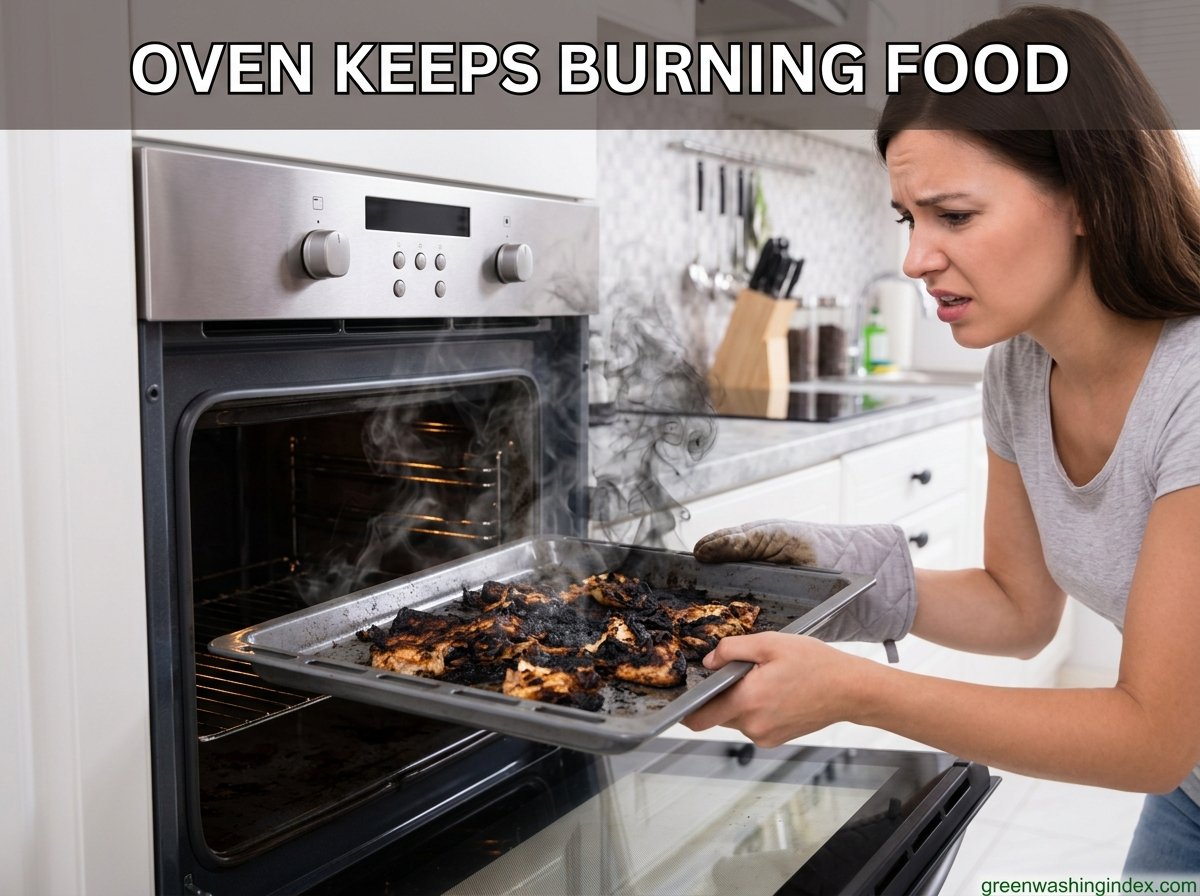
An oven that keeps burning food is typically suffering from temperature control problems caused by a faulty thermostat, damaged temperature sensor, or failing heating elements. Other culprits include incorrect rack position, dark cookware that absorbs too much heat, or blocked vents restricting airflow. Understanding whether the issue stems from user error, maintenance neglect, or mechanical failure is the first step toward fixing the problem and saving your meals from destruction.
Before diving into repairs, consider the hidden costs beyond ruined dinners. Burning food wastes ingredients, increases your energy bills from repeated cooking attempts, and creates unnecessary food waste that impacts the environment. Our team has analyzed hundreds of appliance repair cases and forum discussions to bring you the most comprehensive troubleshooting guide available.
When your oven keeps burning food, the root cause typically falls into one of three categories. User error accounts for about 40% of burning complaints, maintenance issues contribute 35%, and mechanical failures make up the remaining 25%.
Here are the most common reasons your oven is burning everything:
Identifying which category your problem falls into will save you time and money on unnecessary repairs.
Sometimes the problem is not a broken oven but incorrect usage. Before calling a repair technician, rule out these common user errors that make an oven too hot for successful cooking.
The middle rack is the sweet spot for most baking. Moving your food just one rack position can mean the difference between perfect cookies and charcoal briquettes.
When you place pans on the bottom rack, they sit too close to the bake element. This causes the bottoms to burn while the tops remain undercooked. Conversely, the top rack puts food too near the broil element, scorching the surface while the interior stays raw.
Forum users consistently report that moving from the bottom rack to the center position solved their burning problems immediately. One Reddit user stated their cookies went from “burnt bottoms, doughy tops” to perfectly even simply by adjusting rack height.
Dark-colored, nonstick, and glass bakeware absorb and retain more heat than shiny metal pans. If your recipe calls for 350°F and you use a dark pan, you are effectively cooking at 375°F or higher.
Aluminum foil creates similar problems. Covering the entire rack with foil blocks airflow and reflects heat downward, burning whatever sits below. Using foil to catch drips? Place it on a lower rack, not directly on the oven floor.
Switching to light-colored, heavy-gauge aluminum baking sheets can eliminate burning issues without any oven repairs. One user reported their black nonstick sheets burned everything in 15 minutes, while light aluminum pans produced perfect results at the same temperature and time.
Patience matters when baking. Putting food into a cold oven or one that has not fully preheated leads to uneven cooking and burning as the heating elements work overtime to reach target temperature.
Convection ovens require special attention. The fan circulation cooks food 25% faster than conventional ovens. If you do not reduce the temperature by 25°F or the cooking time by 25%, you will consistently overcook and burn your meals.
Recipe accuracy also varies. Older recipes often assume conventional ovens, while modern recipes may assume convection. Check whether your recipe specifies which oven type it was developed for.
Cramming too many pans into the oven blocks proper airflow. Hot air cannot circulate evenly, creating pockets of intense heat that burn food while other areas undercook.
Leave at least 2-3 inches between pans and between pans and oven walls. When cooking multiple dishes simultaneously, rotate them halfway through cooking time to ensure even exposure to heat.
A poorly maintained oven develops problems that mimic mechanical failures. Regular cleaning and inspection can prevent many oven burning everything scenarios.
The temperature sensor is a thin metal probe extending from the back oven wall. When coated with grease, food splatter, or carbon buildup, it cannot accurately read the internal temperature.
A dirty sensor reads cooler than reality. Your oven compensates by heating longer and hotter, resulting in burned food even when you set the correct temperature.
Clean the sensor gently with a soft cloth and mild detergent. Never use abrasive scrubbers that could damage the probe. After cleaning, test the oven with an independent thermostat calibration check using an oven thermometer.
Oven vents release excess heat and moisture during cooking. When blocked by food debris, aluminum foil, or grease buildup, heat gets trapped inside and creates hot spots.
Locate your vents (typically at the back of the oven cavity, under the rear element, or in the oven door) and ensure they are completely clear. Never cover vents with foil or baking sheets, even to catch drips.
The rubber or fiberglass gasket around your oven door seals in heat. Over years of use, this gasket becomes compressed, torn, or brittle, allowing heat to escape.
When heat leaks out, the oven works harder to maintain temperature. This causes temperature spikes and uneven heating that burns food. Inspect your gasket for visible damage or perform the dollar bill test: close a bill in the door and pull. If it slides out easily, your seal is failing.
Spills and drips that carbonize on heating elements create hot spots. These spots burn significantly hotter than the rest of the element, scorching anything nearby.
Turn off the oven and let elements cool completely before cleaning. Use a damp cloth to wipe away debris. For stubborn buildup, a plastic scraper works better than metal tools that could damage the element coating.
When user error and maintenance are ruled out, component failure is the likely culprit. These repairs range from simple DIY fixes to situations requiring professional appliance troubleshooting expertise.
The thermostat controls when heating elements turn on and off to maintain temperature. A failing thermostat may not cycle off, causing continuous heating and severe burning.
Signs of thermostat failure include the oven running significantly hotter than set, never reaching set temperature, or erratic temperature swings. Testing requires accessing the thermostat (usually behind the control panel) and checking continuity with a multimeter.
Replacement thermostats cost $30-75 for the part, with professional installation adding $150-250 in labor.
The sensor probe tells the control board the actual oven temperature. When it fails, the oven receives incorrect temperature readings and responds inappropriately.
Testing the sensor requires removing it and checking resistance with a multimeter. At room temperature (70°F), most sensors should read approximately 1080-1100 ohms. Resistance changes predictably with temperature; consult your oven manual for the specific chart.
Sensor replacement is a manageable DIY project costing $20-50 for the part. The sensor usually attaches with two screws and a simple connector.
Modern ovens rely on electronic control boards to process sensor data and manage heating cycles. When the board fails, temperature regulation becomes unpredictable.
Control board symptoms include completely wrong temperatures, no heat, or the oven shutting off randomly. Unfortunately, boards are expensive ($150-400) and difficult to test without specialized equipment. Many technicians recommend replacing the board only after ruling out cheaper components like sensors and thermostats.
Bake elements (bottom) and broil elements (top) can fail in ways that cause burning. A partially grounded element may stay on continuously instead of cycling, creating excessive bottom heat.
Visual inspection reveals many element problems. Look for blistering, bubbling, or bright spots on the element surface. A healthy element glows evenly when activated; uneven glowing indicates deterioration.
Element replacement is straightforward for most electric oven burning food scenarios. Parts cost $25-80, and installation requires only basic tools.
Gas oven burning food problems differ from electric models. The igniter draws electrical current to open the gas valve and ignite the burner. A weak igniter may cause delayed ignition, leading to temperature spikes when the gas finally ignites.
The safety valve regulates gas flow. If stuck partially open, it delivers too much gas and creates excessive heat. Gas line pressure issues can also cause overheating.
Gas oven repairs involve safety risks. Unless you have specific gas appliance experience, call a professional for igniter, valve, or gas line issues.
Even properly functioning ovens drift out of calibration over time. Your oven might display 350°F while actually running at 425°F or 300°F.
Place an oven thermometer in the center of the middle rack. Preheat to 350°F and wait 20 minutes. Check the thermometer reading. Some ovens allow thermostat calibration through the control panel; others require professional adjustment.
Many forum users report their ovens running exactly 100 degrees hot or cold. One user on a DIY forum confirmed their rental property ovens were both “exactly 100 degrees off” and needed calibration adjustment.
Follow this numbered checklist to diagnose why your oven keeps burning food:
If steps 1-3 solve your problem, you have eliminated mechanical issues. If problems persist after steps 4-10, component replacement is likely needed.
Understanding repair costs helps you decide whether to fix or replace your oven. Here is a realistic cost comparison for common repairs:
| Repair Type | DIY Cost (Parts Only) | Professional Cost (Parts + Labor) | DIY Difficulty |
|---|---|---|---|
| Temperature Sensor | $20-50 | $150-250 | Easy |
| Heating Element | $25-80 | $175-300 | Easy |
| Thermostat | $30-75 | $200-350 | Moderate |
| Door Gasket | $15-40 | $100-200 | Easy |
| Control Board | $150-400 | $400-800 | Moderate |
| Gas Igniter | $40-90 | $250-400 | Moderate/Hard |
| Calibration Service | $0-25 (thermometer) | $100-175 | Easy |
Consider replacement if your oven is over 10 years old and repair costs exceed 50% of a new unit. New double wall ovens and standard models offer better energy efficiency than decade-old units, potentially saving money long-term.
Some situations require professional intervention for safety and effectiveness. Call a technician if:
Gas ovens present particular risks. Natural gas leaks can cause explosions, and improper repairs can create carbon monoxide hazards. Professional service for gas appliances typically costs more but provides essential safety verification.
At GreenWashingIndex, we care about sustainability. A malfunctioning oven that keeps burning food creates environmental consequences beyond your kitchen.
Wasted food accounts for 8% of global greenhouse gas emissions. When your oven ruins dinner repeatedly, you throw away ingredients that required water, fertilizer, transportation fuel, and packaging to produce. Each burnt meal contributes to this footprint.
Additionally, an oven that cannot maintain temperature runs longer and cycles more frequently. This increased energy consumption raises your utility bills and your carbon footprint. A 50-degree calibration error can increase cooking energy use by 15-20%.
Fixing your oven promptly is an environmentally responsible choice. If repair is impractical, consider energy-efficient induction ranges or toaster ovens for small meals, which use significantly less energy than full-size conventional ovens.
Start by testing with an oven thermometer to check actual vs displayed temperature. Clean the temperature sensor, check rack position, and switch to light-colored cookware. If these steps fail, test the heating elements and thermostat with a multimeter. Replace faulty sensors or elements yourself, but call a professional for gas components or control board issues.
Bottom burning usually indicates the food is too close to the lower heating element. Move your rack to the center position. Dark or nonstick pans also absorb excess heat and burn bottoms faster than light aluminum. Blocked bottom vents can trap heat and create hot spots on the oven floor.
DIY heating element replacement costs $25-80 for the part. Professional replacement including labor typically runs $175-300. The repair is straightforward for most electric ovens, requiring only basic tools and about 30 minutes of work.
Warning signs include temperature variance of 25+ degrees from the setting, uneven cooking with some areas burning while others remain undercooked, visible damage to heating elements, inconsistent preheating times, and the oven shutting off unexpectedly during cooking cycles.
When your oven keeps burning food, systematic troubleshooting saves money and restores your cooking confidence. Start with the simple fixes: rack position, cookware color, and thorough cleaning. These resolve the majority of burning complaints without spending a dollar on parts.
If basic adjustments fail, test your oven temperature and inspect components. Temperature sensor and heating element replacements are manageable DIY projects for most homeowners. Know your limits, though. Gas appliances and complex electrical work warrant professional attention for safety.
Remember the environmental angle. Fixing your oven promptly reduces food waste and energy consumption. Whether you repair or replace, taking action is better than enduring months of ruined meals and escalating utility bills. Use the troubleshooting steps in this guide to diagnose your specific issue, and get back to creating perfectly cooked dishes instead of charcoal.
