
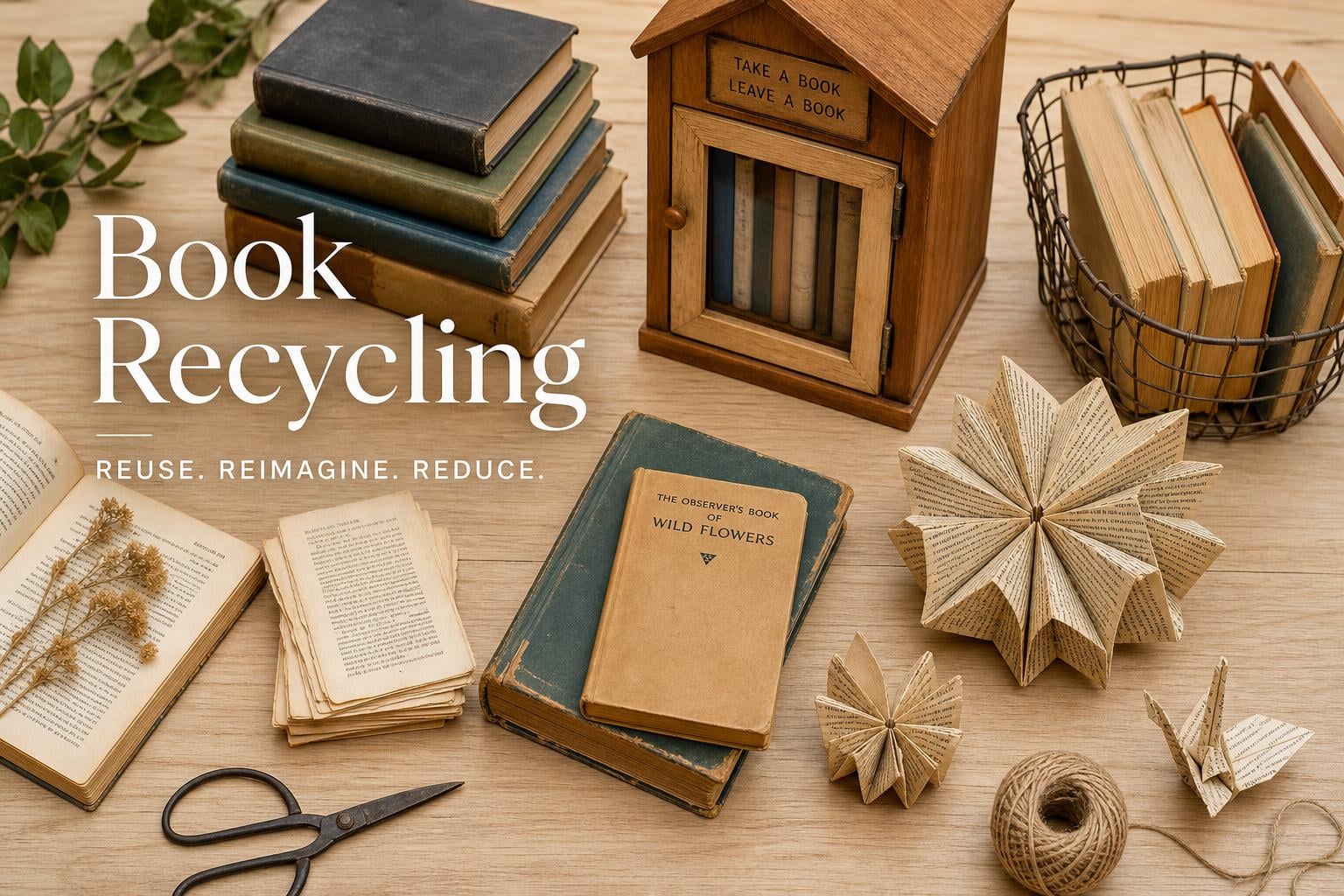
The best way to dispose of old books: Donate books in good condition to libraries, schools, Better World Books drop-off bins, Little Free Libraries, or thrift stores like Goodwill and Salvation Army. For damaged books, remove hardcover bindings and recycle the pages with mixed paper at your local recycling center or transfer station.
If you have shelves groaning under the weight of novels you will never reread, dog-eared paperbacks from a decade ago, or college textbooks that lost their resale value the moment the semester ended, you are not alone. Millions of households face the same question every year. Book recycling offers a practical, environmentally responsible answer that goes far beyond tossing volumes into the trash.
Every ton of recycled paper saves approximately 17 trees, 380 gallons of oil, 7,000 gallons of water, and 3 cubic yards of landfill space. When you choose to recycle, donate, or upcycle old books instead of sending them to a landfill, you directly reduce the demand for virgin paper and keep valuable paper fibers in circulation. In 2026, with sustainability at the forefront of consumer consciousness, knowing how to dispose of books properly matters more than ever.
This guide walks you through six proven methods for giving old tomes a second life, explains the technical paper recycling process in plain language, and covers special situations like textbook disposal, moldy books, and hardcover versus paperback rules. Whether you have a single novel or an entire estate collection, you will find an approach that fits.
Book recycling encompasses every method of keeping volumes out of landfills, from donation and resale to curbside mixed paper recycling and creative upcycling. The United States generates roughly 12 million tons of paper waste from books, magazines, and printed materials each year. A significant portion of that waste could be diverted through smarter disposal habits.
The beauty of book recycling lies in its flexibility. A novel in decent condition can find a new reader through a Little Free Library on your block. A water-damaged paperback can still be recycled as mixed paper at a transfer station. Even a outdated encyclopedia set can be transformed into wall art, planters, or furniture. The key is matching each book to the right disposal channel based on its condition, type, and your local resources.
Why should book recycling matter to you? The environmental impact is substantial. According to the EPA and paper industry data, recycling one ton of paper conserves 17 mature trees, preserves 7,000 gallons of water, saves 380 gallons of oil, and eliminates 3 cubic yards of landfill space. These figures translate directly into reduced deforestation, lower greenhouse gas emissions, and less pressure on municipal waste systems.
Beyond the environmental math, book recycling serves a social purpose. When you donate a book, you put knowledge into the hands of someone who may not have access to affordable reading material. Prison libraries, underfunded schools, senior centers, and community literacy programs all rely on donated volumes. Your old paperback might become the next favorite story for a child, an inmate pursuing education, or a senior seeking companionship between pages.
There is also a practical dimension. Decluttering your shelves creates physical and mental space. Moving, downsizing, or handling an estate cleanout often produces dozens of boxes of books that need somewhere to go. Having a clear plan for responsible disposal reduces stress and ensures nothing ends up in a landfill unnecessarily.
Every book follows a journey. It begins as raw timber processed at a paper mill, travels to a printing press, lands on a bookstore shelf, and eventually reaches your hands. What happens next determines whether that journey continues or ends prematurely in a dump.
A book in good condition can pass through multiple readers before its paper fibers wear out. Paper fibers themselves can be recycled five to seven times before they become too short and weak for new paper products. This means a single novel could theoretically live through dozens of hands and several recycling cycles before its fibers finally retire into compost or landfill cover. Understanding this lifecycle helps you make informed decisions about where each book should go next.
Also Read: Metal Recycling: Your Guide to Sustainable Disposal
Book recycling takes many forms, and the best method depends on the book’s condition, your goals, and what resources are available locally. The six methods below cover everything from passing a book to its next reader to pulping damaged pages at a paper mill. For more context on the broader philosophy of giving old items new purpose, check out our guide on the goal of upcycling.
Donation is the most impactful form of book recycling because it extends a book’s usable life without consuming additional resources. A donated book skips the energy-intensive pulping process entirely and goes straight to a new reader. The key is finding the right destination for each type of book.
Here are the best donation options for books in good, readable condition:
Local libraries: Most public libraries accept donations. Some add titles to their shelves, while others sell them at book sales to fund programs. Call ahead to confirm what they accept, as many libraries refuse outdated reference materials or damaged volumes.
Better World Books: This organization collects books through drop-off bins located in grocery store and shopping center parking lots across the country. Books in good condition are resold, and proceeds fund global literacy programs. Unsellable books are recycled responsibly.
Discover Books: Similar to Better World Books, Discover Books operates donation bins nationwide and focuses on getting books to readers who need them most, including underserved communities.
Little Free Libraries: These small wooden boxes on neighborhood sidewalks let anyone take or leave a book. Use the Little Free Library website or app to find one near you. This is one of the easiest and most community-driven book recycling methods available.
Schools and teachers: Classroom libraries always need fresh titles. Children’s books, young adult novels, and reference materials in good shape are especially welcome.
Prison book programs and Books Through Bars: These organizations send reading material to incarcerated individuals who often have extremely limited access to books. paperback dictionaries, novels, GED prep materials, and how-to guides are in high demand.
Thrift stores (Goodwill, Salvation Army, local shops): These accept most books in sellable condition. Proceeds support community programs. Be aware that some thrift stores are overwhelmed with donations and may refuse large quantities or outdated textbooks.
Senior centers and hospitals: These facilities often maintain reading libraries for residents and patients. Large-print books and gentle fiction are particularly appreciated.
Reddit users in the r/books and r/declutter communities confirm that libraries are not offended when you donate books they cannot shelve. They typically sell or recycle those volumes themselves, so donating is never a waste. The important thing is to call ahead and avoid dumping boxes of moldy or water-damaged books, which create disposal problems for the receiving organization.
Trading is one of the oldest and most efficient forms of book recycling. You give away a book you have finished and receive one you have not read yet. No money changes hands, no new resources are consumed, and every book stays in active circulation.
Modern book trading has evolved well beyond the old model of swapping with friends. Here are the best options available in 2026:
Paperback Swap: One of the longest-running book trading sites, offering a credit-based system where you earn a credit for every book you send and spend credits on books you want.
BookMooch: A community-driven platform that operates on a similar point system and has an international user base.
Bunzo and BookSwap app: Newer mobile-first apps that make trading as simple as snapping a photo and connecting with nearby readers.
Little Free Libraries: Beyond donation, these neighborhood boxes function as informal trade spots. Leave a book, take a book.
Buy Nothing and Freecycle groups: Local community groups on social media where neighbors give away items including books at no cost. These are especially effective for offloading multiple books at once during a move or decluttering project.
Facebook book swap groups: Niche groups organized by genre or region where members post titles they want to trade. These often produce higher-quality matches than general marketplace listings.
Trading keeps stories in motion and builds connections between readers. It also solves the problem of what to do with books that have sentimental value but no longer serve your reading life.
Also Read: Ink Cartridge Recycling: Your Ultimate Green Guide
Selling books is a form of recycling that rewards you financially while ensuring the book reaches someone who wants it. The platforms available for selling used books have expanded significantly in recent years, giving you more options than the traditional used bookstore route.
Online platforms worth exploring:
BookScouter: A price comparison tool that scans ISBNs and shows you which buyback vendors offer the most money. It eliminates guesswork and is especially useful for textbooks.
PangoBooks: A mobile marketplace designed specifically for used books, popular among readers who want to sell directly to other readers without middleman fees.
ThriftBooks: One of the largest online used book sellers. They also purchase books in bulk through their seller program.
Cash4Books: An online buyback service that provides instant quotes based on ISBN and pays for shipping.
Amazon and eBay: Still reliable for collectible editions, textbook sales, and bulk lots. Amazon’s individual seller plan works well for higher-value titles.
Facebook Marketplace: Ideal for local sales with no shipping costs. Bundle deals move faster than single titles.
Offline options:
Used bookstores: Many offer cash or store credit for popular titles, classics, and books in excellent condition. Credit typically yields a higher return than cash.
Garage sales and flea markets: Effective for clearing large quantities quickly, though prices per book will be low.
For sustainable shopping alternatives, check out our guide to zero waste stores including ThriftBooks. Before selling, check each book’s condition, compare prices across platforms, and be honest in your listings. Books with torn pages, water stains, or excessive highlighting will fetch lower prices or may not sell at all.
When a book is too damaged to donate or sell but too interesting to throw away, upcycling transforms it into something entirely new. This method of book recycling taps into your creativity and produces one-of-a-kind pieces that carry the history of the original volume.
Popular upcycling projects include:
Framed page art: Remove pages with beautiful typography, illustrations, or foreign-language text and frame them as wall decor.
Book sculptures: Fold pages into geometric patterns, animals, or architectural shapes. Book folding art has become a popular craft with free templates available online.
Functional furniture: Stack and glue books together to create side tables, stools, or even bookshelf dividers. Add a glass top or cushion to finish the look.
Hidden storage: Hollow out the interior of a thick hardcover to create a secret compartment for valuables.
Gift wrap and greeting cards: Use pages with interesting text or illustrations as wrapping paper, envelopes, or card backgrounds.
Book page wreaths: Roll or fold individual pages into a circular wreath form for seasonal or year-round home decor.
Planters and luminaries: Hollow out thick volumes to create planters for succulents or stack them as bases for table lamps.
Each upcycling project keeps pages out of the waste stream and produces a conversation piece that carries the character of the original book. If you want to dive deeper into the philosophy of giving old objects new purpose, explore our complete guide to the goal of upcycling.
Also Read: CRT Monitors Recycling Guide: Save Earth, Start Today!
Curbside recycling is often the first method people consider, but books require specific preparation depending on their type and your local program’s rules. Not all recycling programs accept books, and those that do have different requirements for hardcover versus paperback volumes.
Paperback books and softcover magazines are generally accepted in curbside mixed paper recycling in most municipalities. They are sorted at the recycling center alongside newspaper, junk mail, and paperboard. Remove any plastic wrappers, inserts, or non-paper components before placing them in your recycling bin.
Hardcover books require more preparation. The rigid cover boards, cloth binding, and glue are not compatible with standard mixed paper processing. Most curbside programs ask you to remove the hardcover binding entirely before recycling the interior pages. Some programs refuse hardcover books outright and require you to bring them to a transfer station or drop-off location.
Steps for preparing books for curbside recycling:
Check your local program’s website or call your waste management provider to confirm whether books are accepted.
For paperbacks, remove any plastic covers, bookmarks, and non-paper inserts.
For hardcovers, tear off the front and back cover boards and remove the spine binding. Recycle only the loose interior pages.
Place accepted books in your recycling bin loose or in a paper bag. Do not bag them in plastic.
Keep wet, moldy, or yellowed books out of curbside recycling. These contaminate the paper stream and are rejected at the sorting facility.
Books fall under the same mixed paper category as paper bags and newspaper. If you want to understand how other paper products are recycled, read our paper bag recycling guide. Just like pizza boxes have specific rules about grease contamination, book recycling has its own guidelines about what materials are accepted. Learn more about how contamination affects paper recycling in our related guide.
When curbside pickup is not an option and donation is not possible, professional book recyclers and specialized drop-off locations provide a reliable alternative. Several national organizations and tools can help you find the nearest book recycling point.
Best resources for finding book recycling near you:
Earth911 Recycling Locator: Visit earth911.com, enter “books” and your ZIP code, and the tool returns a list of nearby recycling locations that accept books. This is the most comprehensive recycling locator available and covers books, magazines, and mixed paper.
Better World Books drop-off bins: These green bins appear in parking lots across the country. They accept books in any condition and either resell, donate, or recycle them responsibly.
Discover Books bins: Similar to Better World Books, these bins are positioned in high-traffic areas and process books through resale and recycling channels.
Local transfer stations and recycling centers: Most county transfer stations accept books alongside other mixed paper products. Some offer free pickup for large quantities.
Libraries: Even if a library cannot use your donated books, staff can often direct you to local recyclers who specialize in paper products.
Used bookstores: Many independent bookstores maintain relationships with paper recyclers and will accept books they cannot resell.
For large-volume disposal, such as estate cleanouts or library weeding projects, some recyclers offer free pickup service when you have ten or more boxes. Search online for “book recycling pickup near me” or contact your county solid waste department for referrals.
Also Read: Computer Recycling: Green Guide to Old Tech Disposal
Understanding the paper recycling process helps you see why preparation matters and why certain books are rejected. When books arrive at a paper mill, they enter a multi-stage transformation that converts old pages into new paper products.
The pulping process begins when books are sorted and baled alongside other mixed paper. The bales are fed into a large vat called a pulper, where water and chemicals break the paper down into a slurry of individual fibers. This slurry, known as paper pulp, is the raw material for all recycled paper products. During pulping, contaminants like staples, bindings, and plastic covers are screened out and removed.
De-inking is the next stage. Ink is separated from the paper fibers using a combination of heat, chemicals, and mechanical action. Most modern books use soy-based ink, which breaks down more easily during de-inking than older petroleum-based inks. The removed ink is collected and either disposed of safely or repurposed for other industrial uses.
Fiber bonding and rolling follow. The cleaned pulp is diluted with water, spread onto a moving mesh screen, and pressed to remove excess moisture. The fibers bond together as the sheet dries, forming new paper. This paper is then rolled, cut, and shipped to manufacturers who turn it into coffee filters, egg cartons, paper towels, cereal boxes, insulation, and even animal bedding.
The paper fiber lifecycle is not infinite. Each time paper goes through the pulping process, its fibers shorten slightly. After approximately five to seven recycling cycles, the fibers become too short and weak to form new paper. At that point, they are either composted, used as landfill cover, or incorporated into low-grade paper products that do not require strong fiber content.
The distinction between hardcover and paperback books matters significantly for recycling. The two formats are constructed differently, contain different materials, and require different preparation steps before they can enter the recycling stream.
Paperback books consist of paper pages glued into a flexible cardstock cover. The entire book is made of paper and is widely accepted in curbside mixed paper recycling. No disassembly is required beyond removing any plastic wrappers or non-paper inserts.
Hardcover books contain rigid cover boards made of cardboard, cloth, leather, or synthetic materials, bound to the page block with strong adhesive glue. The binding materials contaminate the paper recycling stream and must be removed before the pages can be recycled. Most curbside programs require you to tear off the covers and spine, then recycle only the loose pages.
If your local program does not accept hardcover books at all, the alternative is to bring them to a transfer station or a drop-off bin operated by Better World Books or Discover Books. These organizations process hardcovers through their own recycling channels and handle binding removal professionally.
Not every book can be recycled through standard paper recycling channels. Certain conditions render paper fibers unusable and can even contaminate an entire batch of recycled paper if they slip through.
Wet and water-damaged books are the most common rejection. When paper gets wet, the fibers begin to break down and lose their structural integrity. Mold grows quickly on damp paper, and recycling facilities will not accept moldy materials because spores can spread through the entire paper batch.
Yellowed and aged pages present a different problem. The yellowing you see in old paperbacks is caused by lignin oxidation. Lignin is a natural polymer found in wood that breaks down over time when exposed to light and air. As lignin oxidizes, it weakens the paper fibers and introduces acidic compounds that degrade the quality of recycled paper. Most paper mills reject heavily yellowed paper for this reason.
Moldy books must never be placed in recycling or donation bins. Mold spores spread to other books and can cause health problems for workers handling the materials. If a book has visible mold growth, the safest disposal method is to seal it in a plastic bag and place it in the regular trash. Alternatively, you can tear out the clean pages and compost them as brown matter if your compost setup handles paper.
For books that cannot be recycled, upcycling remains an option. Yellowed pages can still be used for crafts, and water-damaged hardcovers can be transformed into decorative objects. Composting is another route: shredded book pages work well as carbon-rich brown matter in a backyard compost bin.
Textbooks present unique recycling challenges. They are heavy, often hardcover, and lose resale value rapidly as new editions are published. Many thrift stores and donation centers refuse outdated textbooks because they are difficult to resell and take up valuable shelf space.
First, check for resale value. Use BookScouter to scan the ISBN and see if any buyback vendor is still purchasing that edition. Even outdated textbooks sometimes retain value for international markets or specific courses. If the book has no resale value, move to the next steps.
Consider donation to specialized programs. Books for Africa accepts textbooks and educational materials for shipment to schools and libraries across the African continent. Prison book programs also welcome educational content, including textbooks on mathematics, science, history, and vocational skills. Always check each organization’s current needs before shipping.
If the textbook cannot be donated or sold, recycle it through the standard process for hardcover books. Remove the cover boards and spine binding, then recycle the interior pages as mixed paper. Some textbooks have spiral bindings or plastic composites that must be fully removed before recycling.
Several national and international organizations specialize in collecting, redistributing, and recycling books. These programs make large-scale book recycling accessible to anyone, regardless of local curbside availability.
Better World Books: A B Corporation that collects books through drop-off bins and library partnerships. Books are resold online, donated to literacy partners, or recycled. Proceeds fund global literacy and education initiatives.
Discover Books: Operates donation bins nationwide and partners with libraries, thrift stores, and recyclers. Their mission focuses on getting books to readers who lack access while ensuring no usable book is wasted.
Little Free Libraries: A nonprofit movement with more than 175,000 registered book exchange boxes worldwide. Anyone can start one or find one nearby using their online map.
Books for Africa: Ships donated textbooks, library books, and children’s books to schools and libraries in Africa. They accept bulk donations and provide shipping instructions on their website.
Prison Book Program and Books Through Bars: These volunteer-run organizations send free books to incarcerated individuals. paperback fiction, dictionaries, GED materials, and how-to guides are in constant demand.
Darien Book Aid Plan: Sends books to Peace Corps volunteers, missions, and libraries in developing countries.
Supporting these programs through donations amplifies the impact of your book recycling efforts. Every book that reaches a new reader through these channels represents one less volume in a landfill and one more opportunity for knowledge to spread.
Beyond the practical question of where to drop off books, donation carries a deeper significance. It is an act of generosity that connects you to readers you will never meet. The paperback thriller that kept you up at night might do the same for someone in a prison cell, a hospital bed, or a classroom halfway around the world.
Books hold knowledge, escape, comfort, and transformation. When you donate instead of discarding, you extend that value far beyond your own shelf. International programs like Books for Africa and Darien Book Aid ship entire libraries to communities where books are scarce and expensive. Prison book programs provide educational and recreational reading to people who often have no other access to literature.
The emotional dimension matters too. Many people feel genuine guilt about parting with books, a phenomenon so common it has its own name: bibliophile’s guilt. The most effective antidote is knowing that your books are going somewhere they will be wanted and used. Taking a few minutes to match each book to the right destination turns a decluttering chore into an act of meaningful giving.
If you are clearing out a large collection, consider a combination approach. Sell valuable titles through BookScouter or PangoBooks, donate readable volumes to Better World Books or a local library, recycle damaged paperbacks through curbside mixed paper, and upcycle anything too interesting to pulp. This layered strategy ensures every book finds its best possible next chapter.
Most curbside recycling programs do not accept hardcover books as-is because the rigid cover boards, cloth binding, and glue contaminate the mixed paper stream. You typically need to remove the hardcover binding entirely and recycle only the loose interior pages. Some programs refuse hardcovers altogether and require you to bring them to a transfer station or Better World Books drop-off bin.
Outdated encyclopedias have almost no resale value and are often refused by libraries and thrift stores. The best options are upcycling them into craft projects, recycling the pages as mixed paper after removing the covers, or donating them to artists and teachers who use reference materials creatively. Some transfer stations accept full sets for bulk paper recycling.
Yes. Always check a book’s value before recycling or donating it. Use BookScouter to scan the ISBN and compare buyback prices, or search completed eBay listings for similar editions. First editions, signed copies, vintage pulp paperbacks, and certain collectible series can be worth significant money. Rare or antique books should be appraised by a specialist.
For large quantities, start by sorting into categories: sellable, donatable, recyclable, and upcyclable. Sell valuable titles through BookScouter or in bulk lots on eBay. Donate good-condition books to Better World Books bins, libraries, or thrift stores. Recycle damaged paperbacks through curbside mixed paper. Some recyclers and used bookstores offer free pickup when you have ten or more boxes to clear.
No. Wet books have degraded paper fibers, and moldy books spread spores that contaminate entire recycling batches. Both must be kept out of curbside recycling and donation bins. Seal moldy books in plastic bags and dispose of them in the regular trash. For wet books, you can shred and compost the clean pages as brown matter if no mold is present.
Yellowing is caused by lignin oxidation. Lignin is a natural polymer in wood that breaks down when exposed to light and air over time. As it oxidizes, it weakens paper fibers and introduces acidic compounds that degrade recycled paper quality. Most paper mills reject heavily yellowed pages. Lightly yellowed paperbacks may still be accepted in mixed paper recycling, but heavily aged volumes should be upcycled or composted instead.
Use the Earth911 Recycling Locator by entering your ZIP code and searching for books. Better World Books and Discover Books also maintain networks of green drop-off bins in grocery store and shopping center parking lots nationwide. Your local library, transfer station, or county recycling center can also point you to the nearest book recycling location.
In most municipalities, yes. Paperback books are accepted in curbside mixed paper recycling alongside newspaper, junk mail, and paperboard. Remove any plastic wrappers, inserts, or non-paper components before placing them in your bin. Always check your local program rules first, since acceptance policies vary by region.
Book recycling is far more than a single action. It is a spectrum of options that ranges from handing a novel to your next-door neighbor through a Little Free Library to feeding old pages into an industrial pulper that transforms them into coffee filters and egg cartons. Every method on that spectrum serves the same goal: keeping books out of landfills and putting their value back into circulation.
The six methods covered here, donating, trading, selling, upcycling, curbside recycling, and professional recycling, give you a toolkit for any situation. Match each book to the right channel based on its condition, your local resources, and your personal goals. Sell what has value, donate what someone else can read, recycle what is damaged, and upcycle what sparks your creativity.
Book recycling is just one part of a broader sustainable lifestyle. For more ways to reduce waste and live greener, explore our sustainable lifestyle tips and our guides to metal recycling, ink cartridge recycling, and computer recycling. The next time you eye a dusty shelf full of books you will never open again, remember that each one has a next chapter waiting. Book recycling is how you help that chapter begin.
