
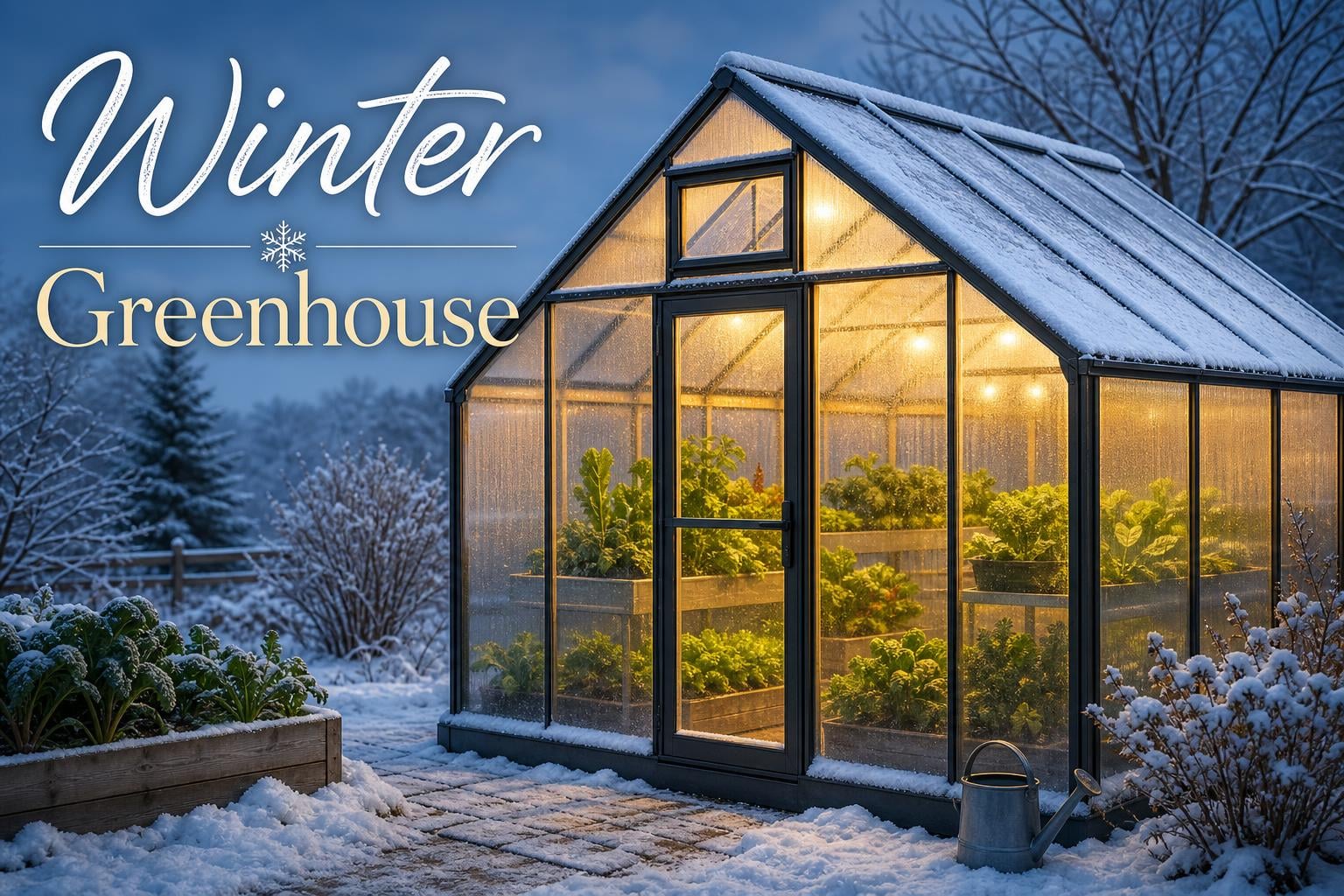
A winter greenhouse transforms the coldest months of the year into a productive growing season, letting you harvest fresh vegetables when outdoor gardens sit dormant under snow. Whether you live in USDA zone 3 where temperatures plunge to negative 40 or zone 7 where winters stay relatively mild, the right structure and techniques can keep cold-hardy crops alive and thriving. This guide walks through every decision you need to make, from choosing a greenhouse type to selecting specific crop varieties, managing temperatures, controlling condensation, and handling the snow loads that winter brings.
Building a functional winter greenhouse involves more than just erecting a structure and hoping for the best. You need to understand how different glazing materials affect insulation, how thermal mass can store daytime heat for frigid nights, and which crops actually survive in an unheated greenhouse versus those that need supplemental warmth. The information here draws on years of hands-on testing and real-world temperature data collected across multiple growing seasons.
By the end of this guide, you will have a clear roadmap for planning your winter greenhouse planting calendar, managing ventilation and humidity, protecting your structure from snow damage, and selecting the best grow lights for those short, dark days. We will also break down heating costs so you can budget effectively and explore the growing movement of deep winter greenhouses designed specifically for harsh northern climates.
A winter greenhouse is a structure designed specifically to maintain growing conditions for plants during the coldest months of the year. Unlike a standard backyard greenhouse that primarily extends the spring and fall seasons, a winter greenhouse is engineered to capture and retain solar heat, withstand heavy snow accumulation, and protect cold-tolerant crops from freezing temperatures. The goal is not necessarily to recreate summer conditions but to keep the interior warm enough for specific vegetables, herbs, and overwintering plants to survive and in many cases continue producing.

The physics behind a winter greenhouse are straightforward but powerful. Sunlight passes through transparent or translucent glazing materials such as glass, polycarbonate panels, or polyethylene sheeting and warms the air, soil, and thermal mass objects inside. That heat stays trapped even as outside temperatures drop after sunset. On a sunny winter day, an unheated greenhouse can easily maintain interior temperatures 20 to 30 degrees Fahrenheit above the outdoor reading. This means when it is 17 degrees Fahrenheit outside, the inside of a well-positioned greenhouse can reach 50 degrees or more.
Winter greenhouses come in many configurations, from small backyard structures covering a few raised beds to large commercial operations spanning thousands of square feet. Some gardeners use simple hoop houses covered with a single layer of polyethylene sheeting, while others invest in insulated polycarbonate structures or build partially underground walipinis that take advantage of the earth’s stable subsurface temperature. The best choice depends on your climate zone, budget, growing goals, and how much time you can dedicate to maintenance through the season.
Growing food in a winter greenhouse gives you access to fresh, nutrient-dense produce at a time when grocery store vegetables have traveled thousands of miles and lost much of their nutritional value along the way. Leafy greens harvested from your own greenhouse in January contain higher vitamin content than produce shipped from warmer regions and sitting on shelves for days. For homesteaders and anyone interested in food security, a winter greenhouse represents meaningful steps toward year-round self-sufficiency.
Beyond fresh food, a winter greenhouse serves several other purposes simultaneously. It provides a protected environment for starting spring seedlings early, giving you a six to eight week head start on the outdoor growing season. It shelters tender perennials and Mediterranean herbs like rosemary that would not survive freezing temperatures in the ground. It also creates a microclimate where you can experiment with crops slightly outside your hardiness zone, such as trying citrus or avocados in a well-heated structure.
The environmental benefits matter as well. By producing food on your own property during winter, you reduce reliance on industrial agriculture and the carbon emissions associated with long-distance transport, refrigerated storage, and plastic packaging. A winter greenhouse also keeps your gardening skills sharp year-round, prevents the winter doldrums that many gardeners experience when they cannot work the soil, and provides a peaceful, sunlit space during the darkest months.
Also Read: How Much Does a Greenhouse Cost? A Breakdown of Expenses
Choosing the right structure is the foundation of successful winter greenhouse gardening. Each type of greenhouse offers distinct advantages and trade-offs in terms of insulation value, durability, cost, and the amount of heat it can retain without supplemental heating. Understanding these differences helps you match the structure to your climate zone, budget, and growing ambitions. If you are ready to start comparing specific products, our guide to the best greenhouse kits covers tested options with winter performance data.
Traditional glass greenhouses are what most people picture when they think of a greenhouse. Single or double-pane glass panels mounted in aluminum or wooden frames create an elegant, light-filled structure that maximizes sunlight transmission. Glass offers excellent optical clarity, allowing roughly 90 percent of visible light to pass through, which helps with both plant growth and passive solar heating during short winter days.
Superior light transmission: Glass passes up to 90 percent of visible light, giving plants maximum access to winter sunshine.
Long lifespan: Quality glass greenhouses can last decades without needing glazing replacement, unlike polyethylene film that degrades every few years.
Aesthetic appeal: Glass structures add architectural beauty to a property and blend well with formal garden designs.
The main drawbacks of glass are poor insulation value and fragility. Single-pane glass has an R-value of approximately 0.95, meaning heat escapes rapidly once the sun sets. Double-pane insulated glass improves this to about R-2.0 but adds significant cost. Glass is also vulnerable to hail, falling branches, and impacts from debris during winter storms. For gardeners in snowy climates, glass greenhouses require strong framing and careful snow management to prevent structural damage.
Polycarbonate greenhouses use twin-wall or multi-wall polycarbonate panels that trap air between layers of durable plastic. This trapped air provides significantly better insulation than single-pane glass while still allowing roughly 80 percent of light transmission. Twin-wall polycarbonate typically achieves an R-value of 1.6 to 2.0, and thicker multi-wall panels can reach R-3.0 or higher. In real-world testing, our Palram Mythos greenhouse review documented winter temperatures staying 15 to 20 degrees Fahrenheit above outside readings without any supplemental heating over four full seasons.
Excellent impact resistance: Polycarbonate panels are virtually unbreakable and easily withstand hail, snow loads, and flying debris.
Better insulation: Twin-wall construction traps insulating air pockets that reduce heat loss compared to single-pane glass.
Diffused light: The multi-wall structure scatters incoming light, reducing shadows and reaching lower leaves more effectively.
Polycarbonate panels are lighter than glass, making these greenhouses easier to assemble and transport, yet they are structurally strong enough for snow-prone regions. The main trade-off is that polycarbonate gradually loses light transmission over 10 to 15 years as the material ages and the UV-protective coating wears down. The diffused light also reduces direct solar heat gain, which can slightly reduce passive solar warming on very cold but sunny days.
Hoop houses, also called high tunnels or polytunnels, consist of curved metal or PVC hoops covered with one or more layers of greenhouse-grade polyethylene sheeting. They are the most affordable winter greenhouse option and can be built quickly without specialized skills or permanent foundations. A single-layer hoop house offers minimal insulation but raises nighttime temperatures 5 to 10 degrees above ambient outdoor conditions. Adding a second layer of polyethylene inflated with a small blower creates an insulating air gap that boosts temperature retention significantly.
Affordability: Hoop houses cost a fraction of glass or polycarbonate greenhouses of the same size.
Quick assembly: Most hoop house kits can be erected in a single weekend with basic tools.
Expandable design: You can easily extend the length by adding more hoops and covering material.
The trade-off for affordability is durability. Standard polyethylene sheeting lasts approximately four years before requiring replacement due to UV degradation. Hoop houses are also more vulnerable to wind damage and heavy snow loads than rigid structures. For winter use in snowy regions, choose a hoop house with a gothic or peaked roof design rather than a perfectly rounded arch so snow sheds naturally rather than accumulating on top.
Geodesic dome greenhouses use a network of triangular panels arranged into a spherical shape. This geometric design distributes stress evenly across the entire structure, making domes exceptionally strong and capable of handling extreme wind and snow loads. The curved shape also sheds snow naturally, preventing the dangerous accumulation that can flatten conventional greenhouses with flatter roof pitches.
Exceptional structural strength: Triangular geometry distributes loads evenly, resisting heavy snow and high winds.
Uniform light distribution: The curved surface captures sunlight from all angles throughout the day.
Natural snow shedding: The dome shape prevents snow from accumulating on the roof.
Geodesic domes also offer excellent heat retention because the spherical shape minimizes the surface area relative to interior volume. Less exterior surface area means less heat escapes to the outside. The downside is that dome construction is more complex than other greenhouse types, and the triangular glazing panels can be expensive to source and replace.
Solar greenhouses are designed around passive solar heating principles to maximize natural heat collection and minimize energy consumption. They typically feature a steep south-facing glazed wall that captures low-angle winter sun and a heavily insulated north wall that prevents heat loss. Thermal mass elements such as water barrels, stone walls, or concrete floors absorb heat during the day and release it slowly through the night. A similar principle powers lean-to greenhouses, which use an existing heated wall as their north side for additional warmth.
Daytime heat storage: Thermal mass materials like water barrels and masonry absorb solar energy during sunny hours.
Slow nighttime release: Stored warmth radiates back into the greenhouse overnight, moderating temperature swings.
Low operating cost: Passive solar design can eliminate or dramatically reduce the need for supplemental heating.
The key to a successful solar greenhouse is matching the thermal mass to the glazing area and the climate zone. In colder zones 3 through 5, you need more thermal mass and better insulation to compensate for shorter days and longer cold spells. A common rule of thumb is two to three gallons of water per square foot of glazing for effective thermal storage.
Walipinis are underground or partially sunken greenhouses that originated in the high-altitude Andes of South America. By digging the growing area several feet below ground level, these structures take advantage of the earth’s remarkably stable subsurface temperature. At depths of four to six feet, soil temperatures in most climates remain between 40 and 55 degrees Fahrenheit year-round, providing natural insulation against extreme cold above.
Earth’s natural insulation: Below-ground construction maintains stable temperatures even during extreme cold snaps.
Low energy requirements: The surrounding soil buffers temperature swings, reducing or eliminating heating needs.
Wind resistance: A largely underground structure is naturally protected from damaging winter winds.
Building a walipini requires significant excavation work and careful drainage planning to prevent groundwater from flooding the growing area. The south-facing wall must be glazed to capture sunlight, while the other walls are earthen berms. When built correctly, walipinis can maintain above-freezing temperatures even in zone 3 and 4 climates without supplemental heat.
The Deep Winter Greenhouse, or DWG, is a specific design pioneered by researchers at the University of Minnesota that combines passive solar principles with an insulated, partially underground structure optimized for extreme northern climates. A DWG features a steep south-facing glazing wall angled to capture the low winter sun, a thick insulated north wall, and a rock bed thermal storage system beneath the growing area that captures and stores daytime solar heat.
During the day, a small fan moves warm air from the peak of the greenhouse down through perforated pipes buried in a rock bed beneath the soil. The rocks absorb the heat and release it slowly overnight, keeping the greenhouse above freezing even when outside temperatures drop to negative 20 degrees Fahrenheit or lower. DWGs are specifically designed for zones 3 through 5 and can support cold-hardy crops like brassicas, spinach, and Asian greens through the deepest part of winter without any fossil fuel heating.
The Deep Winter Greenhouse movement is gaining traction among northern homesteaders, small-scale market farmers, and sustainability advocates who want to produce food year-round in extreme cold climates. While construction costs are higher than a simple hoop house, the long-term savings on heating fuel and the ability to grow food through January and February make DWGs an attractive investment for serious winter growers.
Also Read: Indoor Greenhouse Magic: Grow Plants All Year!
Finding the right winter greenhouse means matching structure specifications to your specific climate, growing goals, and budget. A greenhouse that works beautifully in the Pacific Northwest may fail entirely in a Minnesota or Alberta winter. Taking time to evaluate your conditions before buying or building saves money and frustration down the line. For budget-conscious growers, exploring portable greenhouse options can be worthwhile, but always verify snow load ratings before committing to a winter setup.

Your USDA hardiness zone should be the first factor you consider when selecting a winter greenhouse. The zone system divides North America into 13 zones based on average minimum winter temperatures, and it directly determines which crops will survive and how much supplemental heating you will need.
Determine your USDA zone: Zones 3 to 5 experience minimum temperatures of negative 40 to negative 10 degrees Fahrenheit and require heavily insulated structures with significant thermal mass or supplemental heating. Zones 6 to 8 see minimums of negative 10 to 20 degrees and can often succeed with a simple hoop house or polycarbonate greenhouse. Zones 9 and above rarely freeze, and even lightweight structures suffice for season extension.
Assess snow load requirements: Regions that receive heavy lake-effect or mountain snow need greenhouses rated for at least 30 pounds per square foot of snow load. Check manufacturer specifications before purchasing any kit, as many lightweight greenhouses are rated for only 10 to 15 pounds.
Evaluate winter daylight hours: Northern latitudes above 45 degrees may receive fewer than 8 hours of usable daylight in December and January. This limited light, combined with the 10-hour day length threshold where most plant growth dramatically slows, means you may need grow lights for productive winter harvesting.
Consider wind exposure: Open sites with prevailing winter winds increase heat loss dramatically. Natural windbreaks like evergreen hedgerows or placing the greenhouse against an existing wall can reduce heating costs significantly.
Account for humidity patterns: Maritime climates with damp winters face greater condensation and mold challenges than dry continental climates. Automatic vents and good air circulation are essential in humid regions.
If you are in zones 7 through 10, raised bed greenhouses can work well for winter growing without additional heating. These compact structures sit directly over existing raised beds and capture enough solar energy to keep cold-hardy vegetables productive through mild winter conditions.
Balancing upfront investment against long-term operating costs is essential when planning a winter greenhouse. The cheapest structure may cost far more over five years once you factor in heating bills, repairs, and replacement covering material. For a detailed analysis of what different greenhouse types cost to buy and operate, our greenhouse cost breakdown covers expenses from budget kits to permanent installations.
Initial cost versus lifetime value: A twin-wall polycarbonate greenhouse may cost more upfront than a hoop house but will last 15 to 20 years with minimal maintenance while providing far better insulation.
Heating fuel expenses: Electric, propane, and natural gas heating costs add up quickly. Passive solar design and thermal mass can reduce or eliminate these ongoing costs.
Maintenance and replacement: Polyethylene covering needs replacement every 3 to 5 years. Polycarbonate panels last 10 to 15 years. Glass can last a lifetime if not broken.
Size and heating relationship: Larger greenhouses cost more to build and heat, but a properly designed large greenhouse with good thermal mass can actually maintain temperatures more efficiently than a small one because the volume-to-surface-area ratio improves.
DIY versus professional installation: Building your own hoop house or walipini saves significant money but requires time, skills, and careful research. Kit greenhouses with pre-cut components cost more but go together quickly and reliably.
Sustainability of materials: Choose greenhouse glazing and framing materials that are recyclable and responsibly sourced. Avoid polyethylene sheeting with harmful plasticizers, and consider reclaimed glass or sustainably harvested lumber for framing.
Also Read: Hydroponics Greenhouse Essentials: Grow Greener Today!
The crops you choose for your winter greenhouse determine whether your efforts yield abundant harvests or disappointing results. Not all vegetables can handle cold greenhouse conditions, and even among cold-tolerant species, specific varieties vary enormously in their ability to survive freezing temperatures and limited light. Selecting named varieties bred specifically for winter production makes the difference between a thriving winter harvest and plants that struggle or fail.
Cold-hardy crops fall into three main categories that thrive in winter greenhouse conditions: leafy greens, root vegetables, and brassicas. These plant families evolved to tolerate cold temperatures and can photosynthesize efficiently even in low light. The key is choosing varieties specifically bred or selected for cold tolerance, short days to maturity, and resistance to bolting when temperatures fluctuate.
Leafy Greens:
Spinach (Space F1, Winter Bloomsdale): Spinach is one of the most cold-tolerant crops available. Varieties like Winter Bloomsdale and Space F1 survive temperatures down to 15 degrees Fahrenheit inside an unheated greenhouse and continue producing new leaves for repeat harvesting throughout winter.
Kale (Winterbor, Red Russian, Lacinato): Winterbor kale is a workhorse variety specifically bred for cold weather, tolerating temperatures as low as 10 degrees Fahrenheit. Red Russian and Lacinato also perform well, and many growers report that kale actually tastes sweeter after exposure to cold due to starches converting to sugars.
Lettuce (North Pole, Winter Density, Salanova): North Pole lettuce was specifically bred for winter greenhouse production and can survive hard frosts. Salanova varieties offer quick maturation and beautiful presentation for salad mixes, while Winter Density provides a reliable butterhead type that holds well in cold conditions.
Swiss Chard (Fordhook Giant, Bright Lights): Both Fordhook Giant and the colorful Bright Lights variety tolerate winter greenhouse temperatures well and continue producing tender new leaves for months.
Mache (Valerianella locusta): Also known as corn salad, mache is one of the most cold-hardy salad greens available. It grows slowly but reliably through the coldest months and has a nutty flavor prized by winter growers.
Asian Greens (Tatsoi, Mizuna, Komatsuna): Tatsoi forms a beautiful rosette that survives freezing temperatures and continues growing even in low light. Mizuna and komatsuna provide spicy, peppery greens that mature quickly and handle cold conditions well.
Root Vegetables:
Carrots (Napoli): Napoli is the gold standard winter greenhouse carrot, bred specifically for late-season harvest and cold storage. Grown in deep beds inside a winter greenhouse, Napoli carrots develop exceptional sweetness as winter progresses.
Beets (Detroit Dark Red, Touchstone Gold): Both classic Detroit Dark Red and golden Touchstone varieties tolerate cold greenhouse conditions and can be harvested throughout winter as baby beets or left to mature.
Radishes (Easter Egg, French Breakfast): Fast-growing radishes are ideal for winter greenhouse gaps between slower crops, ready to harvest in 25 to 30 days even in reduced winter light.
Herbs and Alliums:
Parsley (Italian Giant): Parsley is surprisingly cold-tolerant and continues producing fresh leaves through winter in an unheated greenhouse, providing a steady supply of this essential culinary herb.
Cilantro (Santo, Calypso): These slow-bolting cilantro varieties actually prefer the cooler temperatures of a winter greenhouse and are far less likely to flower prematurely compared to spring plantings.
Scallions (Evergreen Bunching): Bunching onions are extremely cold-hardy and can be harvested throughout winter, providing fresh onion flavor when garden onions have long since been harvested.
Chives: While chives go dormant in extreme cold, they will continue producing in a minimally heated winter greenhouse and provide early spring harvests weeks before outdoor plants break dormancy.
Remember that plants grow much more slowly in winter due to shorter days and lower light intensity. Once day length drops below the 10-hour threshold, most crops essentially pause active growth and simply maintain themselves. This means you should plant crops early enough to reach near-maturity before this slowdown occurs, typically by late October in northern zones. Focus on harvesting established plants rather than expecting new growth from seeds sown during the shortest days of December and January.
Timing is arguably the most critical factor in winter greenhouse success. Plant too late and crops will not reach maturity before winter light levels drop below the growth threshold. Plant too early and warm autumn temperatures may cause cool-season crops to bolt or become leggy before cold weather arrives. A well-planned planting calendar ensures steady harvests throughout the darkest months.
The key calculation for winter greenhouse planting is working backward from your first expected frost date and the date when day length drops below 10 hours. For most of the United States and Canada, this occurs in early to mid-November. You want crops to be mature or nearly mature by this point so they can simply hold in the greenhouse and be harvested gradually through winter.
Late summer (August): Start seeds for slow-maturing brassicas like kale and broccoli in modules or trays. These need 60 to 80 days to reach transplant size and maturity.
Early fall (September): Direct-sow fast-growing greens like spinach, lettuce, mizuna, and tatsoi directly into greenhouse beds. These need 40 to 50 days to reach harvestable size.
Mid-fall (October): Sow root vegetables like Napoli carrots and beets. Plant garlic cloves for green garlic harvest. Transplant brassica seedlings into their permanent positions.
Late fall (late October to early November): Last chance planting of cold-tolerant greens like mache and claytonia. These will germinate slowly but establish enough to provide late winter harvests.
Deep winter (December to January): Minimal planting activity. Focus on maintaining and harvesting established crops. Consider microgreens and sprouts for fresh greens during this period.
Late winter (February): As day length increases above 10 hours, plant growth resumes. This is the time to start onion seeds, leeks, and early brassicas for spring transplanting.
To calculate exact planting dates for your winter greenhouse, determine your days to maturity for each crop and count backward from your first expected frost date. Add a 20 percent buffer for the slower growth rates caused by shorter days and cooler temperatures in fall. This adjusted figure tells you the latest possible sowing date for each crop.
In many regions, natural winter light is simply insufficient for productive plant growth even inside a well-positioned greenhouse. Northern latitudes above 45 degrees may receive fewer than 8 hours of usable daylight in December, well below the minimum most vegetables need for active photosynthesis. Grow lights bridge this gap by supplementing or replacing natural sunlight during the shortest days of the year.
LED grow lights have become the preferred choice for winter greenhouse supplementation due to their energy efficiency, low heat output, and long lifespan. Modern full-spectrum LED fixtures provide the wavelengths plants need for both vegetative growth and photosynthesis while consuming a fraction of the electricity required by older high-pressure sodium or metal halide systems. A typical setup uses 25 to 40 watts per square foot of growing area, suspended 12 to 24 inches above the plant canopy.
The goal with winter grow lights is not to create artificial summer. Instead, aim to extend the effective photoperiod to 10 or 12 hours total by supplementing natural daylight for a few hours in the morning and evening. This crosses the critical growth threshold and keeps plants actively photosynthesizing rather than merely surviving. For leafy greens and herbs, relatively modest light levels are sufficient. Fruiting crops like tomatoes or peppers require significantly higher intensity and are generally not worth the energy cost for winter greenhouse production.
Timer-controlled lighting is essential for consistency. Set your fixtures to turn on before dawn and extend past sunset to achieve the target photoperiod. Monitor your electricity usage, as running multiple high-intensity fixtures for hours each day can add noticeably to winter power bills. Position reflective material like white plastic or mylar sheeting on nearby walls to bounce light back toward plants and maximize efficiency from each fixture.
Also Read: Essential Lean-to-Greenhouse Guide: Build with Confidence!
Maintaining adequate temperature is the central challenge of winter greenhouse gardening. The specific approach depends on your climate zone, the crops you are growing, and your budget for energy costs. Most cold-hardy vegetables can survive temperatures down to 25 or 30 degrees Fahrenheit, so the goal in an unheated or minimally heated greenhouse is simply to keep the interior above this threshold during the coldest nights.

Real-world temperature data demonstrates what is possible. On sunny winter days, an unheated polycarbonate greenhouse can maintain interior temperatures 20 to 30 degrees above outside readings. This means at 17 degrees Fahrenheit outside, the inside can reach 50 degrees or higher. However, this temperature differential drops significantly overnight without thermal mass or supplemental heat, and during cloudy stretches, daytime gains are minimal.
A layered approach to heating provides the best combination of effectiveness and economy. Start with passive methods that cost nothing to operate, add thermal mass for heat storage, and then supplement with active heating only when temperatures threaten to drop below your crops’ survival threshold.
Passive solar design: Orient the greenhouse with its longest glazed wall facing south to capture maximum winter sunlight. A 90-degree south orientation is ideal, but southeast to southwest orientations also work. The low winter sun penetrates deeply into a south-facing structure, warming soil, plants, and thermal mass materials.
Water barrel thermal mass: Stack black-painted 55-gallon water barrels along the north interior wall. Water has excellent thermal storage capacity, absorbing heat during the day and releasing it slowly overnight. The standard recommendation is 2 to 3 gallons of water per square foot of glazing. Water barrels typically moderate nighttime temperatures by 5 to 8 degrees compared to a greenhouse without thermal mass.
Compost pile heating: An active compost pile inside or adjacent to the greenhouse generates significant heat as organic matter decomposes. A well-managed hot compost pile can maintain temperatures of 130 to 160 degrees Fahrenheit at its core, providing gentle radiant heat to surrounding plants while also producing valuable compost for spring.
Bubble wrap insulation: Line the interior walls and roof with large-cell horticultural bubble wrap during the coldest months. This simple addition can reduce heat loss by 30 to 50 percent and costs very little. Use UV-resistant bubble wrap designed for greenhouses, as standard packing material degrades quickly in sunlight.
Row covers and frost blankets: Inside the greenhouse, drape horticulture fleece or frost blankets directly over plants on the coldest nights. A single layer of row cover fabric provides 2 to 4 degrees of frost protection, and double layering extends this further. Mini hoop tunnels covered with row fabric inside the greenhouse create a greenhouse-within-a-greenhouse effect that adds significant protection.
Electric space heaters: When passive methods are insufficient, a thermostatically controlled electric heater provides reliable backup heating. Oil-filled radiant heaters are efficient and safe for greenhouse use. In our Palram Glory greenhouse review, a 1500-watt oil-filled radiator successfully maintained 50 degrees Fahrenheit inside a polycarbonate greenhouse during cold winter nights.
Heating mats for soil warmth: Seedling heat mats placed under trays and pots warm the root zone directly, which is especially valuable for seed starting and keeping young plants growing during cold spells.
Hot water radiant systems: For larger or permanently heated greenhouses, hydronic heating systems circulate warm water through pipes buried in the growing beds or set in concrete floors. These systems provide even, gentle bottom heat and can be powered by solar water heaters, wood boilers, or conventional gas boilers.
Understanding the operating costs of different heating approaches helps you budget effectively and choose methods that make financial sense for your situation. The actual cost varies significantly based on your local electricity and fuel rates, greenhouse size, insulation quality, and target temperature, but the following comparison provides useful relative guidance.
Passive solar and thermal mass: Essentially free to operate after initial setup. Water barrels cost 40 to 80 dollars each, and bubble wrap runs 30 to 60 dollars for a small greenhouse. Annual operating cost is zero.
Electric space heater (1500W): Running 8 hours per night during the coldest months, expect 4 to 8 dollars per day depending on local electricity rates. Monthly winter heating bills of 100 to 250 dollars are common for a small greenhouse.
Propane heater: Propane costs vary but typically run 2 to 4 dollars per hour for a 30,000 BTU heater. A full 20-pound propane tank lasts approximately 10 to 15 hours of continuous heating.
Wood stove: If you have access to free firewood, a small greenhouse wood stove can heat for essentially the cost of your labor. Purchased firewood costs 150 to 300 dollars per cord, with a small stove consuming roughly half a cord per winter season.
Hydronic radiant system: High upfront cost of 2,000 to 5,000 dollars for installation, but low ongoing operating costs if powered by solar thermal collectors or a wood boiler.
The most economical approach for most home growers is to maximize passive solar heating and thermal mass first, then use a small electric heater with a thermostat as backup only during the coldest nights. This strategy keeps operating costs manageable while ensuring crops survive extreme cold events.
Snow accumulation on a winter greenhouse roof poses one of the most serious threats to the structure and the plants inside. A single cubic foot of fresh snow weighs between 5 and 15 pounds depending on moisture content, and wet snow can weigh even more. An accumulated load of just 6 inches of wet snow on a 10-by-12-foot greenhouse adds over 3,600 pounds of weight to the roof. Without proper design and active snow management, this load can cause catastrophic structural failure.
Before purchasing or building any winter greenhouse, verify its snow load rating with the manufacturer or engineer. Structures designed for southern climates may have ratings of only 10 pounds per square foot, which is inadequate for regions that receive significant snowfall. Northern greenhouse kits should be rated for at least 30 pounds per square foot, and ideally higher for mountain or lake-effect snow zones.
Roof pitch matters enormously for snow management. Flat or low-slope roofs accumulate snow dangerously, while steeper pitches allow snow to slide off naturally. Gothic-arched hoop houses and A-frame designs shed snow far better than perfectly rounded Quonset styles. Geodesic domes excel in snowy climates because their curved surfaces prevent accumulation from any direction.
Active snow removal becomes necessary during heavy storms regardless of design. Use a soft-bristled push broom or foam-padded roof rake to gently pull snow off the exterior glazing. Never use metal tools, which can scratch or crack polycarbonate panels and shatter glass. Work from outside the structure rather than climbing onto the roof, which is extremely dangerous in winter conditions. Remove snow promptly during storms rather than waiting until accumulation becomes unmanageable, as each additional layer compresses the snow below into heavier, denser ice.
Inside the greenhouse, monitor the roof framework during and after heavy snow for any signs of bowing, cracking, or joint separation. If you notice structural deflection, clear snow immediately and consider adding temporary supports. Preventative reinforcement of ridge poles and rafters before winter begins is far easier than emergency repairs during a blizzard.
Once your winter greenhouse is operational and planted, ongoing care through the coldest months determines whether your crops thrive or merely survive. Winter plant care differs significantly from summer growing and requires adjustments to watering frequency, ventilation strategy, humidity management, and pest monitoring. Understanding these seasonal differences prevents common problems that can ruin a winter harvest.
Different crops have different temperature requirements, and understanding these thresholds helps you manage heating and crop placement within the greenhouse. Most cold-hardy vegetables thrive at daytime temperatures of 50 to 65 degrees Fahrenheit and nighttime temperatures of 35 to 45 degrees. When temperatures consistently drop below 28 degrees even during the day, most active growth stops and plants enter a dormant holding pattern.
Invest in a maximum-minimum thermometer to track both the highest and lowest temperatures reached over 24 hours. This data reveals dangerous overnight drops that you might otherwise miss.
Place thermometers at plant canopy height rather than overhead, as cold air pools near the ground and temperatures can vary by several degrees between floor and roof.
Set heating system thermostats to activate at 35 to 38 degrees Fahrenheit for cold-hardy crops, or at 45 degrees for more tender winter greens like lettuce.
Be aware of sunny winter days that can rapidly overheat a sealed greenhouse. Temperatures can soar to 80 degrees or higher on bright January afternoons, stressing cold-adapted plants.
Use automated vent openers that respond to temperature without electricity, ensuring ventilation even when you are not present to monitor conditions.
Watering is one of the most frequently misunderstood aspects of winter greenhouse care. Plants need far less water during winter because lower light levels and cooler temperatures dramatically slow transpiration and growth. Overwatering is a far greater danger than underwatering during the cold months, as saturated soil loses its insulating air pockets and conducts cold directly to plant roots, causing freeze damage.
Late summer and fall: Water daily or every other day as you would during the normal growing season while plants are actively growing and days are still long.
Early winter (November to December): Reduce watering to twice per week, checking soil moisture 2 inches deep before each watering session.
Deep winter (January to February): Water every 2 to 3 weeks for established plants, and only when the top 2 inches of soil feel dry. Water in the morning on sunny days so moisture is absorbed before nighttime temperature drops.
Late winter (March): Gradually increase watering frequency as day length increases and plant growth resumes.
Always water early in the day during winter so foliage has time to dry before nightfall. Wet leaves at night dramatically increase the risk of fungal diseases and frost damage. Use lukewarm water rather than ice-cold tap water, which can shock plant roots in cold soil. A watering can or drip irrigation system delivers water directly to the root zone without wetting foliage.
Proper ventilation is critical in a winter greenhouse, even though opening vents during cold weather seems counterintuitive. Without air exchange, moisture released by plants and soil through transpiration accumulates inside the closed structure, condensing on cold interior surfaces as water droplets. This condensation creates ideal conditions for fungal diseases including botrytis gray mold, powdery mildew, and damping-off, all of which can devastate winter crops.
The goal of winter ventilation is moisture control rather than cooling. Even brief periods of air exchange on sunny days replace humid interior air with drier outdoor air, reducing condensation significantly. Automatic vent openers that operate using wax cylinders require no electricity and respond precisely to temperature changes, opening roof vents when interior temperatures rise and closing them as temperatures drop.
Open vents for 30 to 60 minutes on sunny midday periods when temperatures are highest, even if this means the greenhouse cools temporarily.
Use a small circulating fan running continuously at low speed to keep air moving. Stagnant air promotes disease, while gentle airflow strengthens plant stems and discourages fungal spores from settling.
Install a hygrometer to monitor humidity levels. Aim to keep relative humidity below 80 percent during daytime hours.
Water in the morning rather than afternoon so excess moisture evaporates and vents out during the warmest part of the day.
Remove condensation from interior glazing surfaces using a squeegee or by improving ventilation, as dripping water spreads disease pathogens.
Space plants adequately to allow airflow between them. Crowded plants stay damp longer and are far more susceptible to disease.
Light is often the limiting factor for winter greenhouse production rather than temperature. Once day length drops below the 10-hour threshold, typically in early November through late January in most of North America, plant growth slows dramatically regardless of how warm you keep the greenhouse. This biological reality means that crops must be planted early enough to reach maturity before this slowdown occurs.
Orient the greenhouse east-to-west with the longest glazed wall facing south to capture maximum winter sun.
Clean all glazing surfaces inside and out before winter to maximize light transmission. Even a thin film of algae or dust can reduce light penetration by 10 to 20 percent.
Paint north-facing interior walls white or line them with reflective mylar to bounce available light back onto plants.
Prune or remove plants that shade others, prioritizing light access for your most productive winter crops.
Consider supplemental LED grow lights as discussed in the earlier section if your latitude or local conditions limit winter sunlight.
Because plants grow slowly during winter, they also need far less fertilizer than during peak growing season. Over-fertilizing produces soft, succulent growth that is particularly vulnerable to cold damage and disease. Reduce feeding to once every 4 to 6 weeks during deep winter, using diluted liquid fertilizers such as fish emulsion or kelp fertilizer that provide gentle nutrition without forcing rapid growth.
Avoid high-nitrogen fertilizers entirely during the shortest days, as these stimulate vegetative growth that plants cannot support under low light conditions. Resume regular feeding in late winter when day length increases and active growth resumes. Compost tea or diluted compost extract provides an excellent gentle source of winter nutrition that also supports beneficial soil microorganisms.
By carefully managing temperature, watering, ventilation, light, and nutrition, your winter greenhouse can produce abundant harvests of fresh greens, root vegetables, and herbs throughout the coldest months. The key is adapting your care practices to match the slower pace of winter plant growth rather than applying summer growing techniques to a fundamentally different season.
Polycarbonate greenhouses are generally considered the best choice for winter growing because their twin-wall construction provides superior insulation compared to single-pane glass while maintaining excellent light transmission. For extreme cold climates in zones 3 through 5, a deep winter greenhouse or partially underground walipini design offers the best combination of passive solar heating and earth insulation. Look for structures rated for at least 30 pounds per square foot of snow load in snowy regions.
Yes, a properly equipped greenhouse can absolutely be used throughout winter. Even an unheated greenhouse maintains temperatures significantly above outdoor conditions, often 20 to 30 degrees warmer on sunny days. This protection allows cold-hardy crops like kale, spinach, carrots, and Asian greens to survive and produce through the coldest months. Adding thermal mass, bubble wrap insulation, and row covers further extends what you can grow.
An unheated greenhouse will not prevent all freezing, but it significantly moderates temperatures. On sunny winter days, the interior can reach 50 degrees Fahrenheit even when outside temperatures are near zero. However, during extended cloudy periods or extremely cold nights, interior temperatures can still drop below freezing. Cold-hardy crops like kale, spinach, and mache survive these dips, but tender plants need additional protection from row covers, thermal mass, or minimal supplemental heating.
The best winter greenhouse crops are cold-hardy leafy greens, root vegetables, and brassicas. Specific recommended varieties include Winterbor kale, North Pole and Salanova lettuce, Napoli carrots, Winter Bloomsdale spinach, tatsoi, mache, scallions, and parsley. These crops tolerate cool temperatures, limited light, and occasional freezing. Avoid warm-season crops like tomatoes and peppers unless you have supplemental heating and grow lights, as they require consistently warm temperatures and long days.
A winter greenhouse opens the door to year-round food production that defies the limitations of cold, snow, and short days. By choosing the right structure for your climate zone, selecting proven cold-hardy crop varieties, and applying the heating, watering, and ventilation strategies covered in this guide, you can harvest fresh vegetables from your winter greenhouse every month of the year. The investment in time and materials pays dividends in food security, nutrition, and the deep satisfaction of growing your own food when most gardens sit dormant.
Start by assessing your climate zone and identifying which greenhouse type fits your budget and snow load requirements. Plan your planting calendar backward from your first frost date, focusing on varieties specifically bred for winter production like Winterbor kale, Napoli carrots, and North Pole lettuce. Layer your heating strategy from passive solar design through thermal mass and minimal supplemental heating to keep operating costs manageable while protecting your crops through the coldest nights.
For more guidance, explore our detailed reviews of specific greenhouse models like the Palram Mythos and Palram Hybrid, browse our comparison of the best greenhouse kits on the market, or dive into our greenhouse cost breakdown to plan your budget. The FAQ section above answers the most common questions gardeners have about winter greenhouse growing, and our guides to portable greenhouses and lean-to designs cover additional options for specific situations. Your winter greenhouse journey starts with a single seed planted at the right time.
