

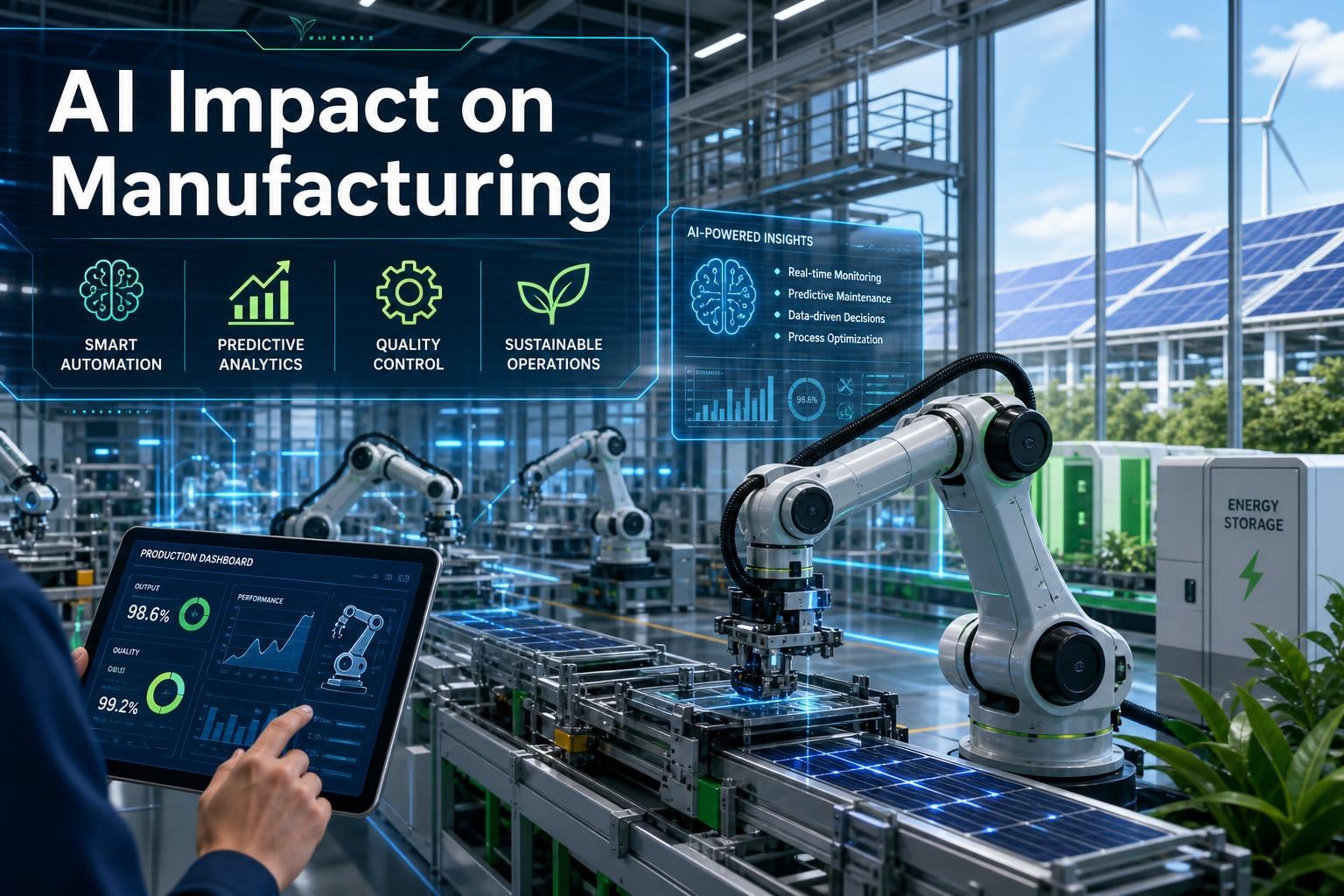
The AI impact on manufacturing has shifted from experimental pilot projects to measurable, enterprise-scale outcomes. According to MarketsandMarkets, the AI in manufacturing market is projected to grow from $2.08 billion in 2022 to $10.11 billion by 2027, with longer-term projections reaching $155.04 billion by 2030. A recent survey by the World Economic Forum found that 68% of manufacturers have already implemented at least one AI use case on their factory floors.
What makes this shift significant is the alignment between operational efficiency and environmental sustainability. AI-driven systems are reducing unplanned downtime by up to 30%, improving defect detection rates by 85%, and cutting energy consumption across production lines. For an industry historically responsible for roughly a quarter of global carbon emissions, these gains represent a meaningful path toward greener production.
This article examines the full scope of AI’s role in modern manufacturing within the Industry 4.0 and emerging Industry 5.0 frameworks. We cover specific applications including predictive maintenance, quality control, supply chain optimization, digital twin technology, generative design, and energy management. We also address implementation challenges, workforce implications, and real-world case studies from companies like Tesla, Siemens, BMW, and Schneider Electric.
Whether you are evaluating AI adoption for a small production facility or scaling enterprise-level smart factory initiatives, this guide provides data-driven insights to help you understand how AI is reshaping manufacturing and what it means for sustainable production in 2026.
AI in manufacturing is the application of machine learning, computer vision, natural language processing, and predictive analytics to industrial production processes. It encompasses everything from real-time equipment monitoring and automated quality inspection to supply chain demand forecasting and generative product design. The goal is to improve operational efficiency, reduce waste, lower costs, and minimize environmental impact.
The concept is embedded within the broader Industry 4.0 framework, often called the Fourth Industrial Revolution. Industry 4.0 refers to the integration of IoT sensors, cloud computing, AI, and cyber-physical systems into manufacturing operations. The European Commission has begun promoting the term Industry 5.0, which shifts the focus from pure automation and efficiency toward human-centric, sustainable, and resilient manufacturing. Industry 5.0 emphasizes collaboration between workers and intelligent machines rather than full replacement of human labor.
The market data tells a compelling story. Beyond the headline figures of $2.08 billion growing toward $10.11 billion by 2027, adoption rates reveal that AI is no longer confined to early adopters. McKinsey reports that companies scaling AI across manufacturing operations see a 10 to 15% improvement in overall equipment effectiveness (OEE). Deloitte found that predictive maintenance programs powered by AI deliver an average return on investment within 12 to 18 months of implementation.
Key impact areas where AI is delivering quantifiable results include:
Predictive maintenance: Up to 30% reduction in unplanned downtime and 20 to 40% lower maintenance costs
Quality control: 85% improvement in defect detection rates compared to manual inspection
Supply chain optimization: 65% reduction in lost sales due to stockouts and 10 to 40% lower warehousing costs
Energy management: 10 to 20% reduction in energy consumption across production facilities
Workforce safety: Automated monitoring of hazardous environments reduces workplace incidents
These outcomes position AI as a foundational technology for any manufacturer pursuing both competitive advantage and sustainability targets. For a deeper look at how AI and related technologies are transforming industrial supply chains, our guide on electronic component distributors leveraging AI and blockchain for transparency covers practical applications.
Industrial robotics has evolved significantly since the first programmable robotic arms appeared on automotive assembly lines in the 1960s. Today’s robots are equipped with computer vision, force-sensing capabilities, and machine learning algorithms that allow them to adapt to varying tasks in real time. This evolution has direct implications for sustainable manufacturing.
Modern robotic systems achieve levels of precision that human workers simply cannot match consistently. In cutting, welding, dispensing, and assembly operations, this precision translates directly into material savings. A robotic laser cutter programmed with AI optimization can nest parts to minimize scrap material, reducing raw material waste by 15 to 25% compared to manual nesting.
Consistent quality is another sustainability benefit. When every part meets specification on the first attempt, manufacturers avoid the energy and material costs associated with rework or scrap. In electronics manufacturing, for example, AI-guided pick-and-place robots achieve placement accuracies measured in microns, virtually eliminating defects that would otherwise result in discarded components and wasted solder material.
Better production planning through AI also contributes to waste reduction. Algorithms analyze order volumes, material availability, and machine capacity to optimize production schedules. This prevents overproduction, which the Lean Manufacturing philosophy identifies as one of the seven wastes. When factories produce only what is needed, when it is needed, both material waste and energy consumption drop.
Energy consumption in manufacturing is a major cost driver and environmental concern. AI-powered robotic systems address this through intelligent power management. Unlike legacy machines that run at full power continuously, modern AI-connected equipment adjusts energy usage based on real-time production demands. When a machine is idle between cycles, the system automatically reduces power draw or enters a low-energy standby mode.
Siemens has implemented AI-driven energy optimization across its manufacturing facilities, reporting energy savings of up to 20% in certain production lines. The system monitors electricity usage at the machine level and identifies patterns of waste that human operators would struggle to detect. Schneider Electric has taken a similar approach, using AI to manage energy consumption across its smart factories and reporting progress toward its goal of carbon-neutral operations.
Speed also plays a role. Because robots can operate at higher cycle rates than manual processes, jobs are completed faster. Shorter production runs mean less total machine operating time, which translates to lower cumulative energy consumption per unit produced. The combination of speed, precision, and intelligent power management makes robotics one of the most effective levers for reducing the carbon footprint of manufacturing operations.
A significant development in manufacturing robotics is the rise of collaborative robots, or cobots. Unlike traditional industrial robots that operate behind safety cages, cobots are designed to work alongside human workers. They are equipped with force-limiting sensors and safety mechanisms that allow them to stop or slow down when a person enters their workspace.
Cobots represent a shift toward workforce augmentation rather than replacement. In assembly operations, a cobot might handle repetitive, physically demanding tasks like heavy lifting or precision fastening, while the human worker focuses on quality checks, process oversight, and problem-solving. This division of labor improves both productivity and job quality. BMW has deployed cobots extensively in its assembly plants, where they assist workers with tasks like applying sealant and inserting components in hard-to-reach areas.
For sustainability, cobots offer a practical advantage for small and medium-sized manufacturers. They require less capital investment than full robotic automation systems, making it feasible for smaller operations to adopt automation and achieve the associated efficiency and waste-reduction benefits. This accessibility is helping spread the gains of smart manufacturing beyond large enterprise factories.
Predictive maintenance is one of the highest-ROI applications of AI in manufacturing. Traditional maintenance strategies fall into two categories: reactive (fixing equipment after it breaks) and preventive (servicing equipment on a fixed schedule regardless of actual condition). Both approaches waste resources. Reactive maintenance causes unplanned downtime that disrupts production and wastes materials in process. Preventive maintenance often results in unnecessary servicing, replacing parts that still have useful life.
AI-powered predictive maintenance replaces both strategies with a data-driven approach. IoT sensors installed on equipment continuously collect data on variables like vibration, temperature, pressure, acoustic emissions, and electrical current draw. Machine learning algorithms analyze this streaming data to detect patterns that precede equipment failures.
The system learns what normal operation looks like for each specific machine and component. When sensor readings deviate from the learned baseline, the AI flags the anomaly and predicts how long the component can continue operating before failure. This allows maintenance teams to schedule repairs during planned downtime, order replacement parts in advance, and avoid the cascading costs of unexpected breakdowns.
Deloitte reports that AI-driven predictive maintenance reduces unplanned downtime by up to 30% and lowers overall maintenance costs by 20 to 40%. McKinsey’s research shows that manufacturers implementing predictive maintenance programs see a 20% reduction in equipment downtime and a 10% reduction in annual maintenance costs. The sustainability benefits extend beyond cost savings. When machines operate at peak efficiency, they consume less energy per unit produced. Fewer unexpected breakdowns mean less wasted material from interrupted production runs.
Reddit discussions among manufacturing professionals consistently identify predictive maintenance as the best starting point for AI adoption. Users on r/manufacturing recommend beginning with a single critical asset, building a clean data pipeline, and demonstrating measurable ROI before expanding to additional equipment. This incremental approach addresses the cultural resistance and data quality challenges that often derail large-scale AI initiatives.
Quality control has undergone a fundamental transformation with the integration of computer vision and deep learning. Traditional visual inspection relied on human workers examining products on fast-moving production lines. This approach is inherently limited by human factors: fatigue, distraction, inconsistent standards between inspectors, and the physical impossibility of examining every single unit at production speed.
AI-powered machine vision systems solve these limitations. High-resolution cameras capture images of every product as it moves down the line. Deep learning models trained on thousands of images of both defect-free and defective products can identify anomalies in milliseconds. The systems detect defects that are invisible to the human eye, including microscopic cracks, surface contamination, color variations, and dimensional deviations measured in fractions of a millimeter.
The performance gains are substantial. Research compiled by Dozuki indicates that AI-based defect detection achieves up to 85% improvement in detection accuracy compared to manual inspection. Some advanced systems report defect detection rates exceeding 99%, with false positive rates below 1%. This means fewer defective products reach customers, reducing warranty claims, returns, and the environmental cost of replacing failed products.
From a sustainability perspective, early defect detection prevents the waste of additional processing on parts that are already flawed. In multi-stage manufacturing processes, catching a defect at the first operation saves the energy, materials, and labor that would otherwise be invested in subsequent steps. Semiconductor manufacturing, where each wafer may pass through hundreds of processing steps, benefits enormously from this early detection capability.
Siemens uses AI-based visual inspection in its electronic manufacturing facilities, where the system inspects solder joints on circuit boards with a level of detail and consistency that human inspection cannot achieve. The company reports significant reductions in defect escape rates and associated rework costs. Similarly, automotive manufacturers use machine vision to inspect paint finishes, weld quality, and component assembly, catching defects before vehicles leave the plant.
Manufacturing supply chains have become extraordinarily complex, spanning multiple countries, thousands of suppliers, and volatile demand patterns. The COVID-19 pandemic exposed the fragility of traditional supply chain management approaches, driving rapid adoption of AI-powered optimization tools. The AI impact on manufacturing supply chains is now one of the most active areas of investment.
AI transforms supply chain management through demand forecasting, inventory optimization, and logistics planning. Traditional forecasting methods rely on historical sales data and simple statistical models. AI systems ingest a far broader range of data sources, including market trends, weather patterns, social media sentiment, economic indicators, and real-time point-of-sale data. Machine learning algorithms identify complex correlations between these variables and future demand, producing forecasts that are significantly more accurate than traditional methods.
The results are measurable. According to industry data, AI-driven demand forecasting can reduce lost sales due to stockouts by 65% and lower warehousing costs by 10 to 40%. By maintaining optimal inventory levels, manufacturers reduce the capital tied up in excess stock and minimize the waste of perishable or obsolete materials. This directly supports sustainability goals by preventing overproduction and reducing the environmental footprint of warehousing operations.
AI also enables what supply chain professionals call demand sensing, a real-time capability that adjusts forecasts based on the most current available signals. Unlike traditional forecasting which operates on weekly or monthly cycles, demand sensing can update predictions daily or even hourly. This agility is particularly valuable in industries with short product life cycles or volatile demand, such as consumer electronics and fashion.
On the procurement side, AI systems analyze supplier performance data, pricing trends, and risk factors to optimize sourcing decisions. They can identify alternative suppliers when disruptions occur, reducing the cascading effects of supply chain interruptions. AI and blockchain technologies are also being combined to improve supply chain transparency, enabling manufacturers to trace raw materials back to their origins and verify sustainability claims. For more on how these technologies work together in the electronics sector, see our coverage of AI and blockchain in electronic component supply chains.
Digital twin technology represents one of the most powerful applications of AI within the Industry 4.0 framework. A digital twin is a virtual replica of a physical asset, process, or entire factory. It is connected to its physical counterpart through IoT sensors that feed real-time data into the digital model. This connection allows manufacturers to simulate, analyze, and optimize operations without disrupting actual production.
The sustainability implications are significant. Instead of running physical experiments that consume energy and materials, engineers can test process changes, layout modifications, and equipment upgrades on the digital twin first. If a simulated change improves throughput or reduces energy consumption, it can then be implemented on the physical factory floor with confidence. If the simulation shows no benefit or unintended negative consequences, the manufacturer avoids wasting resources on a failed experiment.
Digital twins also support energy optimization by modeling how energy flows through a facility. Siemens has been a pioneer in this space, creating digital twins of its manufacturing plants that model electricity consumption at the machine level. The AI system can identify opportunities to shift energy-intensive processes to off-peak hours, reducing both costs and strain on the electrical grid.
BMW uses digital twin technology to optimize its vehicle assembly lines. By simulating the entire production process digitally, the company can identify bottlenecks, test alternative sequencing, and validate changes before implementation. This approach has reduced commissioning time for new production lines and improved overall equipment effectiveness.
As digital twin technology matures, manufacturers are moving beyond single-asset models to create facility-wide and even supply-chain-wide twins. These comprehensive models enable systemic optimization, revealing interactions and dependencies that are invisible when looking at individual machines in isolation.
Generative AI has moved beyond text and image generation into the manufacturing domain, where it is transforming product design, process planning, and knowledge management. In generative design, engineers input design constraints and performance requirements, and AI algorithms generate hundreds or thousands of design alternatives. The AI evaluates each option against the specified criteria and surfaces the most promising candidates.
This approach produces designs that human engineers might never conceive. The AI-generated solutions often use less material, weigh less, and perform as well or better than conventionally designed parts. In aerospace and automotive manufacturing, where weight reduction translates directly into fuel savings and emissions reduction over the product’s lifetime, generative design delivers both economic and environmental benefits.
Generative AI is also being applied to operational knowledge management. Manufacturing organizations accumulate vast amounts of documentation, including equipment manuals, maintenance procedures, safety protocols, and quality standards. Large language models can index this information and provide natural language interfaces that allow workers to quickly find relevant procedures or troubleshooting guidance. This reduces downtime spent searching for information and ensures that best practices are consistently applied.
The emerging concept of agentic AI, where autonomous AI agents handle multi-step operational tasks, represents the next frontier. For example, an AI agent might monitor inventory levels, detect a looming shortage, automatically generate a purchase order, and route it for approval, all without human intervention. While still in early stages, this capability could dramatically streamline procurement and inventory management processes.
Energy management is where the AI impact on manufacturing most directly intersects with environmental sustainability. Manufacturing accounts for approximately 25% of global carbon emissions, making it one of the largest industrial contributors to climate change. AI-powered energy management systems offer a practical path to reducing this footprint while simultaneously lowering operating costs.
AI energy management works by continuously monitoring electricity, gas, and water consumption across every system in a facility. Machine learning algorithms identify patterns of waste, predict future energy demand based on production schedules, and automatically adjust equipment settings to minimize consumption. For example, the system might reduce compressed air pressure during periods of low production activity or adjust HVAC settings based on real-time occupancy and temperature data.
Manufacturers implementing AI energy management systems typically see 10 to 20% reductions in energy consumption. Schneider Electric, which manufactures energy management products, has applied its own AI-powered EcoStruxure platform across its facilities. The company reports that these implementations have delivered energy savings of up to 30% in certain operations while supporting its commitment to carbon-neutral operations.
Carbon footprint reduction extends beyond direct energy consumption. AI systems can optimize logistics routes to reduce transportation emissions, select materials with lower embodied carbon, and identify opportunities to replace energy-intensive processes with more efficient alternatives. By analyzing the complete life cycle of manufactured products, AI helps manufacturers make decisions that reduce environmental impact from raw material extraction through end-of-life disposal.
AI-driven sorting technologies are also revolutionizing waste management and recycling processes. These systems use computer vision and machine learning to identify and separate recyclable materials at speeds and accuracies far beyond manual sorting. Our article on AI-driven sorting in waste management explores how this technology is being deployed. For manufacturers focused on closed-loop material flows, these AI systems enable the recovery and reuse of materials that would otherwise be discarded.
Tesla has built AI into the core of its manufacturing strategy. The company’s Gigafactories use heavily automated production lines where robots handle battery pack assembly, body welding, and paint application. Tesla’s AI systems optimize production scheduling in real time, adjusting to supply chain disruptions and demand fluctuations without human intervention.
The company also applies AI to its battery manufacturing processes, where precision and consistency are critical for both performance and safety. Machine learning algorithms monitor production parameters and identify subtle deviations that could affect battery quality. This level of oversight has helped Tesla scale battery production while maintaining the quality standards necessary for electric vehicle safety and longevity.
Siemens operates what is widely regarded as one of the most advanced AI-driven manufacturing facilities in the world, located in Amberg, Germany. The facility produces programmable logic controllers and uses AI throughout the production process. The factory achieves a reported quality rate of 99.99885%, meaning that only a handful of defects occur per million units produced.
AI manages nearly every aspect of the Amberg facility, from production scheduling and material flow to quality inspection and energy optimization. Digital twin technology allows engineers to simulate process changes before implementing them physically. The facility serves as both a production site and a proving ground for Siemens’ own industrial AI and IoT products.
BMW has integrated collaborative robots and digital twin technology across its global manufacturing network. At its plants in Germany and the United States, cobots work alongside human operators on tasks ranging from sealant application to component insertion. The company reports that this human-robot collaboration has improved both productivity and ergonomics, reducing physical strain on workers while increasing output.
BMW also uses digital twins to plan and optimize its assembly lines. Before building or modifying a physical production line, the company creates a detailed digital model and runs simulations to validate the design. This approach has reduced the time required to bring new vehicle models into production and minimized the costly physical rework that traditionally accompanies line commissioning.
Samsung applies AI not only in its manufacturing processes but also in the products it builds. The company’s Bespoke AI washing machines use artificial intelligence to optimize wash cycles, reducing both water and energy consumption. Samsung reports that these AI-powered washers can reduce microplastic pollution from synthetic fabrics by up to 54%, a significant environmental benefit given the scale of the global appliance market.
This example illustrates how the AI impact on manufacturing extends beyond the factory floor into the products themselves. When manufacturers embed AI into their products, the sustainability benefits accumulate over the entire product life cycle. Our guide to eco-friendly washing machine brands provides more detail on how AI is being used to create more sustainable appliances.
While the benefits of AI in manufacturing are well-documented, the path to successful implementation is fraught with challenges. Gartner has reported that approximately 85% of AI projects fail to deliver tangible business outcomes. Understanding these challenges is essential for manufacturers considering AI adoption, and acknowledging them honestly is a matter of credibility rather than a concession.
AI systems require clean, structured, and comprehensive data to function effectively. Many manufacturing facilities operate with fragmented data siloed across different systems: programmable logic controllers, enterprise resource planning software, manufacturing execution systems, and standalone sensors that were never designed to communicate with each other. Integrating these disparate data sources into a unified pipeline that AI can process is often the most time-consuming and expensive part of an AI implementation project.
The problem is compounded by data quality issues. Sensor calibration drifts over time, manual data entry introduces errors, and historical records may be incomplete or inconsistent. MIT Sloan research has documented what is sometimes called the productivity paradox: AI implementations can initially decrease measured productivity as organizations struggle with data preparation, system integration, and process changes before the benefits materialize.
The capital investment required for AI in manufacturing extends well beyond software licenses. Facilities need IoT sensors, edge computing hardware, network infrastructure upgrades, and cloud computing resources. For small and medium-sized manufacturers, these upfront costs can be prohibitive. Reddit discussions in manufacturing communities reveal that smaller operations often struggle to justify AI investments when the payback period extends beyond 18 to 24 months.
Forum users consistently recommend starting with a focused pilot project that targets a specific, measurable problem. Predictive maintenance on a critical piece of equipment is the most commonly suggested starting point because it delivers clear, quantifiable ROI that can justify broader investment. The key is demonstrating value quickly before budget holders lose patience.
The shortage of professionals with expertise in both AI technologies and manufacturing operations is a significant barrier. Data scientists who understand machine learning often lack domain knowledge about manufacturing processes, while experienced manufacturing engineers may not have training in data science and machine learning. Bridging this gap requires either hiring expensive cross-disciplinary talent or investing in training programs for existing staff.
Cultural resistance is equally challenging. Workers who have spent decades perfecting their craft may view AI systems with suspicion, particularly if the technology is presented as a replacement for human judgment rather than a tool to augment it. Successful implementations emphasize collaboration between AI systems and human workers, positioning AI as a decision-support tool that provides recommendations while leaving final authority with experienced operators.
Connecting factory floor equipment to AI systems and cloud platforms expands the cyber attack surface. Manufacturing facilities have become attractive targets for ransomware and other cyberattacks, and a successful breach can halt production for days or weeks. Securing AI-connected manufacturing systems requires investment in network security, access controls, and continuous monitoring capabilities.
Regulatory frameworks are also evolving. The European Union’s AI Act, which introduces risk-based requirements for AI systems, will affect manufacturers operating in or selling to EU markets. Companies need to ensure that their AI implementations comply with applicable regulations, which adds complexity to already challenging implementation projects.
The question of how AI affects manufacturing jobs is one of the most frequently asked and most emotionally charged topics in the field. The reality is more nuanced than either the optimistic narrative of universal job creation or the pessimistic prediction of mass automation-driven unemployment.
Certain repetitive, physically demanding, or hazardous tasks are indeed being automated. Jobs that consist primarily of predictable, repetitive movements are the most vulnerable to automation by AI-powered robotic systems. However, this category represents a subset of manufacturing employment, not the entirety of it.
At the same time, AI is creating new categories of manufacturing employment. Roles such as AI system integrators, data scientists for manufacturing, robot maintenance technicians, and AI ethics compliance officers did not exist a decade ago. The World Economic Forum projects that while AI may displace certain manufacturing roles, it will create new positions that require different skill sets. The net employment effect depends heavily on how effectively companies and educational institutions manage the transition through reskilling programs.
The Industry 5.0 framework promoted by the European Commission explicitly positions AI as a tool for workforce augmentation rather than replacement. In this model, AI systems handle data processing, pattern recognition, and routine decision-making while human workers focus on creative problem-solving, complex judgment calls, and tasks requiring adaptability and contextual understanding. The cobot deployments at BMW exemplify this approach, where machines handle the physically demanding work and humans provide oversight and quality assurance.
For workers, the key to remaining relevant in an AI-augmented manufacturing environment is continuous skill development. Training programs focused on data literacy, basic programming, and AI system operation are becoming standard offerings in manufacturing organizations. Some companies are partnering with community colleges and vocational schools to develop curricula that prepare the next generation of manufacturing workers for an AI-enabled workplace.
Understanding the AI impact on manufacturing requires placing it within the context of the Fourth Industrial Revolution. Industry 4.0, a term coined in 2011, describes the convergence of digital technologies with industrial production. Its core pillars include IoT connectivity, cloud and edge computing, AI and machine learning, autonomous robotics, and additive manufacturing.
The Industry 4.0 maturity model provides a framework for manufacturers to assess their current digital capabilities and plan their advancement. Organizations progress from initial digitization efforts, through interconnected systems, to fully autonomous operations where AI systems manage production with minimal human intervention. Most manufacturers today sit in the middle stages of this maturity curve, with significant room for advancement.
Industry 5.0, introduced by the European Commission in 2021, builds on Industry 4.0 but reframes the relationship between technology and human workers. While Industry 4.0 focuses primarily on efficiency and automation, Industry 5.0 adds three complementary priorities: human-centricity, sustainability, and resilience. The framework acknowledges that manufacturing must serve not only economic goals but also social and environmental objectives.
For manufacturers, the Industry 5.0 perspective provides a useful lens for evaluating AI investments. Rather than asking only whether a technology will reduce costs or increase output, Industry 5.0 encourages evaluation of whether it improves working conditions, reduces environmental impact, and strengthens supply chain resilience. This broader evaluation criteria aligns naturally with the sustainability goals that are increasingly mandated by regulators, investors, and customers.
The AI impact on manufacturing is no longer a future possibility but a present reality. The technology is delivering measurable improvements in efficiency, quality, cost, and environmental performance across companies of all sizes. The market is growing rapidly, adoption rates are climbing, and the competitive gap between AI-enabled manufacturers and those relying on traditional methods is widening.
For manufacturers considering AI adoption, the most effective approach is incremental and problem-focused. Start with a specific operational challenge that has clear financial impact, such as unplanned downtime on critical equipment or high defect rates on a key product line. Build a clean data pipeline, select an appropriate AI tool, run a focused pilot, and measure results rigorously. Success in a narrow domain builds the organizational confidence and data infrastructure needed for broader AI initiatives.
Sustainability should be a central consideration, not an afterthought. The same AI systems that improve operational efficiency also reduce environmental impact by cutting waste, lowering energy consumption, and optimizing resource utilization. Manufacturers that explicitly connect their AI investments to sustainability targets are better positioned to meet increasingly stringent environmental regulations and to respond to growing customer demand for responsibly produced goods.
The relationship between AI and the manufacturing workforce requires deliberate management. Companies that invest in reskilling programs, position AI as a tool for augmentation rather than replacement, and involve workers in the implementation process achieve better outcomes than those that impose top-down automation. The Industry 5.0 framework provides a useful guide for balancing technological advancement with human and environmental considerations.
For more insights on sustainable manufacturing and recycling practices, explore our guides on sustainable metal disposal and eco-friendly electronics recycling. These resources complement the manufacturing strategies discussed here by addressing the end-of-life phase of industrial products.
AI in manufacturing refers to the application of machine learning, computer vision, predictive analytics, and generative AI to industrial production processes. The impact includes up to 30% reduction in unplanned downtime, 85% improvement in defect detection accuracy, 10 to 20% reduction in energy consumption, and 65% reduction in lost sales through improved demand forecasting. The AI in manufacturing market is projected to grow from $2.08 billion in 2022 to $10.11 billion by 2027.
According to the World Economic Forum, approximately 68% of manufacturers have implemented at least one AI use case. Adoption is highest in predictive maintenance, quality control, and supply chain optimization. The rate of adoption varies by company size, with large enterprises leading and small to medium manufacturers increasingly entering the space through focused pilot projects.
AI is automating certain repetitive and hazardous tasks, but it is also creating new job categories in data science, robotics maintenance, and AI system management. The Industry 5.0 framework promoted by the European Commission emphasizes workforce augmentation, where AI handles data processing and routine decisions while human workers focus on complex problem-solving and oversight. The net employment effect depends on how effectively companies manage reskilling and transition programs.
The primary challenges include data quality and integration issues, high upfront implementation costs, a shortage of professionals with combined AI and manufacturing expertise, cultural resistance from workers, and cybersecurity risks associated with connecting factory equipment to cloud platforms. Gartner reports that approximately 85% of AI projects fail to deliver tangible business outcomes, often due to inadequate data infrastructure or unrealistic expectations about ROI timelines.
AI reduces waste through precision automation that minimizes material scrap, early defect detection that prevents additional processing on flawed parts, predictive maintenance that avoids production-interrupting breakdowns, and optimized production scheduling that prevents overproduction. Generative design tools also create parts that use less material while meeting performance requirements, directly reducing raw material consumption.
Industry 4.0 focuses on the integration of digital technologies including IoT, AI, cloud computing, and robotics into manufacturing operations to improve efficiency and automation. Industry 5.0, introduced by the European Commission in 2021, builds on Industry 4.0 by adding three priorities: human-centricity, sustainability, and resilience. It reframes AI as a tool for augmenting human workers rather than replacing them and emphasizes environmental responsibility alongside economic performance.
The AI impact on manufacturing represents one of the most significant industrial transformations of our generation. With the market projected to reach $10.11 billion by 2027 and 68% of manufacturers already implementing AI use cases, the technology has moved well beyond the experimental phase. Companies like Tesla, Siemens, BMW, and Schneider Electric are demonstrating that AI delivers measurable improvements in efficiency, quality, cost reduction, and environmental sustainability when implemented strategically.
The sustainability dimension makes this transformation particularly significant. Manufacturing accounts for roughly a quarter of global carbon emissions, and AI-powered systems offer concrete mechanisms for reducing that footprint. From energy management systems that cut consumption by 10 to 20% to predictive maintenance that reduces resource-wasting downtime by 30%, the technology provides practical tools for aligning industrial production with environmental responsibility.
However, the path to successful AI adoption requires honest acknowledgment of the challenges. Data quality issues, implementation costs, skills gaps, cultural resistance, and cybersecurity concerns are real barriers that demand deliberate strategies. The 85% project failure rate reported by Gartner underscores the importance of starting with focused pilot projects, building clean data infrastructure, and managing organizational change effectively.
The Industry 5.0 framework offers a valuable guide for navigating this transformation. By prioritizing human-centricity, sustainability, and resilience alongside efficiency, manufacturers can build operations that are not only more productive but also more socially and environmentally responsible. The companies that embrace this balanced approach will be best positioned to thrive in a manufacturing landscape that increasingly demands both competitive performance and sustainable practices.
As we look ahead, the AI impact on manufacturing will continue to deepen. Generative AI, agentic AI systems, and increasingly sophisticated digital twins will open new possibilities for optimization and innovation. Manufacturers that begin building their AI capabilities today, with clear sustainability goals and a commitment to workforce development, will shape the future of an industry that is greener, smarter, and more resilient.
