

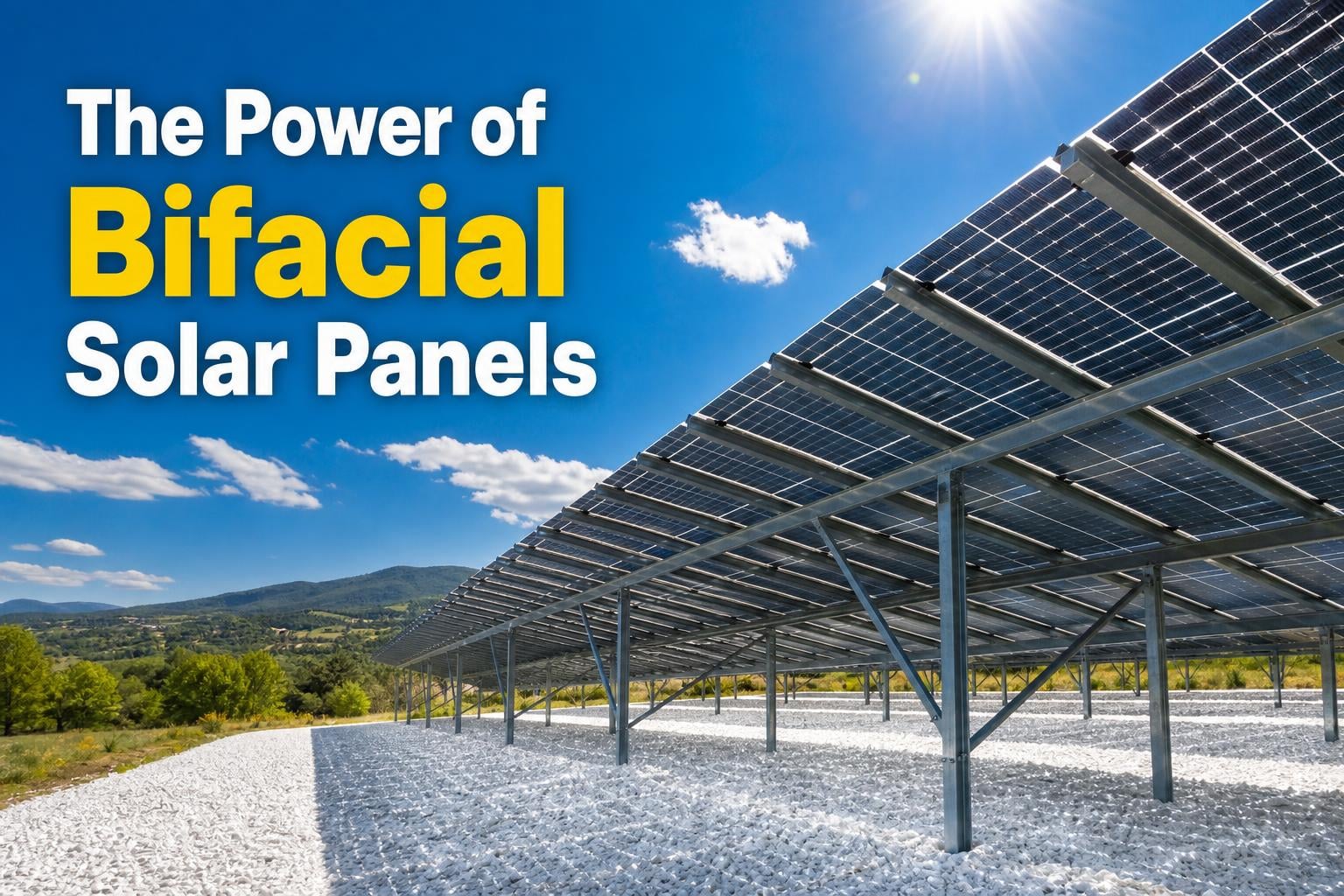
Solar energy has changed dramatically over the past few years, and bifacial solar panels are one of the biggest reasons why. These dual-sided modules now account for over 50 percent of utility-scale installations worldwide, and they are steadily gaining ground in residential and off-grid markets too. If you have heard the buzz but are not quite sure what makes them different from standard panels, this guide breaks down everything you need to know about bifacial solar panels in 2026.
Traditional monofacial panels only generate electricity from one side. Bifacial modules flip that concept by capturing sunlight on both the front and rear surfaces, squeezing extra kilowatt-hours out of the same footprint. Depending on installation conditions, that can translate to anywhere from 5 to 30 percent more energy output. For anyone evaluating a solar investment, understanding how this technology works, what it costs, and where it actually delivers results can mean the difference between a smart purchase and wasted money.
I have spent months digging through research data, manufacturer specifications, and real user experiences from solar forums to put together this comprehensive resource. Whether you are planning a ground-mounted array for a rural property, weighing options for a commercial rooftop, or just curious about whether these panels make sense for a solar pergola, you will find straightforward answers here. Let us get into what bifacial solar panels are, how they work, and whether they are worth it for your situation.
Here is what this guide covers:
Bifacial solar panels are photovoltaic modules designed to generate electricity from both their front and rear surfaces. Standard solar panels, often called monofacial panels, have photovoltaic cells on the front side and an opaque polymer backsheet on the rear. Bifacial modules replace that opaque backsheet with either a second sheet of tempered glass or a transparent polymer backing, allowing light to reach the rear side of the cells.
This dual-sided construction means the panel can capture direct sunlight on the front and reflected or diffused light on the back. The rear-side energy production adds to the total output without requiring additional land area. Think of it as getting bonus energy from light that would otherwise bounce off the ground and go to waste.
The cells inside bifacial panels are functionally similar to those in monofacial modules. Most use monocrystalline silicon sliced thin enough to allow some light transmission through the wafer. The key difference is that both surfaces of the cell can participate in the photovoltaic conversion process. Modern bifacial panels increasingly rely on N-type silicon and TOPCon (Tunnel Oxide Passivated Contact) cell architecture, which offers higher efficiency and lower degradation than older P-type PERC designs.
One metric you will see when comparing bifacial modules is the bifaciality factor. This number expresses the rear-side power output as a percentage of the front-side output under standard test conditions. Most current bifacial panels have a bifaciality factor between 65 and 90 percent. A panel rated at 400 watts on the front with a 70 percent bifaciality factor can produce up to 280 additional watts from the rear under ideal lighting, though real-world rear-side gains are typically much lower.
Bifacial solar cells are not a new invention. Researchers at the Soviet space program experimented with two-sided cells as far back as the 1960s for satellite applications. The concept was sound, but manufacturing costs and technical limitations kept bifacial technology confined to niche aerospace and research uses for decades.
Through the 1990s and 2000s, companies like Sanyo (later acquired by Panasonic) and PVGS worked on commercializing bifacial designs, but the modules remained expensive and their advantages hard to quantify. The real turning point came around 2015 to 2018, when improvements in cell processing and the rise of dual-glass module construction drove costs down dramatically.
By 2019, bifacial modules began capturing serious market share in utility-scale solar farms. The introduction of N-type TOPCon cell technology further accelerated adoption because it paired naturally with bifacial designs and delivered higher efficiency. By 2026, bifacial panels dominate new utility-scale projects globally, and major manufacturers including LONGi, JA Solar, Trina Solar, JinkoSolar, and Canadian Solar now offer bifacial modules as standard products across their lineups.
To understand how bifacial solar panels work, it helps to start with the basic photovoltaic effect that powers all solar cells. When sunlight hits a silicon semiconductor, photons transfer energy to electrons in the silicon lattice. Those energized electrons are swept across a built-in electric field at the cell junction, creating a flow of direct current electricity. This process happens identically whether the light arrives at the front or the back of the cell.
In a monofacial panel, the rear side of the cell sits against an opaque backsheet, so any light reaching the rear is absorbed as heat rather than converted to electricity. In a bifacial panel, the transparent rear cover allows photons to enter the cell from behind. These photons can be either direct sunlight (if the panel is angled or oriented to catch rear sun exposure) or light reflected off the ground and surrounding surfaces.
The amount of extra energy a bifacial panel produces depends heavily on a concept called albedo, which measures how reflective a surface is. Albedo is expressed on a scale from 0 to 1, where 0 means the surface absorbs all light and 1 means it reflects all light. Higher albedo surfaces bounce more sunlight up toward the rear of the panel, increasing rear-side energy production.
Here are typical albedo values for common surfaces and what they mean for bifacial gain:
This albedo data explains why bifacial panels perform so well in certain environments and underwhelm in others. A ground-mounted array over reflective gravel in Arizona will dramatically outperform the same panels bolted flat against a dark shingle roof. Forum users on Reddit frequently report that panels mounted just two inches above a roof surface see almost no rear-side benefit, which tracks with the low albedo of most roofing materials and the lack of airflow to scatter light underneath.
Most bifacial panels manufactured in 2026 use N-type silicon cells rather than the older P-type design. N-type cells use phosphorus-doped silicon as the base material, which is less susceptible to light-induced degradation and maintains higher performance over the panel lifetime. This translates to better long-term energy yield.
TOPCon technology takes N-type cells further by adding an ultra-thin tunnel oxide layer between the silicon wafer and the rear contact. This passivation layer reduces electron recombination losses, meaning more of the generated electricity actually makes it out of the cell. TOPCon cells regularly achieve efficiency ratings above 22 percent on the front side alone, and their bifaciality factor often reaches 80 to 85 percent. When you see bifacial panels advertised with high wattage ratings in the 430 to 600 watt range, TOPCon technology is usually what makes that possible.
Bifacial solar panels offer several concrete advantages over traditional monofacial modules. These benefits are not just theoretical. They are backed by field studies, manufacturer testing data, and real-world reports from solar installers and DIY enthusiasts.
The primary advantage is increased energy production from the same panel area. A study by LONGi Solar, one of the world’s largest panel manufacturers, found that bifacial modules produced 11 percent more energy than monofacial panels in standard ground-mounted installations. When paired with solar tracking systems that follow the sun throughout the day, the gain increased to 27 percent.
Reddit users across solar communities consistently report real-world gains in the 5 to 15 percent range for typical installations, with higher numbers on reflective surfaces. Users in snowy climates report particularly strong performance during winter months because snow cover acts as a natural reflector. Even modest gains compound significantly over a 25-year panel lifespan.
Bifacial panels generate electricity during conditions when monofacial panels produce little or nothing. On cloudy days, diffused light scatters from all directions, and bifacial modules capture some of that scattered light on their rear surface. During early morning and late evening hours when the sun is low on the horizon, bifacial panels catch reflected light that monofacial panels miss entirely.
This extended production window is especially valuable for off-grid systems where every additional watt-hour reduces battery drain. Users running EcoFlow bifacial panels for backup power note that the extra morning and evening production helps stretch battery capacity during extended outages.
Most bifacial panels use dual-glass construction, meaning tempered glass protects both sides of the cells. This design offers better protection against moisture ingress, UV degradation, and mechanical stress than a single-glass-plus-polymer-backsheet configuration. Forum users note that the stiffer dual-glass construction reduces panel flex during installation and transport, which may help prevent micro cracks in the silicon cells.
Manufacturers back this durability with strong warranties. Most bifacial panels now carry 25 to 30 year performance warranties guaranteeing at least 84 to 87 percent of original output at the end of the warranty period. The 30 percent federal solar tax credit available through the Investment Tax Credit helps offset the higher upfront cost as well.
Bifacial panels work well in configurations where monofacial panels underperform. Vertical east-west installations take advantage of morning sun on one face and afternoon sun on the other, creating a more even daily production curve that better matches household electricity consumption patterns. Solar carports, pergolas, and canopy structures benefit enormously because the open space beneath the panels allows reflected light to reach the rear surface.
Agrivoltaics, the practice of combining solar generation with agriculture, is another growing application. Bifacial panels mounted high above crops allow farmers to generate electricity while maintaining productive land beneath. The partial shade from the panels can even reduce water evaporation and heat stress on certain crops.
To maintain that dual-sided performance, keeping both surfaces clean matters. Dust, pollen, or debris on either side reduces output. Regular upkeep goes a long way, and you can learn more about cleaning your solar panels properly to maximize efficiency from both faces.
For all their advantages, bifacial solar panels are not the right choice for every situation. Understanding the downsides helps you make an informed decision rather than chasing technology for its own sake. Here are the main drawbacks to consider.
Bifacial panels typically cost 10 to 20 percent more than comparable monofacial modules. The additional tempered glass, more complex cell processing, and tighter manufacturing tolerances all contribute to the premium. While the gap has narrowed as production volumes have increased, you are still paying more per watt at the point of purchase.
This is the biggest issue for homeowners. Most residential solar installations mount panels parallel to the roof surface with just a few inches of clearance. In that configuration, the roof itself blocks light from reaching the rear of the panel. Even if your roof has a decent albedo, the narrow gap between panel and roof does not allow enough light to scatter underneath.
EnergySage, a respected solar marketplace, is blunt about this: bifacial panels are generally not practical for most residential rooftop installations. The rear-side gain is negligible because the house itself obstructs the light path. Bifacial panels only make residential sense for ground-mounted systems, solar pergolas, or canopy structures where the rear side has clear access to reflected light.
To capture rear-side energy, bifacial panels need adequate clearance from the mounting surface. Industry guidelines suggest a minimum of one meter of clearance between the panel rear and the ground or roof for meaningful bifacial gain. This means standard flush-mount rooftop racking systems will not work effectively. Ground mounts, tracking systems, and elevated structures are needed to realize the full benefit, which adds installation cost and complexity.
Forum users frequently express frustration after mounting bifacial panels close to a roof and seeing almost no gain. The panels work, but only the front side contributes meaningfully. One Reddit user described it as paying a premium for bifacial capability and then essentially using the panel as a monofacial module.
Unlike monofacial panels where you can predict output based on orientation and sunlight hours, bifacial performance varies significantly based on the albedo of the surface below and the surrounding environment. A panel over white gravel will outperform the same panel over grass by a wide margin. This makes it harder to accurately estimate energy production before installation, which complicates system sizing and ROI calculations.
For off-grid systems, bifacial panels can sometimes exceed their nameplate wattage rating during peak conditions with high albedo. A 400-watt panel might briefly produce 440 or 450 watts when rear-side reflection is strong. If your charge controller or inverter is sized exactly to the panel’s rated output, this can cause overcurrent situations. Off-grid users need to account for the potential extra output when sizing their system components.
This is one of the most common questions people ask, and the honest answer is that it depends entirely on your installation scenario. Let us break down the head-to-head comparison so you can decide which type fits your project.
Energy Production: Bifacial panels produce 5 to 30 percent more energy than monofacial panels depending on surface albedo and installation type. On a standard ground mount over grass, expect roughly 5 to 10 percent gain. Over reflective surfaces or with solar trackers, gains can reach 25 to 30 percent. For rooftop installations with minimal clearance, the gain is negligible and both types perform similarly.
Cost: Monofacial panels are less expensive per watt. The bifacial premium currently runs 10 to 20 percent. For a typical 400-watt residential panel, that might mean paying extra for bifacial capability that the installation cannot fully exploit. On ground-mounted systems where the gain justifies the cost, the premium pays for itself through additional energy production.
Durability: Dual-glass bifacial panels have an edge here. The glass-on-glass construction resists moisture, UV degradation, and PID (potential induced degradation) better than glass-backsheet designs. Both types carry 25-year warranties, but bifacial dual-glass modules tend to degrade more slowly over time.
Best Use Cases: Bifacial panels excel in ground-mounted arrays, solar carports, pergolas, tracking systems, agrivoltaic installations, utility-scale farms, and off-grid setups with reflective ground cover. Monofacial panels remain the sensible choice for standard residential rooftop installations where the rear side has no access to light.
The Bottom Line: Bifacial is not inherently better than monofacial. It is a tool suited to specific jobs. If your installation gives the rear side access to reflected light, bifacial panels will reward you with extra energy. If not, you are better off saving money with monofacial panels and investing the difference in additional panel capacity.
Not all bifacial panels are built the same way. Understanding the different types helps you choose the right module for your application.
The most common type, featuring tempered glass on both the front and rear. The cells are laminated between two sheets of glass, providing maximum protection and durability. These panels are heavier than backsheet designs but offer the best long-term performance and weather resistance. Most panels from LONGi, Trina, JA Solar, and JinkoSolar use this construction.
These use tempered glass on the front and a transparent polymer backsheet on the rear. They are lighter and less expensive than dual-glass versions but sacrifice some durability. The transparent backsheet still allows rear-side light transmission, though slightly less efficiently than glass. These are a good middle-ground option for cost-sensitive installations.
Frameless designs eliminate the aluminum frame around the panel edges. Without a frame, there is nothing to cast shadows on the rear cells, which can marginally improve bifacial performance. Frameless panels also resist dirt accumulation at the edges and tend to shed snow more easily. Prism Solar, a US-based manufacturer, is known for high-quality frameless bifacial modules. Mounting frameless panels requires specialized clamping systems.
Smaller, foldable bifacial panels designed for RVs, camping, and mobile off-grid use. Brands like Renogy, EcoFlow, and BougeRV dominate this category. These panels typically range from 100 to 220 watts and are designed to be set up on the ground where they can capture reflected light naturally. They are an excellent way to get more charging capacity from a compact, portable form factor.
Pricing for bifacial solar panels spans a wide range depending on size, brand, and intended application. Here is a breakdown of what you can expect to pay in 2026.
Portable bifacial panels for RVs and camping start around $85 to $200 for compact 100 to 200 watt units. Residential and commercial bifacial panels typically cost between $250 and $400 per panel for 400 to 450 watt modules. At the high end, premium large-format panels from top manufacturers can reach $650 to $800. These figures put bifacial panels at roughly $2.55 to $2.85 per watt, compared to about $2.20 to $2.50 per watt for monofacial equivalents.
The panel price is only part of the equation. Bifacial installations often require specialized mounting hardware to provide rear-side clearance, which adds cost. Ground-mounted systems need racking, concrete footings, and trenching for wiring. Tracking systems add further expense but also maximize bifacial gain.
For a residential ground-mounted bifacial system, total installed costs run about 10 to 20 percent higher than a comparable rooftop monofacial system. However, the 30 percent federal solar tax credit applies to the total system cost including panels, mounting, and installation labor, which helps offset the premium.
ROI for bifacial systems depends on several variables working together. Higher local electricity rates accelerate payback because each additional kilowatt-hour produced displaces more expensive grid power. Areas with net metering programs that credit surplus production at retail rates are especially favorable for bifacial installations.
A ground-mounted bifacial system in a sunny region with a reflective surface can pay back the additional bifacial premium in 2 to 4 years through extra energy production. Over a 25-year lifespan, the cumulative additional energy from the rear side can represent thousands of dollars in saved electricity costs. For utility-scale installations where even small percentage gains translate to massive savings, bifacial panels have become the default choice precisely because the economics are so compelling.
For residential rooftop installations, the math changes. If the rear side cannot capture meaningful reflected light, the bifacial premium may never pay for itself. In that scenario, monofacial panels represent the better financial decision.
How you install bifacial panels determines whether you actually capture the rear-side energy benefit. Here are the main installation approaches and the best practices for each.
Ground mounting is the most effective way to deploy bifacial panels. The panels are elevated on racks with several feet of clearance above the ground, allowing reflected light to reach the rear surface. Tilting the panels at an angle that matches your latitude maximizes both front and rear production. The ground beneath the array can be enhanced with reflective gravel or light-colored materials to boost albedo.
Single-axis and dual-axis trackers physically rotate the panels to follow the sun throughout the day. When paired with bifacial modules, trackers deliver the highest energy yields of any solar configuration. The LONGi study showing 27 percent energy gain used tracking systems. Trackers add cost and moving parts that require maintenance, but for large installations the energy premium justifies the investment.
Bifacial panels mounted on carport or canopy structures serve double duty by providing shade and generating electricity. The open structure beneath the panels allows reflected light from the ground or parked vehicles to reach the rear surface. Commercial parking lots are increasingly being converted to solar carports using bifacial modules, creating distributed power generation from otherwise unused space.
Mounting bifacial panels vertically facing east and west creates a production profile that peaks in the morning and evening rather than at midday. This pattern better matches typical residential electricity consumption. The rear side captures afternoon or morning sun while the front catches the opposite. Snow shedding is also excellent in vertical orientation since snow slides off rather than accumulating.
Combining agriculture with solar generation using bifacial panels is gaining traction. Panels are mounted high enough to allow farming equipment and livestock underneath. The partial shade reduces heat stress on certain crops while the crops reflect light up to the panel rear surface. Research farms in Europe and North America are actively studying optimal crop and panel combinations for this dual-use approach.
Utility-scale solar is where bifacial technology has had the biggest impact. These massive installations, often covering hundreds of acres, use single-axis tracking systems with bifacial panels mounted over natural terrain. The combination of tracking and bifacial gain can boost annual energy production by 20 to 30 percent compared to fixed-tilt monofacial systems. Major developers now specify bifacial panels as standard equipment for new utility projects because the levelized cost of electricity is lower despite the higher upfront panel cost.
Commercial buildings with flat white or light-colored membrane roofs can benefit from bifacial panels. The reflective roof surface provides decent albedo, and the panels are typically mounted on racks that provide adequate clearance. Warehouses, manufacturing facilities, and distribution centers are ideal candidates. The large flat roof areas and reflective roofing materials create conditions where bifacial gain justifies the premium.
The off-grid and DIY solar community has embraced bifacial panels enthusiastically. Reddit users report buying 550-watt bifacial panels at auction prices for homestead installations. The extra energy from rear-side production helps stretch limited battery capacity during cloudy periods. EcoFlow users running multiple bifacial panels in series for backup power appreciate the extended morning and evening production that helps bridge gaps between sunny days.
One common thread from forum discussions: bifacial panels only deliver their promised gains when given space to breathe. Users who mount them flat against surfaces are consistently disappointed. Those who elevate them, place them over reflective surfaces, or use tracking mounts report satisfaction with the additional energy production.
Bifacial panels have an unexpected advantage in snowy regions. Fresh snow has an albedo of 0.80 to 0.90, meaning it reflects 80 to 90 percent of incoming sunlight. When snow covers the ground around a bifacial array, the rear side captures that reflected light and produces significant additional energy. Some installations in Alaska, Canada, and Scandinavia report their highest bifacial gains during winter months when snow cover is at its peak.
The bifacial solar market is dominated by a handful of large manufacturers, with several smaller brands serving specialty niches. Here are the companies producing the most respected bifacial panels available in 2026.
LONGi Solar is the world’s largest solar manufacturer and a pioneer in bifacial technology. Their Hi-MO series bifacial panels using N-type TOPCon cells are widely regarded as industry benchmarks for quality and performance. LONGi’s research data on bifacial energy yield is frequently cited across the industry.
JA Solar, Trina Solar, and JinkoSolar round out the top four Chinese manufacturers that collectively supply the majority of bifacial modules worldwide. All three offer N-type TOPCon bifacial panels with warranties of 25 to 30 years and bifaciality factors above 75 percent.
Canadian Solar is known for excellent quality control and strong warranty support. Their bifacial modules are popular in both utility-scale and commercial markets across North America.
Prism Solar is a US-based manufacturer specializing in high-quality frameless bifacial panels. They are frequently recommended in solar forums for buyers who want domestically produced modules with premium construction.
For portable and small-scale bifacial needs, Renogy, EcoFlow, and BougeRV are the go-to brands. These companies offer folding bifacial panels designed for RVs, camping, and mobile off-grid applications. Their products are widely available and well-reviewed by the DIY solar community.
Bifacial solar panels have earned their place as a dominant force in the solar industry by delivering measurable energy gains in the right conditions. They produce 5 to 30 percent more electricity than monofacial panels when installed with proper clearance over reflective surfaces. For utility-scale farms, commercial flat roofs, ground-mounted residential arrays, solar carports, and off-grid setups, the technology delivers real value that justifies the premium.
At the same time, bifacial panels are not a universal upgrade. Standard residential rooftops with flush-mounted panels see almost no benefit from the rear side, making monofacial panels the smarter financial choice in those situations. The key is matching the technology to your specific installation rather than assuming newer always means better.
Key Takeaways:
