

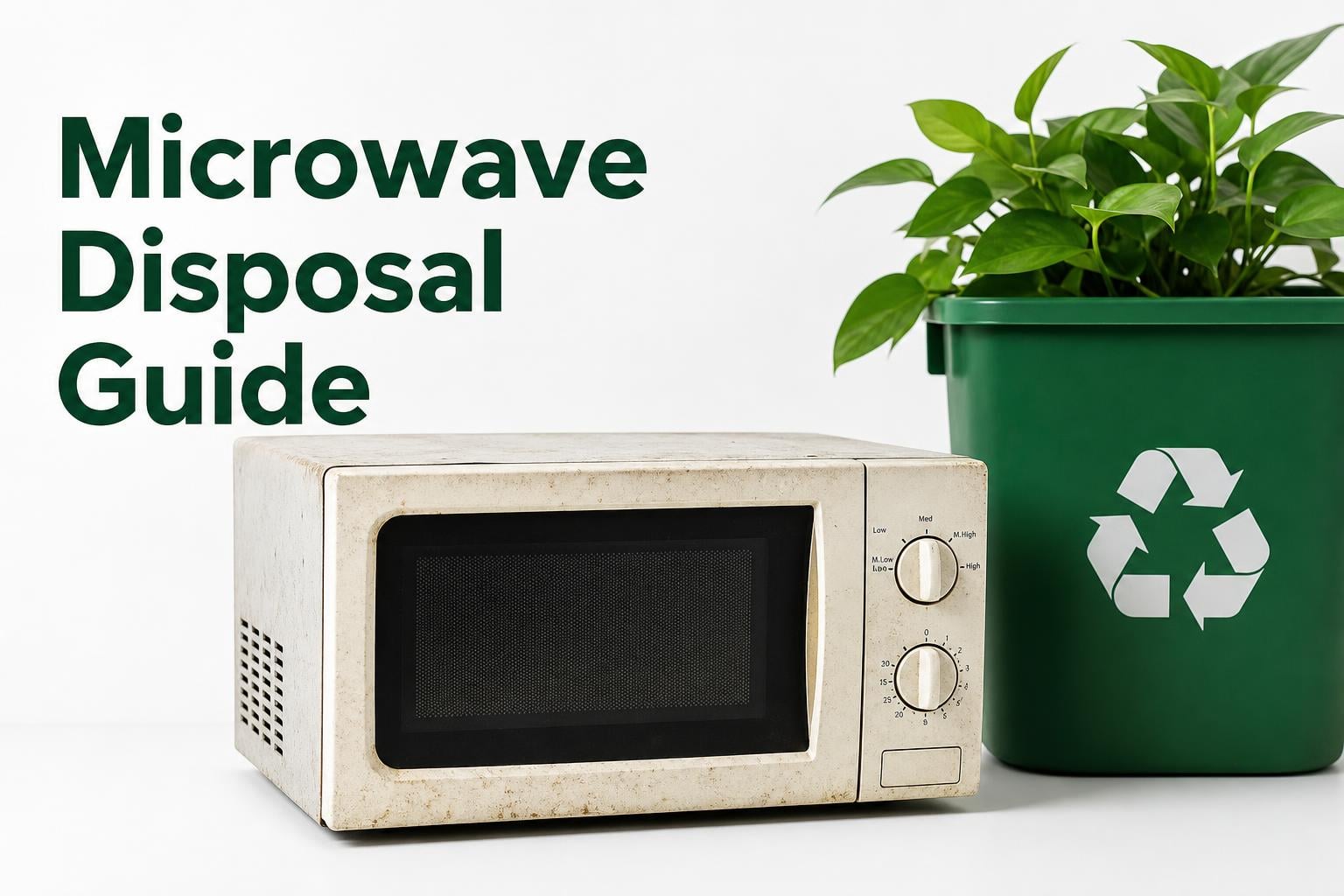
That moment when your microwave stops heating food properly is frustrating, and figuring out what to do with the old unit can feel even harder. Microwave disposal trips up a lot of homeowners because you cannot simply set the appliance on the curb with your weekly trash. In fact, doing so is illegal in many states and can result in fines that catch people off guard. The good news is that free and low-cost recycling options have expanded significantly in 2026, making responsible disposal easier than ever.
Every year, Americans discard millions of microwaves, adding to a growing e-waste crisis that reached over 60 million metric tons globally. Microwaves contain recoverable steel, copper, and electronic components, but they also house hazardous materials like the magnetron and high-voltage capacitor that demand special handling. Proper microwave disposal keeps toxic substances out of landfills while reclaiming valuable metals for future use. This guide walks you through every option available so you can choose the path that fits your situation, budget, and location.
Here is what this guide covers:
Microwave disposal means more than just getting rid of an appliance you no longer need. It involves sending the unit through a certified recycling channel that separates recoverable materials from hazardous ones. Microwaves fall under the category of electronic waste, sometimes called e-waste, because they contain circuit boards, electronic controllers, and components that hold onto dangerous substances. Tossing one into a standard garbage bin introduces those substances directly into the waste stream, where they eventually leach into soil and groundwater.

According to the latest Global E-Waste Monitor, the world generates more than 60 million metric tons of electronic waste annually, and less than 20 percent of it gets recycled through formal channels. Microwaves represent a meaningful slice of that total because the average American household replaces one every seven to ten years. Each discarded unit contains roughly 15 to 20 pounds of recoverable steel along with copper wiring, aluminum, glass, and assorted plastics. When these materials get recovered instead of buried, manufacturers need less virgin ore and the environmental footprint of new appliances drops accordingly.
For a broader look at how all household appliances move through the recycling system, our comprehensive appliance recycling guide covers the full lifecycle from pickup to material recovery.
Before you handle an old microwave for disposal, you need to understand what lurks behind the metal casing. Three components in particular require special attention because they pose real safety risks if mishandled. Knowing about these parts explains why certified recyclers exist and why tossing a microwave in the trash violates environmental regulations in many jurisdictions.
The magnetron is the heart of every microwave, generating the radio waves that heat your food. While the magnetron itself contains valuable copper and steel, some older models use ceramic insulators made with beryllium oxide. This compound is safe during normal operation but becomes a serious health hazard if the ceramic is crushed, ground, or heated to high temperatures. Inhaling beryllium oxide dust can cause chronic beryllium disease, a severe lung condition. For this reason, recyclers handle magnetrons with protective protocols and never send them through standard metal shredding.
The high-voltage capacitor is arguably the most dangerous component for anyone attempting DIY disassembly. Capacitors store electrical charge even after the microwave has been unplugged, and a microwave capacitor can hold a charge of up to 2,000 volts or more for days. Touching the wrong terminal without properly discharging the capacitor can deliver a life-threatening shock. This is the single biggest reason appliance repair professionals and recycling facilities discourage homeowners from opening microwave casings.
Printed circuit boards inside the electronic control panel often contain leaded solder and small amounts of other heavy metals. When circuit boards end up in a landfill, rainwater gradually dissolves those metals and carries them into surrounding soil. Over time, this contamination reaches groundwater supplies and creates long-term environmental damage that is expensive and difficult to reverse.
These hazards are exactly why microwave disposal through a licensed e-waste facility matters so much. Certified recyclers know how to discharge capacitors safely, extract magnetrons without breaking ceramic components, and process circuit boards through specialized streams that capture hazardous materials before they cause harm.
When you drop off a microwave at a certified recycling center, the unit enters a multi-stage process designed to recover as much material as possible. Workers begin by manually removing hazardous components like the magnetron and capacitor, which go through separate handling channels. The remaining chassis then moves through mechanical separation equipment that sorts materials by type and density.
The steel outer casing typically accounts for the largest share of recoverable material. Recyclers bundle this steel with other scrap metal and ship it to foundries that melt it down for use in new products, from construction rebar to car parts. Copper wiring recovered from the power cord, transformer, and magnetron goes to copper refineries where it gets purified and drawn into new wire. Aluminum components, when present, follow a similar path through aluminum recycling streams.
The glass turntable and door window represent another recoverable stream, though not every facility accepts microwave glass due to its tempered nature. Plastic interior panels and housing pieces are sorted by polymer type when feasible, though mixed plastics often end up as waste-to-energy fuel rather than recycled pellets. The circuit board, after hazardous components are stripped, gets processed through smelting operations that recover precious metals like gold, silver, and palladium from the contacts and traces.
Not every part of a dismantled microwave can be recycled. Certain rubber gaskets, adhesive residues, and contaminated plastic films may end up as residual waste. However, a well-run e-waste facility can divert 80 to 90 percent of a microwave’s total weight from landfill disposal. That recovery rate makes a meaningful difference when multiplied across the millions of microwaves discarded each year.
E-waste regulations vary significantly depending on where you live, and that patchwork of rules confuses many residents attempting their first microwave disposal. At the federal level, the Environmental Protection Agency classifies certain discarded electronics as universal waste, a category designed to keep hazardous materials out of municipal landfills while streamlining the collection process. However, individual states have layered their own requirements on top of federal guidelines, creating distinct rules you need to follow based on your location.
California operates one of the most stringent e-waste frameworks in the country through the Department of Toxic Substances Control, or DTSC. Under California law, microwaves are classified as universal waste and cannot legally be placed in any municipal trash or recycling bin. Residents must deliver them to a designated collection facility, a state-approved e-waste recycler, or an authorized retailer take-back location. Many California cities host regular household hazardous waste events where residents can drop off microwaves at no charge. The CalRecycle website maintains a searchable directory of certified collectors so you can find the nearest approved drop-off point.
New York State banned the disposal of most electronic devices in landfills and incinerators under its Electronic Equipment Recycling and Reuse Act. This prohibition explicitly covers small electronic appliances, and microwaves fall squarely within that scope. Manufacturers operating in New York are required to fund free electronics recycling programs, which means residents can often find no-cost drop-off options through participating retailers and municipal collection sites. New York City adds an additional layer of rules through its own e-waste curbside collection program, which allows residents to request a special pickup for eligible electronics.
New Jersey implemented its Electronic Waste Management Act to keep devices containing hazardous materials out of incinerators and landfills. The state requires manufacturers to register with the Department of Environmental Protection and provide free recycling opportunities for covered electronic products. Residents can use the NJDEP website to locate nearby drop-off locations and learn about upcoming community collection events. Many New Jersey counties also operate permanent household hazardous waste facilities that accept microwaves throughout the year.
Even if your state has not enacted specific e-waste landfill bans, most local waste management authorities reject microwaves from regular trash collection. If you are also handling other regulated appliances, our dehumidifier disposal guide covers similar requirements for devices containing refrigerants and electronic components.
The best practice, regardless of where you live, is to contact your municipal waste management office before attempting any disposal. Ask whether your area classifies microwaves as universal waste, whether curbside bulk pickup includes electronics, and whether any fees apply for drop-off. This simple phone call or website check saves you time, prevents potential fines, and ensures your microwave reaches a proper recycling channel.
Once you understand why proper disposal matters and what regulations apply, the actual process becomes straightforward. The following steps walk you through evaluating whether your microwave truly needs to go, preparing it safely for transport, and choosing the right destination for drop-off or pickup.

Before committing to disposal, take a few minutes to determine whether your microwave still has useful life left. Repairing or donating a working appliance is always preferable to recycling, since reuse requires zero energy input and extends the useful life of the materials already invested. Here is a quick evaluation checklist:
If recycling is the right path, a few preparation steps protect you, your vehicle, and the workers who will handle the unit downstream. These steps take less than fifteen minutes and prevent common problems during transport and drop-off.
Safety Warning: Never attempt to open the microwave casing or remove internal components yourself. The high-voltage capacitor can retain a lethal electrical charge for days or even weeks after the unit is unplugged. Only certified technicians with proper discharge tools should disassemble a microwave.
Taking these precautions ensures that both you and the recycling staff stay safe throughout the microwave disposal process. If you are also clearing out other large appliances, our washer and dryer disposal guide follows similar preparation principles for full-size laundry equipment.
Finding the right destination for your old microwave is the step where most people get stuck. The good news is that in 2026 there are more options than ever before, ranging from completely free municipal programs to convenient retailer take-back services. The key is matching your situation to the option that offers the best combination of cost, convenience, and environmental responsibility.

To help you compare the main disposal routes at a glance, here is a breakdown of the most common options:
The most common starting point for microwave disposal is your local municipal waste management system. Many cities and counties operate permanent drop-off facilities that accept small electronics, including microwaves, at no charge to residents. These facilities feed collected e-waste into certified regional recyclers, so you know the materials are handled properly rather than landfilled.
If you have ever searched “microwave disposal near me,” you are tapping into one of the most common local search queries for appliance recycling. The fastest way to find nearby options is to use the Earth911 recycling search tool, which lets you enter your zip code and the item type to generate a list of accepting facilities within driving distance. The Call2Recycle locator and the CalRecycle directory serve similar purposes for residents in states with active e-waste programs.
Beyond permanent drop-off sites, many municipalities schedule periodic e-waste collection events, often held on weekends at community centers, school parking lots, or municipal yards. These events are popular because they consolidate drop-offs from hundreds of households into a single day, which is efficient for both residents and recyclers. Check your city or county website for an events calendar, and mark your calendar early because some events require advance registration or have item limits per vehicle.
Some communities also offer curbside bulk pickup that includes electronics. This service is typically available by appointment only, and not every bulk pickup program accepts microwaves due to their e-waste classification. Call your waste hauler directly to confirm eligibility and schedule a pickup if the service is available in your area.
Before loading up your vehicle, always call the destination facility or check its website to confirm acceptance policies, hours, and any applicable fees. A two-minute phone call can save you a wasted trip, since not every recycling center accepts small appliances and some restrict certain item types on particular days.
Several microwave manufacturers now offer direct recycling programs that take responsibility for their products at end of life. These programs have grown in response to extended producer responsibility laws and increasing consumer demand for sustainable disposal options. The advantage of manufacturer programs is that they typically offer free shipping labels or prepaid mail-back options, eliminating the need to transport the microwave yourself.
LG operates a mail-back recycling program that provides free prepaid shipping labels for small electronics, including microwaves. You simply request a label online, box up the unit, and schedule a carrier pickup from your doorstep. LG partners with certified e-waste recyclers to ensure all returned products go through proper material recovery.
GE Appliances offers a recycling program that accepts old GE-branded microwaves through participating retailers and direct mail-back for certain product lines. GE has invested in closed-loop recycling systems that recover copper, steel, and aluminum from returned appliances for use in new manufacturing.
Hamilton Beach Brands runs a take-back program for small kitchen appliances, including some microwave models under its various brand names. The program provides shipping instructions and prepaid labels through the company’s sustainability website, making mail-back disposal straightforward for owners of qualifying products.
If your microwave was made by a manufacturer not listed here, check the brand’s official website for a sustainability or recycling section. Many companies have launched or expanded take-back programs in recent years, and the landscape changes frequently as new regulations take effect.
National retail chains have become some of the most accessible recycling partners for microwave disposal, thanks to storefront programs that accept small electronics at no charge. These initiatives benefit retailers by driving foot traffic and supporting corporate sustainability goals, while consumers gain a convenient drop-off point that requires no appointment.
Best Buy runs one of the most comprehensive retail recycling programs in the United States. Every Best Buy store accepts a wide range of electronics for recycling at no cost, and many locations accept microwaves and small appliances. Best Buy also offers a haul-away service when you purchase a new appliance and have it delivered, meaning the delivery team removes your old microwave at the same time. There is typically a limit of three items per household per day for in-store drop-off, so plan accordingly if you are recycling multiple devices.
Home Depot participates in electronics recycling through periodic in-store collection events and partnership programs. While Home Depot’s everyday in-store recycling focuses on items like compact fluorescent bulbs and rechargeable batteries, many locations host special e-waste events that accept small appliances including microwaves. Check the store locator on Home Depot’s website for event dates at your nearest location.
Lowe’s offers a similar mix of everyday recycling services and periodic special collection events. Some Lowe’s locations also provide appliance haul-away when you purchase a replacement and arrange delivery, which can include microwave removal depending on the installation service you select.
When using any retailer program, call ahead to confirm that your local store participates and currently accepts microwaves. Participation can vary by location, and program details change periodically as retailers update their sustainability partnerships.
If your microwave still works, donation extends its useful life and keeps perfectly good equipment out of the recycling stream entirely. This is the most environmentally beneficial outcome because reuse requires zero energy for material recovery and provides affordable appliances to people who need them. Several national organizations and community platforms make donation simple.
Habitat for Humanity ReStore locations accept small appliances in working condition, including microwaves. ReStore sells donated items at a fraction of retail prices, with proceeds funding Habitat’s home-building mission. Many ReStore locations offer free pickup for larger donations, so you may not even need to transport the microwave yourself.
Goodwill and Salvation Army thrift stores routinely accept working microwaves at their donation drop-off points. Both organizations resell donated items to fund job training, rehabilitation, and community programs. Call ahead to confirm that your nearest location accepts small appliances, since policies vary by region and store capacity.
For a faster, more direct route, online community platforms connect you with neighbors who may want your microwave. Facebook Marketplace, Craigslist, and Freecycle all allow you to list a working microwave for free or at a low price. Nextdoor is particularly effective because it limits visibility to nearby neighbors, which means no shipping and minimal travel. Many people successfully give away working microwaves within hours of posting on these platforms.
Before donating, clean the microwave thoroughly, test it one final time, and be honest about any quirks or cosmetic issues. A microwave that works but has a noisy fan is still useful to someone on a tight budget, but a unit with a failing door seal should go to recycling instead.
For readers managing multiple appliance disposals, the same donation channels work for washers, dryers, and other large units. Our washer and dryer disposal guide covers donation and recycling options for full-size laundry appliances.
One of the most common questions people ask is how much it costs to get rid of an old microwave. The answer depends almost entirely on which disposal route you choose, and the price range spans from completely free to over $100 for premium haul-away services. Understanding the cost landscape helps you make an informed decision that fits your budget.
Free options are more plentiful than many people realize. Municipal e-waste drop-off centers, manufacturer mail-back programs with prepaid labels, retailer in-store recycling, and donation to charitable organizations all cost nothing. Community e-waste collection events are also free to residents, funded by local government or sponsorship. If cost is your primary concern, one of these routes will almost always work.
Low-cost options typically involve small processing fees at certain recycling facilities, usually ranging from $5 to $25 per appliance. Some private recyclers charge fees to cover the labor and material costs of dismantling hazardous components. These fees are modest compared to the environmental damage that improper disposal causes, and many facilities waive them during special promotion periods or for residents of the municipality they serve.
Premium options include full-service junk removal companies that come to your home, carry the microwave out, and handle disposal. Companies in this category typically charge $79 or more per item, though bundled pricing for multiple items can reduce the per-unit cost. This is the most convenient option for people who cannot transport a microwave themselves or are clearing out an entire household of old appliances.
A practical approach is to start with the free options and only escalate to paid services if those are unavailable or impractical in your area. Most people find that at least one no-cost disposal route is accessible within a reasonable distance of their home.
The e-waste recycling industry has evolved rapidly in recent years, adopting technologies that make material recovery more efficient, more complete, and safer for workers. These advancements are changing what happens to your microwave after you drop it off, and they explain why recycling rates are climbing even as total e-waste generation grows.

Modern e-waste facilities use automated sorting systems that combine optical sensors, eddy current separators, and density-based classification to identify and separate materials at high speed. These systems can distinguish between different metal alloys, polymer types, and composite materials with accuracy that manual sorting cannot match. The result is higher purity in recovered material streams, which makes downstream recycling more economically viable.
Robotic disassembly is another growing frontier. Industrial robots equipped with machine vision can disassemble consumer electronics, including microwaves, along programmed paths that keep human workers away from hazardous components. This reduces occupational exposure to capacitor charges, beryllium oxide dust, and leaded solder. While full robotic disassembly lines remain expensive, several facilities have begun deploying them for high-volume e-waste streams.
Bioleaching represents one of the more experimental but promising approaches. Certain microorganisms can metabolize metals from crushed circuit boards and electronic waste, effectively extracting copper, gold, and other valuable elements through biological processes rather than chemical smelting. Research groups in Europe and Asia are scaling bioleaching pilots, and early results suggest it could become a lower-impact alternative to traditional pyrometallurgical recovery.
Beyond the recycling line itself, software now plays a major role in making e-waste management more transparent and accountable. Blockchain-based tracking systems follow materials from collection point through processing to final material output, creating an auditable chain of custody that discourages the fraudulent dumping practices that have plagued parts of the recycling industry. Some certified recyclers now offer certificates of recycling that document exactly how and where your microwave was processed.
The circular economy concept has also gained traction among appliance manufacturers. In a circular model, materials recovered from end-of-life products feed directly back into new manufacturing, reducing reliance on mined virgin materials. Several brands now design microwaves with disassembly in mind, using fewer adhesive bonds and more modular component architectures so recyclers can separate materials faster and with less contamination.
Three-dimensional printing is opening another creative channel for recovered plastics. Filament made from recycled electronic housings can be used to print everything from replacement parts to consumer goods, giving old microwave plastic a second life in a completely different form. While this application is still niche, it demonstrates how recycling technology and manufacturing innovation are converging to reduce waste.
If your microwave has stopped working but you enjoy hands-on projects, upcycling gives certain components a creative second life before you send the rest to recycling. Upcycling reduces the volume of material entering the waste stream and can produce genuinely useful household items. However, safety must come first, and some projects are best left to people comfortable with basic tools and component identification.
Critical Safety Warning: The capacitor inside a microwave can hold a charge of up to 2,000 volts even after the unit has been unplugged for days. Never remove the outer casing or touch internal components without first having the capacitor professionally discharged. If you are not trained in capacitor discharge procedures, limit your upcycling to external parts only, such as the turntable and door.
Several external components lend themselves to creative repurposing without requiring you to open the casing at all. These projects are safe, simple, and surprisingly versatile.
These ideas scratch the surface of what creative makers have done with old microwave parts. Online maker communities and craft forums share hundreds of variations, from wind chimes made of scrap metal to storage containers fashioned from interior panels. If you enjoy exploring creative repurposing for other materials too, our tire disposal guide includes upcycling ideas for another challenging waste category.
Remember that upcycling should never involve the magnetron, capacitor, or circuit board unless you have professional training. Those components contain hazardous materials that require controlled handling. When in doubt, remove only external parts for crafting and deliver the remaining chassis to a certified recycler.
Yes, microwaves are classified as electronic waste because they contain circuit boards, electronic controllers, and hazardous components like the magnetron and high-voltage capacitor. Most states prohibit placing them in regular household trash, and many require delivery to a certified e-waste recycler or authorized drop-off location.
In most states it is illegal to put a microwave in your regular garbage or curbside recycling bin. California, New York, and New Jersey all have explicit bans on landfilling electronic waste, and many other municipalities reject microwaves from standard trash collection. Violating these rules can result in fines, so always use a designated e-waste disposal channel.
Disposal costs range from completely free to around $100 depending on the route you choose. Municipal drop-off centers, manufacturer mail-back programs, retailer in-store recycling, and donation to charity are all free options. Private recycling facilities may charge $5 to $25 per appliance, and full-service junk removal companies typically charge $79 or more for doorstep pickup and haul-away.
Start by searching Earth911 or Call2Recycle with your zip code to find nearby free drop-off locations. Best Buy stores accept small electronics for recycling at no charge, and many municipalities operate free e-waste drop-off centers or periodic collection events. Manufacturer programs from LG, GE, and Hamilton Beach also offer free prepaid shipping labels for mail-back recycling.
Yes, Best Buy accepts microwaves and other small electronics for recycling at most store locations at no charge. The daily limit is typically three items per household. Best Buy also offers haul-away service when you purchase a replacement appliance and arrange delivery, so the delivery team removes your old microwave at the same time.
Yes, microwaves contain three main hazardous components. The magnetron may use beryllium oxide ceramic insulators that are dangerous if crushed or inhaled as dust. The high-voltage capacitor can retain a lethal electrical charge of up to 2,000 volts for days after unplugging. Printed circuit boards contain leaded solder and heavy metals that can contaminate soil and groundwater if landfilled.
Not every part is recyclable, but a certified e-waste facility can recover 80 to 90 percent of a microwave’s total weight. Steel from the casing, copper from wiring and the transformer, aluminum components, glass from the turntable, and precious metals from circuit boards are all routinely recovered. Certain rubber gaskets, mixed plastics, and adhesive residues may remain as residual waste.
Most thrift stores and charitable organizations only accept microwaves that are in good working condition. If your microwave is broken, donation is generally not an option and you should pursue recycling instead. However, you can list a broken microwave on Freecycle or Craigslist for parts or repair, since some hobbyists and appliance technicians salvage components from non-working units.
Unplug the unit and let it sit for at least 24 hours, then clean the interior of food residue and grease. Secure the door with tape to prevent it from opening during transport, bundle the power cord, and protect the unit from weather if storing it outside temporarily. Never attempt to disassemble the microwave or remove internal components, as the capacitor can deliver a dangerous shock.
Reputable junk removal companies partner with certified e-waste recyclers rather than sending electronics to landfills. However, practices vary by provider, so ask specifically about their recycling policy before booking. Some services charge around $79 per item for microwave removal, which covers pickup, transport, and proper delivery to a recycling facility.
Proper microwave disposal is no longer a mystery once you understand the options, the regulations, and the safety considerations involved. Whether you choose a free municipal drop-off, a manufacturer mail-back program, a retailer take-back initiative, or donation to a local charity, the key is taking action rather than letting the old unit gather dust in your garage. Every microwave that reaches a certified recycler represents recovered steel, copper, and aluminum along with hazardous materials kept safely out of landfills.
The landscape of e-waste recycling continues to improve, with automated sorting, robotic disassembly, and transparent tracking systems making the process cleaner and more efficient each year. State regulations are tightening, manufacturer programs are expanding, and free disposal options are more accessible than they have ever been. There has never been a better time to handle microwave disposal the right way.
If you are upgrading your kitchen and need a replacement after disposing of your old unit, check out our guide to the best countertop microwaves for 2026. And if you found this microwave disposal guide helpful, our site covers responsible disposal for everything from electronics to household waste, so you always have a trusted resource for eco-friendly choices.
