

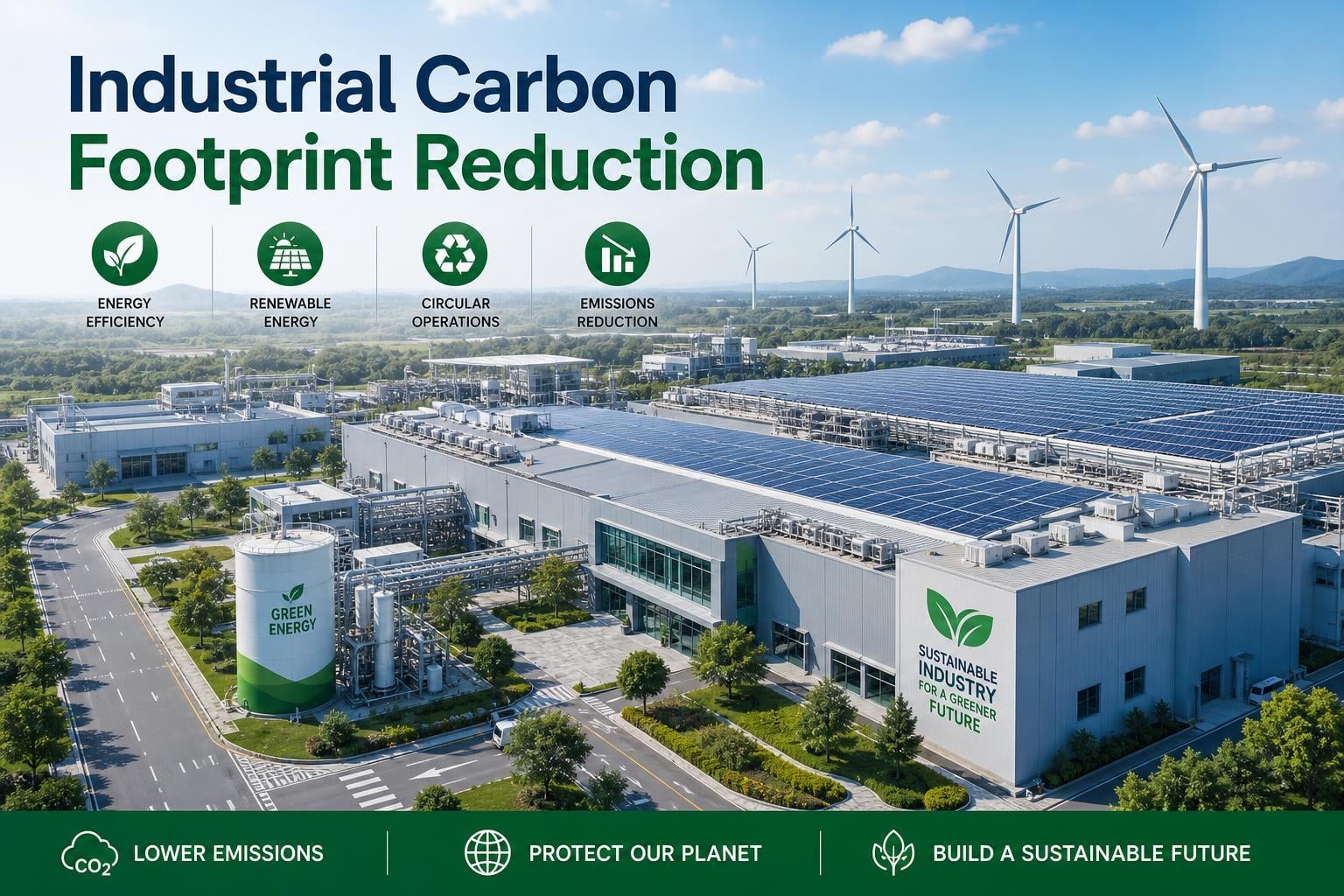
Industrial operations account for roughly one-fifth of global carbon emissions and consume about 54% of all energy used worldwide, according to the World Economic Forum and the U.S. Energy Information Administration. In the United States alone, the industrial sector produces approximately 23% of direct greenhouse gas emissions, rising to 29.6% when electricity-related emissions are included. These numbers make industrial carbon footprint reduction one of the most consequential levers for meeting the Paris Agreement targets and achieving net-zero by 2050.
Companies can no longer treat decarbonization as a voluntary initiative. Regulatory frameworks such as the EU Carbon Border Adjustment Mechanism (CBAM), the Corporate Sustainability Reporting Directive (CSRD), and the Science Based Targets initiative (SBTi) are turning emissions measurement and reduction into legal and financial obligations. The U.S. Inflation Reduction Act has directed hundreds of billions of dollars toward clean energy and industrial decarbonization, creating new incentives for manufacturers to act. Meanwhile, customers, investors, and supply chain partners increasingly demand verifiable emissions data rather than vague sustainability pledges.
This guide breaks down what an industrial carbon footprint actually measures, how to organize reduction efforts using the Scope 1, 2, and 3 emissions framework, and which strategies deliver the largest emissions cuts at the lowest cost. It also covers carbon accounting tools, carbon capture technology, supply chain emissions optimization, carbon offsetting limitations, and the regulatory landscape shaping industrial operations in 2026. Whether you manage a single factory or a multinational manufacturing network, the strategies below provide a practical roadmap for measurable industrial carbon footprint reduction.
For readers exploring sustainability at a broader level, our guide on simple steps to go green covers individual and household actions that complement the systemic industrial changes discussed here.
An industrial carbon footprint represents the total greenhouse gas emissions generated directly and indirectly by a company’s operations, expressed as carbon dioxide equivalent (CO2e). The CO2e metric converts all greenhouse gases, including methane (CH4), nitrous oxide (N2O), and hydrofluorocarbons (HFCs), into a single unit based on their global warming potential (GWP). GWP measures how much heat each gas traps in the atmosphere over a specific time horizon compared to CO2. For example, methane has a GWP roughly 28 times higher than CO2 over a 100-year period, meaning one ton of methane emissions counts as 28 tons of CO2e.
Understanding GWP and CO2e matters because industrial facilities release a complex mix of greenhouse gases, not just carbon dioxide. A steel plant emitting large volumes of CO2 from coke combustion also releases methane from raw material handling. A semiconductor fab may emit significant quantities of perfluorocarbons with GWPs thousands of times higher than CO2. Aggregating all gases into a single CO2e figure allows companies to compare emissions across facilities, track progress, and report results using standardized frameworks like the GHG Protocol.
The GHG Protocol, developed by the World Resources Institute and the World Business Council for Sustainable Development, is the most widely used international standard for measuring and managing greenhouse gas emissions. It defines three categories of emissions, known as Scopes 1, 2, and 3, that together form a complete greenhouse gas inventory. Every credible industrial carbon footprint reduction program starts with building this inventory and understanding where emissions originate across all three scopes.
Distinguishing between a corporate carbon footprint and a product carbon footprint also matters. A corporate carbon footprint aggregates all emissions from a company’s operations and value chain. A product carbon footprint measures emissions associated with a single product throughout its lifecycle, from raw material extraction through manufacturing, use, and disposal. Both metrics inform decarbonization strategy, but they require different data collection methods and serve different reporting purposes under frameworks like CSRD and CDP disclosure.
The Scope 1, 2, and 3 emissions framework provides the structural backbone for every credible industrial carbon footprint reduction strategy. Major competitors in the sustainability space, including Normative, CarbonChain, and C2ES, all organize their guidance around these three categories. Understanding the distinction between them determines where a company should focus its reduction efforts and which strategies will yield the greatest impact.
Scope 1 emissions come from sources a company owns or controls directly. For industrial facilities, these typically include on-site fuel combustion in boilers, furnaces, and kilns; emissions from chemical production processes such as cement calcination or ammonia synthesis; and fugitive emissions from refrigeration equipment, compressed gas systems, or methane leaks in oil and gas operations. Fleet vehicles running on gasoline or diesel also fall under Scope 1.
Scope 1 emissions are often the most straightforward to measure because they involve physical fuel consumption and process inputs that companies already track for operational and financial reasons. However, they can be the hardest to reduce because they are tied to core manufacturing processes that require high temperatures or specific chemical reactions. Strategies for cutting Scope 1 emissions include fuel switching from coal or oil to natural gas or biomass, electrification of heat processes using industrial heat pumps, adoption of green hydrogen as a fuel, and process optimization through lean manufacturing principles.
Scope 2 covers indirect emissions from the generation of purchased electricity, steam, heating, and cooling. When a factory buys electricity from the grid, the power plant burning coal or natural gas to produce that electricity generates emissions on the factory’s behalf. The GHG Protocol assigns these emissions to the energy consumer, not the producer, because the consumer’s demand drives the generation.
Scope 2 emissions represent one of the most accessible reduction opportunities for industrial companies. A facility can lower its Scope 2 footprint by signing Power Purchase Agreements (PPAs) that guarantee electricity from renewable sources, purchasing Renewable Energy Certificates (RECs) in the United States or Guarantees of Origin (GOs) in Europe, installing on-site solar panels or wind turbines, or participating in green tariff programs offered by utilities. Combined heat and power (CHP) systems, also known as cogeneration, can improve overall energy efficiency by capturing waste heat from on-site electricity generation for industrial processes, simultaneously reducing both Scope 1 and Scope 2 emissions.
Scope 3 emissions encompass all other indirect emissions in a company’s value chain, both upstream and downstream. Upstream Scope 3 includes emissions from purchased goods and services, capital goods, fuel production, transportation and distribution, business travel, employee commuting, and waste generated in operations. Downstream Scope 3 covers transportation of sold products, use of sold products, end-of-life treatment, leased assets, franchises, and investments.
According to CDP data analyzed by CarbonChain, supply chain emissions average 26 times higher than a company’s direct operational emissions. For most manufacturers, Scope 3 represents 70 to 90 percent of the total carbon footprint. This makes Scope 3 the largest opportunity for industrial carbon footprint reduction but also the most difficult to address, because it requires engaging suppliers, collecting emissions data across dispersed global networks, and influencing decisions outside the company’s direct control. The SBTi framework provides guidance for setting science-based targets that include Scope 3 emissions, and many companies now require suppliers to report their carbon intensity as a condition of doing business.
You cannot manage what you cannot measure. Carbon accounting is the systematic process of quantifying, tracking, and reporting greenhouse gas emissions across all three scopes. It forms the foundation of any industrial carbon footprint reduction program, because it identifies which operations, processes, and suppliers generate the most emissions and establishes baselines against which progress can be measured. Under the EU CSRD and similar reporting mandates, carbon accounting has shifted from a voluntary best practice to a regulatory requirement for thousands of companies.
The measurement process begins with defining organizational and operational boundaries. Companies must decide whether to account for emissions based on equity share, financial control, or operational control, following GHG Protocol guidance. Once boundaries are set, the next step is collecting activity data, such as fuel consumption records, electricity bills, refrigerant purchases, and supplier-specific emissions reports. These activity data are multiplied by published emissions factors, which represent the average emissions intensity per unit of activity, such as kilograms of CO2 per kilowatt-hour of grid electricity or per liter of diesel fuel consumed.
Specialized carbon accounting platforms have emerged to automate this process. These tools integrate with enterprise resource planning systems, utility data feeds, and supplier surveys to calculate emissions in real time. They also generate reports formatted for CDP disclosure, CSRD compliance, and SBTi target tracking. Companies that lack the resources for a dedicated sustainability team can use simplified carbon footprint calculators to estimate their emissions, though these tools sacrifice accuracy for accessibility.
Data quality remains the single biggest challenge in carbon accounting, particularly for Scope 3 emissions. Reddit communities focused on carbon accounting, including r/carbonaccounting, regularly highlight the difficulty of obtaining accurate emissions data from dispersed global suppliers. Many suppliers lack the capacity or willingness to report, and even those that do often provide incomplete or inconsistent data. Addressing this gap requires investing in supplier engagement programs, providing training and tools, and building emissions reporting requirements into procurement contracts.
With a greenhouse gas inventory in place, companies can prioritize reduction strategies based on emissions impact, implementation cost, and technical feasibility. The most effective industrial carbon footprint reduction programs tackle all three scopes simultaneously, sequencing investments to capture quick wins before moving to capital-intensive transformations.
Energy efficiency is typically the first and most cost-effective reduction strategy because it lowers both emissions and operating costs. Industrial energy efficiency improvements can reduce energy consumption by 10 to 30 percent with relatively short payback periods. The first step is conducting a comprehensive energy audit to identify waste and prioritize upgrades. Energy audits evaluate equipment performance, building envelope integrity, compressed air systems, steam distribution, motor efficiency, and process heating losses.
Common high-impact efficiency measures include upgrading to high-efficiency motors with variable frequency drives, recovering waste heat from exhaust gases for preheating or space heating, optimizing compressed air systems that often leak 20 to 30 percent of generated air, and implementing LED lighting with occupancy sensors. Implementing an energy management system certified to the ISO 50001 standard provides a structured framework for continuous improvement, and companies can take advantage of energy efficiency tax credits for qualifying equipment upgrades.
Combined heat and power systems deserve special attention because they achieve overall thermal efficiencies of 75 to 80 percent, compared to the 50 percent typical of separate heat and power generation. By generating electricity on-site and capturing the waste heat for industrial processes, CHP reduces both Scope 1 fuel consumption and Scope 2 purchased electricity. The Inflation Reduction Act expanded investment tax credits for CHP projects, improving their financial returns.
Renewable energy adoption is the primary strategy for reducing Scope 2 emissions and, increasingly, Scope 1 emissions through electrification. The available options range from simple purchases to long-term infrastructure investments, and the right combination depends on facility location, energy demand profile, and available capital.
Power Purchase Agreements allow companies to buy electricity directly from renewable energy projects at fixed prices over 10 to 25 years. PPAs provide price certainty, hedge against fossil fuel volatility, and deliver additional renewable capacity to the grid that would not otherwise exist. Virtual PPAs, also called financial PPAs, allow companies in regions without competitive electricity markets to support renewable development elsewhere and claim the environmental attributes. RECs and GOs serve as a simpler alternative, certifying that a specified amount of electricity was generated from renewable sources, though they do not necessarily add new renewable capacity.
On-site generation through rooftop solar panels, ground-mounted arrays, or wind turbines reduces reliance on the grid and provides visible evidence of sustainability commitment. The economics have improved dramatically, with solar photovoltaic costs falling more than 80 percent over the past decade. For facilities with consistent heating or cooling loads, geothermal heat pumps and biomass boiler systems offer renewable alternatives to fossil fuel combustion. Biogas captured from anaerobic digestion of organic waste can replace natural gas in boilers and combined heat and power units, creating a circular energy system.
Electrification of industrial processes represents a deeper transformation that shifts emissions from Scope 1 fuel combustion to Scope 2 purchased electricity. Electric arc furnaces in steelmaking, electric boilers for process steam, and electric heat pumps for low-temperature heating all enable facilities to power operations with renewable electricity rather than burning fossil fuels on-site. The World Economic Forum identifies direct electrification and renewable heat as one of four key pillars of industrial decarbonization, alongside hydrogen, CCUS, and systemic efficiency through circularity.
Fuel switching replaces high-carbon fuels with lower-carbon alternatives. Switching from coal to natural gas can reduce emissions by 40 to 50 percent per unit of energy, though methane leaks in the natural gas supply chain can erode some of this benefit. Biomass and biogas can replace fossil fuels in boilers and kilns, with the caveat that sustainability depends on responsible feedstock sourcing. Converting fleet vehicles from diesel to electric or hydrogen fuel cell power addresses mobile source emissions under Scope 1.
Green hydrogen, produced by electrolyzing water using renewable electricity, has emerged as a potential decarbonization pathway for hard-to-abate industrial processes. Steel, cement, chemicals, and heavy transport require temperatures or chemical reactions that are difficult to electrify directly. Hydrogen can serve as both a fuel and a feedstock, and the Congressional Budget Office has highlighted hydrogen alongside carbon capture as a technology critical for reducing emissions in industries where direct electrification is impractical. However, green hydrogen remains expensive and energy-intensive to produce, and scaling will depend on continued cost reductions and policy support.
Carbon capture, utilization, and storage encompasses technologies that capture CO2 emissions at their source and either store them permanently underground or convert them into useful products. For industries where process emissions are inherent to the chemistry, such as cement manufacturing where calcination releases CO2 regardless of fuel choice, CCUS may be the only viable pathway to deep decarbonization. The IPCC and the International Energy Agency both include CCUS as a necessary component of scenarios that limit warming to 1.5 or 2 degrees Celsius.
Post-combustion capture systems use chemical solvents to absorb CO2 from flue gases after fuel combustion. Pre-combustion capture gasifies fuel before combustion, producing a hydrogen-rich stream and a concentrated CO2 stream that is easier to separate. Oxy-fuel combustion burns fuel in pure oxygen instead of air, producing a flue gas of nearly pure CO2 and water vapor. Each approach involves energy penalties and significant capital costs, but ongoing innovation and policy support through the Inflation Reduction Act’s enhanced 45Q tax credit are improving project economics.
Utilization pathways convert captured CO2 into concrete, synthetic fuels, chemicals, or building materials. While utilization can generate revenue and offset costs, the volumes of CO2 that can be productively used are small compared to industrial emission levels, and the carbon may be re-released when products degrade. Geological storage in deep saline aquifers or depleted oil and gas fields offers permanent sequestration at much larger scale. Companies like ExxonMobil and Chevron are investing in large-scale CCUS hubs that aggregate CO2 from multiple industrial sources for shared transport and storage infrastructure, reducing per-ton costs through economies of scale.
Because Scope 3 emissions dominate the carbon footprint of most industrial companies, supply chain optimization often delivers the largest absolute reductions. The challenge lies in measurement and influence, since suppliers control the emitting activities. Effective supply chain emissions optimization requires a structured approach combining data collection, supplier engagement, procurement reform, and circular economy thinking.
The first step is mapping the supply chain to identify emissions hotspots. A company might discover that a small number of material categories or suppliers account for the majority of upstream emissions. Life cycle assessment tools and environmentally extended input-output models help estimate emissions when supplier-specific data is unavailable. Once hotspots are identified, companies can prioritize engagement with the highest-impact suppliers and request product-specific carbon footprint data.
Procurement reform amplifies impact by building emissions criteria into purchasing decisions. Forward-thinking companies now include carbon intensity in supplier scorecards alongside traditional metrics like price, quality, and delivery reliability. Some set explicit supplier emissions reduction targets and require CDP disclosure as a condition of contract renewal. Localizing supply chains to reduce transportation distances, redesigning products to use lower-carbon materials, and specifying recycled content all contribute to measurable reductions. For insights on material sustainability, our analysis of sustainable material sourcing examines how material choices affect carbon footprints.
Circular economy strategies reduce Scope 3 emissions by keeping materials in use longer and reducing demand for virgin extraction. The waste hierarchy, which prioritizes prevention, then reuse, then recycling, then energy recovery, and finally disposal, provides a decision framework. Industrial symbiosis, where the waste stream of one facility becomes the input for another, transforms linear processes into closed loops. Companies can also redesign products for durability, repairability, and recyclability. Our guides on industrial recycling and material recovery and circular economy through upcycling explore practical applications of these principles.
Digital transformation is reshaping how industrial facilities monitor, analyze, and reduce their carbon emissions. Industry 4.0 technologies, including the Industrial Internet of Things (IIoT), artificial intelligence, digital twins, and advanced analytics, enable precision control over energy consumption and process efficiency that was impossible with legacy systems.
IIoT sensors deployed across factory floors collect real-time data on energy consumption, equipment performance, temperature, pressure, and emissions. Energy management systems process this data to identify waste, optimize set points, and trigger automated responses. Predictive maintenance algorithms analyze vibration, temperature, and acoustic data to detect equipment degradation before it causes inefficiency or failure, keeping machines running at optimal efficiency and reducing both downtime and wasted energy.
Digital twins, virtual replicas of physical assets or entire facilities, allow engineers to simulate process changes and evaluate their emissions impact before implementation. This reduces the risk and cost of optimization experiments. Additive manufacturing, commonly known as 3D printing, reduces material waste by building parts layer by layer rather than machining away excess material, and it enables lighter component designs that save energy throughout the product lifecycle. Demand response programs use smart grid connectivity to shift energy-intensive processes to periods when renewable energy is abundant or grid carbon intensity is lowest.
AI-driven optimization goes further by continuously learning from operational data and adjusting process parameters in real time. Companies like Siemens and Schneider Electric offer industrial software platforms that integrate energy management, production scheduling, and emissions tracking. The result is a smart factory where sustainability metrics are monitored with the same rigor as output, quality, and cost.
Carbon offsetting allows companies to compensate for emissions they cannot eliminate by funding projects that reduce or remove greenhouse gases elsewhere. Reforestation, renewable energy development, methane capture from landfills, and direct air capture are common offset project types. When used responsibly, offsets can help companies bridge the gap between current emissions levels and their net-zero targets while they invest in longer-term decarbonization technologies.
However, carbon offsetting has significant limitations and carries substantial reputational risk. Many offset projects have been found to overstate their impact, lack permanence, or fail the additionality test, meaning the emissions reductions would have occurred without offset funding. Investigations have repeatedly uncovered low-quality credits in voluntary carbon markets, and companies relying heavily on offsets to claim carbon neutrality have faced accusations of greenwashing. The GHG mitigation hierarchy is clear: avoid emissions first, reduce what cannot be avoided, and only then compensate for unavoidable residual emissions.
Companies making net-zero claims through offsetting alone risk serious credibility damage. Understanding greenwashing risks in carbon offsetting is essential for any industrial sustainability program. The SBTi Net-Zero Standard requires companies to reduce emissions by at least 90 percent before relying on removals for the final 10 percent, and regulators are increasingly scrutinizing offset-based climate claims. Internal carbon pricing, where companies assign a cost to each ton of CO2e in their decision-making, can help prioritize direct reductions over offsets by making emissions visible in financial analyses.
ArcelorMittal, the world’s second-largest steelmaker, has committed to net-zero emissions by 2050 with an interim target of 25 percent reduction by 2030. Steel production accounts for roughly 7 percent of global emissions, making it one of the most carbon-intensive industries. The company is pursuing multiple decarbonization pathways simultaneously, including hydrogen-based direct reduced iron in Hamburg, carbon capture and storage at its Gent facility in Belgium, and electric arc furnace conversion in Europe and North America. These projects demonstrate that even hard-to-abate industries can chart credible paths toward deep decarbonization, though progress depends heavily on policy support, green hydrogen availability, and CCUS infrastructure.
Norican Group, a global leader in industrial metal treatment and surface preparation technologies, partnered with carbon accounting platform Normative to measure and manage its carbon footprint across a complex international value chain. The company faced challenges common to manufacturers with dispersed suppliers and outsourced production: low-quality emissions data, difficulty engaging suppliers, and the complexity of mapping Scope 3 emissions across dozens of countries. By implementing systematic carbon accounting, Norican established baselines, identified emissions hotspots, and set science-based targets for reduction. The case illustrates that measurement, while challenging, is the prerequisite for any credible reduction program and that specialized carbon accounting platforms can help even complex manufacturers build accurate greenhouse gas inventories.
Microsoft has committed to being carbon negative by 2030, meaning it will remove more carbon from the environment than it emits, and to remove all historical emissions since its 1975 founding by 2050. The company’s approach combines aggressive Scope 1 and 2 reductions through renewable energy PPAs covering 100 percent of operational electricity consumption, internal carbon pricing that charges business units for their emissions, and large-scale investments in carbon removal technologies. Microsoft’s experience demonstrates that even technology companies with relatively low direct emissions must address Scope 3 emissions from supply chains, data center hardware, and product use to achieve meaningful reductions. The company’s transparency about challenges, including the difficulty of finding high-quality carbon removal credits, provides valuable lessons for industrial companies navigating similar issues.
The regulatory environment for industrial emissions has transformed dramatically, and compliance is no longer optional. Understanding the major frameworks is essential for any company operating in or trading with major economies. These regulations create both obligations and incentives that shape corporate decarbonization strategy.
The EU CBAM imposes a carbon price on imports of carbon-intensive goods, including iron and steel, cement, fertilizers, aluminum, electricity, and hydrogen. CBAM is designed to prevent carbon leakage, where companies move production to countries with weaker climate policies. Importers must report the embedded emissions in their products and purchase CBAM certificates corresponding to the carbon price that would have been paid under the EU Emissions Trading System. This effectively extends EU carbon pricing to foreign producers, compelling global manufacturers to measure and reduce their carbon intensity or face competitive disadvantages in European markets.
The CSRD requires companies operating in the EU to disclose detailed information about their sustainability performance, including greenhouse gas emissions across all three scopes, climate risk assessment, and decarbonization plans. The directive significantly expands the number of companies subject to mandatory sustainability reporting and introduces standardized disclosure requirements aligned with European Sustainability Reporting Standards. Companies must obtain third-party assurance of their reported data, bringing the rigor of financial auditing to environmental reporting. For industrial companies, CSRD means that carbon accounting must meet auditable standards and that Scope 3 data quality can no longer be ignored.
The SBTi is a voluntary framework that helps companies set emissions reduction targets aligned with what climate science says is necessary to limit warming to 1.5 degrees Celsius. Companies submit targets for validation, and SBTi publishes whether the targets meet its criteria. While voluntary, SBTi validation has become a credibility signal that investors, customers, and regulators increasingly expect. The SBTi Net-Zero Standard requires near-term targets covering Scope 1, 2, and 3 emissions, with Scope 3 targets meeting minimum ambition thresholds. Long-term targets must cover at least 90 percent of emissions across all scopes.
In the United States, the Clean Air Act provides the primary regulatory framework for industrial emissions. Section 111 authorizes the EPA to set New Source Performance Standards (NSPS) for greenhouse gas emissions from stationary sources, including power plants, refineries, cement kilns, and other industrial facilities. The American Innovation and Manufacturing (AIM) Act mandates an 85 percent phasedown of HFCs over 15 years, addressing potent greenhouse gases used in refrigeration and air conditioning. The Inflation Reduction Act represents the largest climate investment in U.S. history, offering tax credits for renewable energy, carbon capture, clean hydrogen, electric vehicles, and industrial decarbonization. These incentives significantly improve the financial returns of emissions reduction projects and accelerate the business case for industrial carbon footprint reduction.
Regulations also target methane emissions from oil and gas production, where fugitive emissions from leaks, venting, and flaring represent a major climate concern. EPA methane rules finalized in 2026 extend and strengthen requirements for leak detection and repair, address routine flaring at oil wells, and introduce a program for third-party emissions monitoring. Companies in the energy sector and their industrial customers must account for these regulations when assessing their carbon footprints and planning reduction strategies.
For practical guidance on taking advantage of government incentives, our HVAC tax credit guide explains how energy efficiency improvements can qualify for federal tax benefits.
Despite clear environmental and regulatory imperatives, industrial companies face significant barriers to decarbonization. Cost remains the most frequently cited obstacle, as carbon capture, green hydrogen, and electrification require substantial capital investment with uncertain returns. The tension between short-term profitability and long-term sustainability investment creates resistance, particularly in industries with thin margins or private ownership. Government incentives like the Inflation Reduction Act help close the cost gap, but companies must still justify upfront spending to boards and shareholders.
Technical barriers compound financial ones. Many industrial processes rely on chemistry and physics that produce CO2 as an unavoidable byproduct, meaning no amount of efficiency improvement can eliminate these emissions without fundamental process redesign or carbon capture. Integrating variable renewable energy into industrial operations that require constant, reliable power supply presents grid stability and energy storage challenges. The shortage of skilled workers trained in energy management, carbon accounting, and clean technology further constrains implementation capacity.
Data quality problems, particularly for Scope 3 emissions, can undermine confidence in reduction targets and make progress difficult to verify. Regulatory uncertainty adds risk to long-term investment decisions, as policies can shift with political cycles. Companies that delay action risk falling behind competitors who build decarbonization capabilities early, accumulating stranded assets as carbon pricing and regulation tighten, and losing customers who increasingly require emissions disclosures from suppliers. The most successful companies treat these barriers as manageable challenges, sequencing investments to capture quick savings from energy efficiency, building internal expertise through pilot projects, and gradually scaling to more transformative technologies.
Industrial carbon footprint reduction is not solely an environmental or compliance exercise. It delivers tangible business benefits that improve financial performance and competitive positioning. Energy efficiency investments reduce operating costs, often paying for themselves within two to five years through lower utility bills. Renewable energy PPAs provide long-term price certainty that protects against fossil fuel price volatility, turning an environmental decision into a financial hedge.
Companies with strong sustainability performance increasingly win contracts over less-prepared competitors, particularly when bidding for work with large corporations that impose Scope 3 emissions requirements on their supply chains. Investors are directing capital toward companies with credible decarbonization plans and away from laggards facing climate-related financial risk. Employees, especially younger workers, prefer employers with genuine environmental commitments, improving recruitment and retention. Carbon pricing mechanisms, whether regulatory like CBAM or voluntary like internal carbon pricing, create direct financial consequences for emissions that prudent companies are already preparing to manage.
The companies that will thrive in the low-carbon economy are those building decarbonization capabilities today. Early movers gain experience with technologies and processes before they become mandatory, develop supplier relationships that prioritize low-carbon materials, and establish the data infrastructure needed for compliance with evolving regulations. Late movers face higher costs, steeper learning curves, and the risk of stranded high-carbon assets as markets transition.
Industries can reduce their carbon footprint by measuring emissions across Scope 1, 2, and 3 categories, then implementing strategies such as energy efficiency upgrades, renewable energy procurement through PPAs and RECs, fuel switching to lower-carbon alternatives, process electrification, supply chain emissions optimization, and carbon capture technology. The most effective programs prioritize quick wins like energy audits and LED retrofits before moving to capital-intensive transformations.
Scope 1 emissions are direct emissions from sources a company owns or controls, such as on-site fuel combustion and process emissions. Scope 2 covers indirect emissions from purchased electricity, steam, heating, and cooling. Scope 3 includes all other indirect emissions in the value chain, both upstream (purchased goods, transportation, supplier operations) and downstream (product use and end-of-life), and typically represents 70 to 90 percent of a manufacturer’s total carbon footprint.
CO2e (carbon dioxide equivalent) is a standardized unit that converts all greenhouse gases into a single metric based on their global warming potential (GWP). GWP measures how much heat each gas traps relative to CO2 over a specific time period. Methane has a GWP about 28 times that of CO2 over 100 years, so one ton of methane equals 28 tons of CO2e.
Manufacturing accounts for approximately one-fifth of global carbon emissions and consumes about 54 percent of all energy used worldwide. In the United States, the industrial sector produces about 23 percent of direct greenhouse gas emissions, rising to 29.6 percent when electricity-related emissions are included, making it the largest emitting sector.
The EU Carbon Border Adjustment Mechanism (CBAM) places a carbon price on imports of carbon-intensive goods such as steel, cement, aluminum, fertilizers, electricity, and hydrogen. Importers must report embedded emissions and purchase CBAM certificates, effectively extending EU carbon pricing to foreign producers and compelling global manufacturers to reduce their carbon intensity to remain competitive in European markets.
Carbon offsetting can help bridge the gap between current emissions and net-zero targets, but it has significant limitations. Many offset projects overstate their impact, lack permanence, or fail additionality tests. The GHG mitigation hierarchy requires companies to avoid and reduce emissions first, using offsets only for unavoidable residual emissions. The SBTi Net-Zero Standard requires at least 90 percent direct reduction before offsets can address the remaining 10 percent.
The GHG Protocol, developed by the World Resources Institute and the World Business Council for Sustainable Development, is the most widely used international standard for measuring and managing greenhouse gas emissions. It defines the Scope 1, 2, and 3 emissions framework and provides guidance for setting organizational boundaries, collecting data, and calculating emissions. It forms the basis for CSRD reporting, CDP disclosure, and SBTi target setting.
Green hydrogen, produced by electrolyzing water using renewable electricity, can decarbonize industrial processes that are difficult to electrify directly, such as steelmaking, cement production, and chemical manufacturing. Hydrogen can serve as both a fuel and a feedstock. However, green hydrogen remains expensive and energy-intensive, and large-scale adoption depends on continued cost reductions and policy support through mechanisms like the Inflation Reduction Act.
Industrial carbon footprint reduction has moved from voluntary aspiration to operational necessity. With manufacturing responsible for roughly one-fifth of global emissions and regulators on both sides of the Atlantic mandating measurement, disclosure, and reduction, companies that fail to act face financial penalties, lost contracts, and stranded assets. The Scope 1, 2, and 3 framework provides the organizing structure, carbon accounting tools provide the measurement foundation, and proven strategies spanning energy efficiency, renewable energy, fuel switching, CCUS, and supply chain optimization provide the practical pathways to deep decarbonization.
The companies succeeding in this transition share common characteristics. They start with measurement, building accurate greenhouse gas inventories before committing to targets. They prioritize quick wins from energy efficiency that fund longer-term investments. They engage suppliers rather than treating Scope 3 as someone else’s problem. They invest in technology, from IIoT sensors to carbon capture, with realistic expectations about costs and timelines. And they communicate transparently, avoiding the greenwashing pitfalls that undermine credibility with customers, investors, and regulators. For organizations seeking to verify genuine sustainability claims, understanding how to identify misleading environmental marketing is essential, as detailed in our greenwashing meaning guide.
The path to net-zero industrial operations is neither simple nor inexpensive, but it is well-defined. Companies that begin now, even with modest first steps, will build the capabilities, data systems, and supplier relationships needed to thrive in a carbon-constrained economy. The strategies, technologies, and regulatory frameworks outlined in this guide provide the roadmap. The time to act is not when regulations force compliance, but now, while the incentives for early action remain available and the cost of delay continues to rise.
