

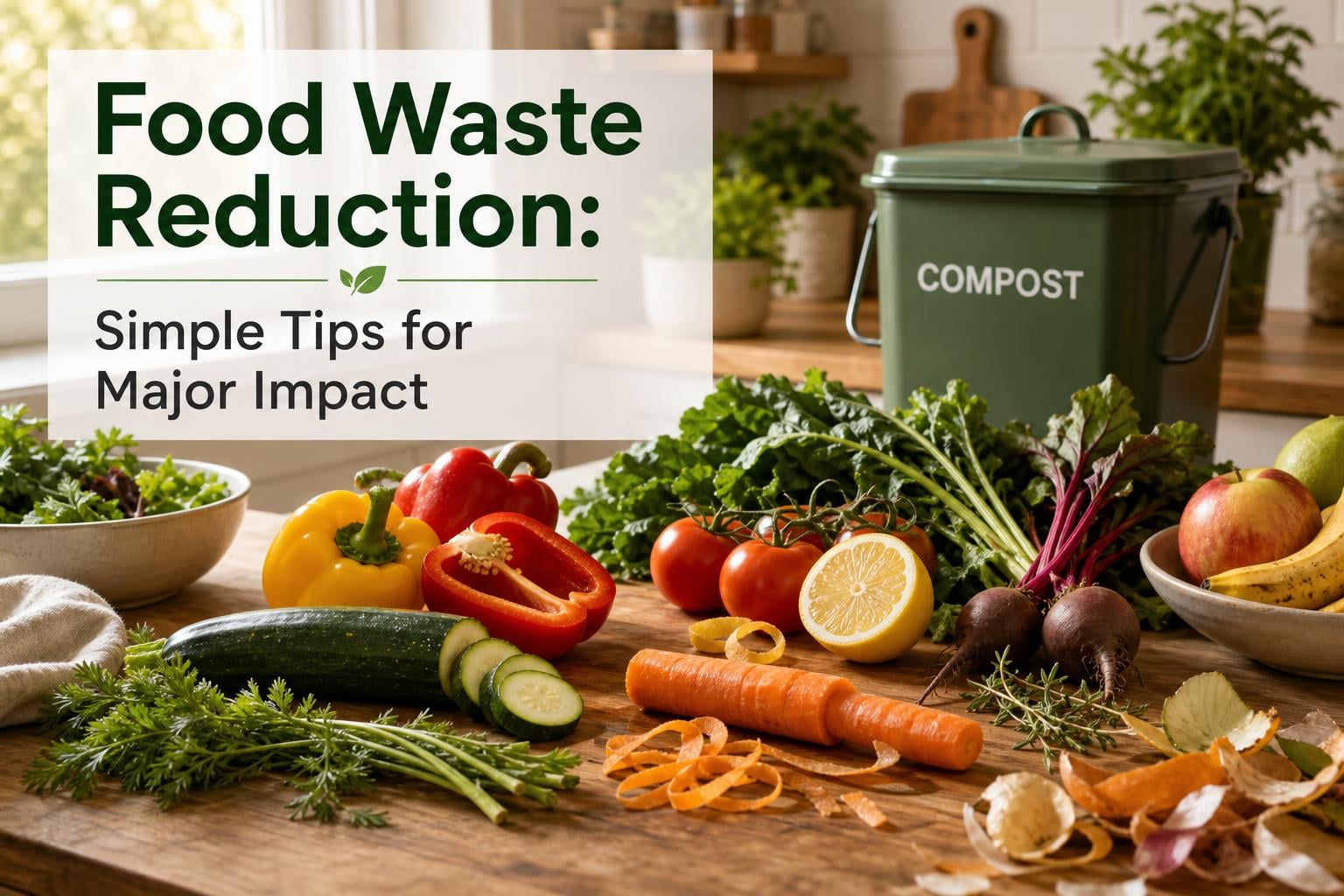
Every year, Americans throw away roughly one-third of all the food produced in this country. That amounts to a staggering financial loss for households and an enormous environmental burden that keeps growing. The average family of four loses an estimated $3,000 annually just from food that gets purchased but never eaten.
The United States set a national food waste reduction goal to cut wasted food in half by the year 2030, and reaching that target will require action from every part of the supply chain. Farms, grocery stores, restaurants, and individual households all have a role to play in this effort. Food waste reduction is not about perfectionism in the kitchen but rather about building practical habits that save money and protect natural resources.
Here is the reality: according to the EPA, approximately 96% of household wasted food ends up in landfills or combustion facilities rather than being composted or recovered. When food decomposes in a landfill, it releases methane, a greenhouse gas that is far more potent than carbon dioxide. This means that the food sitting in your trash bin is actively contributing to climate change.
In this guide, I will walk you through practical strategies for food waste reduction that anyone can start applying today. We will cover the root causes of food waste, how retailers and producers contribute, concrete consumer tips for a zero-waste kitchen, the environmental and financial costs of wasted food, and the community programs that are making a measurable difference.
What You Will Learn
Before we get into solutions, it helps to understand exactly how large the food waste problem has become. According to data from ReFED, a leading nonprofit focused on food waste reduction, the United States wastes approximately 38% of all the food it produces. That lost food represents over $400 billion in economic value annually.
The USDA and EPA jointly established a national goal in 2015 to reduce food waste by 50% by 2030. Progress has been slower than anticipated, which is why grassroots awareness and individual action have become even more important. Every household that changes its habits contributes to moving the needle closer to that national target.
What makes this issue especially frustrating is that while millions of tons of food are being thrown away, more than 44 million Americans face food insecurity. Organizations like Feeding America work tirelessly to rescue surplus food and redirect it to food banks and pantries, but the gap between available surplus and unmet need remains enormous. Food waste reduction is not just an environmental issue but a social justice issue as well.
Food loss happens long before a product reaches your grocery cart. Understanding where waste originates in the production and distribution chain is the first step toward building more effective food waste reduction strategies. When we identify the problem areas, we can support better practices and make informed purchasing decisions.
Food waste occurs at every stage of the supply chain, and the causes vary depending on where you look. At the agricultural level, USDA data shows that farmers sometimes leave entire fields unharvested because market prices fall too low to justify the cost of labor and transportation. Cosmetic standards imposed by retailers also force growers to discard perfectly nutritious produce simply because it has an unusual shape or minor blemish.
At the retail level, grocery stores face significant losses from overstocking, display requirements that encourage abundance, and consumer expectations of flawless produce. The Food Waste Reduction Alliance reports that retailers generate millions of tons of wasted food annually, though large chains have begun implementing donation programs and waste tracking systems to address the issue.
At the household level, which ReFED identifies as the largest single source of food waste in the United States, the main culprits include over-purchasing, poor storage practices, confusion over date labels, and cooking portions that are larger than needed. Forum discussions on communities like r/ZeroWaste reveal that many people genuinely want to reduce their waste but feel overwhelmed by the sheer number of changes they think they need to make.
Farmers and food producers are increasingly adopting technologies and practices that reduce losses before food ever reaches consumers. Precision agriculture tools help growers match planting to anticipated demand, reducing oversupply. Improved cold chain logistics, including better refrigeration during transport, prevent spoilage between the farm and the store.
Some producers have found success by partnering with organizations that specialize in imperfect produce. Companies like Misfits Market and Imperfect Foods buy cosmetically imperfect fruits and vegetables directly from farmers and sell them to consumers at reduced prices. This model keeps nutritious food in the supply chain while giving farmers an additional revenue stream for products that would otherwise go unsold.
Upcycled food products represent another growing trend in production-level food waste reduction. Manufacturers are now creating new food items from ingredients that would traditionally be discarded, such as snack bars made from spent grain, flour from imperfect produce, and broth from vegetable trimmings. The Upcycled Food Association certifies these products, giving consumers a way to support waste reduction through their purchasing decisions.
Investment in storage infrastructure also makes a significant difference. When farmers have access to proper grain silos, cold storage facilities, and drying equipment, they can extend the shelf life of their harvests and reduce post-harvest losses. Government grants and cost-sharing programs have helped many small and mid-sized farms invest in this equipment.
Related Reading: Composting Corn Cobs: Your Ultimate Eco-Guide
Grocery stores and supermarkets occupy a powerful position in the food supply chain. Their purchasing decisions, display strategies, and waste management practices directly influence how much food is lost between the farm and the consumer. Many major retailers have begun treating food waste reduction as a business priority rather than just a sustainability talking point.
Modern retailers are deploying several effective strategies to reduce the amount of food that ends up in their dumpsters. These approaches protect their bottom line while also keeping good food in circulation rather than heading to a landfill.
Some grocery chains have committed to ambitious public targets. Kroger’s Zero Hunger Zero Waste initiative and Walmart’s Project Gigaton are examples of corporate food waste reduction commitments that include measurable goals and public progress reporting. These programs show that large-scale food waste reduction is achievable when companies make it an operational priority.
Stores also have the ability to shape how their customers think about food and purchasing. By creating the right environment and incentives, retailers can steer shoppers toward habits that naturally reduce waste at home.
Forum users on r/ZeroWaste frequently mention that they appreciate stores which make it easy to buy small quantities and offer clear information about how to store food. Many community members report that their waste dropped significantly once their local store started carrying imperfect produce at lower prices.
Related Reading: 15 Paper Towel Usage Tips to Save Money and Environment
The kitchen is where most of us have the greatest direct control over how much food gets wasted. ReFED data shows that households are the single largest source of food waste in the United States, which also means that individual actions can add up to enormous collective impact. The following strategies are organized from planning through to storage and cooking.
Food waste reduction begins before you even enter the grocery store. Taking fifteen minutes to plan your meals for the week and check what you already have in your pantry and fridge prevents over-purchasing, which is one of the most common causes of household food waste.
Before heading to the store, write a shopping list based on your meal plan and stick to it. Many people on r/ZeroWaste and r/foodwaste report that the simple act of shopping from a list cut their household waste dramatically. Take a quick photo of your fridge and pantry shelves before you leave so you can reference what you already have while you shop.
Be realistic about how many meals you will actually cook at home during the week. If you eat out twice a week or have plans that involve leftovers from previous meals, account for that in your planning. Buying ingredients for seven home-cooked dinners when you will realistically only cook four is a guaranteed recipe for waste.
Tools like the SaveTheFood Guest-imator can help you calculate exactly how much food you need when cooking for groups, which is especially useful during holidays and gatherings when over-preparation leads to massive amounts of leftover food that often ends up in the trash.
A zero-waste kitchen is an ambitious but achievable goal when broken into manageable steps. The key is to build habits gradually rather than trying to overhaul everything at once. Here are the most effective strategies that home cooks around the world rely on to keep their food waste to a minimum.
Users across multiple Reddit communities report that keeping a visible inventory list on the fridge door is surprisingly effective. Seeing exactly what is inside prevents the common scenario of buying duplicates that end up spoiling. One popular strategy is dedicating one day per week as an “eat the fridge” day where meals are prepared exclusively from existing ingredients.
A truly zero-waste kitchen extends beyond food itself. Reducing single-use items and finding ways to reduce kitchen waste with smarter paper towel usage can save hundreds of dollars per year while complementing your food waste reduction efforts.
Proper food storage is one of the most impactful food waste reduction skills you can develop. The EPA provides detailed guidance on how to store different types of produce, and understanding the science behind food freshness can dramatically extend the life of your groceries.
First, check your refrigerator and freezer temperatures. The FDA recommends keeping your refrigerator at or below 40 degrees Fahrenheit and your freezer at 0 degrees Fahrenheit. Many people operate their fridges at warmer temperatures without realizing it, which causes food to spoil faster than it should.
Understanding crisper drawer settings is another game-changer for food waste reduction. Most refrigerators have adjustable humidity drawers, and using them correctly can add days or even weeks to the life of your produce.
Some foods should never go in the refrigerator at all. Tomatoes lose their flavor and develop a mealy texture when refrigerated. Potatoes should be stored in a cool, dark place but not in the fridge, where their starches convert to sugar. Onions and garlic prefer dry, ventilated storage. Bananas should stay on the counter. Keep onions and potatoes separated, as onions emit gases that cause potatoes to sprout.
For herbs, treat soft herbs like cilantro and parsley like flowers by placing their stems in a glass of water and covering them loosely with a plastic bag. Hard herbs like rosemary and thyme can be wrapped in a slightly damp paper towel and stored in an airtight container. These small adjustments add up to significantly less wasted produce over time.
Date label confusion is one of the most significant and easily fixable causes of food waste in American households. The FDA estimates that misunderstanding date labels accounts for approximately 20% of all consumer food waste. People throw away perfectly safe, edible food because they misinterpret what these dates actually mean.
The truth is that most food date labels have nothing to do with safety. They are manufacturer suggestions about when the product is at its peak quality. Here is what the most common labels actually mean.
The FDA has been pushing for standardized date labeling to reduce this confusion, and many manufacturers have voluntarily adopted the “Best if Used By” phrasing for quality dates and “Use By” for safety-relevant dates on perishable items. Understanding these distinctions is one of the simplest and most effective food waste reduction habits you can adopt.
When in doubt, trust your senses. If food looks, smells, and tastes normal, it is almost certainly safe to eat. The only exception is for high-risk items like deli meats and ready-to-eat foods where listeria can grow without obvious signs of spoilage. For those items, adhere strictly to the use-by date.
Technology has made food waste reduction easier and more accessible than ever. Several apps and digital tools are specifically designed to help households track, manage, and reduce the amount of food they waste.
Reddit communities consistently highlight Too Good To Go and Olio as genuinely useful tools. Users report that these apps have changed how they think about surplus food, turning what would have been waste into an opportunity for connection and savings.
Restaurants and food service establishments generate enormous amounts of waste, but consumers have more control over this than they might realize. The choices we make when eating out directly contribute to the scale of restaurant food waste.
When ordering, consider sharing large entrees or ordering appetizer portions if you know you typically cannot finish a full meal. American restaurant portions are notoriously large, and plate waste is a significant contributor to restaurant-level food loss. If you do end up with leftovers, ask for a container and take them home rather than leaving food on the plate.
When hosting events or dining with groups, coordinate portions so that food is not over-ordered. Many caterers now offer portions based on actual guest counts rather than inflated estimates. If you have surplus food after an event, consider donating it to a local food rescue organization that can distribute it to shelters and food banks.
Understanding basic food safety principles supports food waste reduction by preventing the unnecessary discard of food that is still safe to consume. One of the most important guidelines is the 2-Hour Rule, which states that perishable foods should not sit at room temperature for more than two hours. In hot weather above 90 degrees Fahrenheit, that window shrinks to just one hour.
This rule applies to leftovers, cooked foods, and items that require refrigeration. By promptly refrigerating or freezing leftovers within that two-hour window, you keep them safe to eat for days or weeks longer. Discarding food that has been left out too long is necessary for safety, so planning portion sizes and serving amounts carefully can prevent that situation from arising in the first place.
Related Reading: 20 Earth Day Tips for a Real Transformation Impact
When we waste food, we waste everything that went into producing it. The water, energy, land, labor, and financial resources invested in growing, processing, packaging, and transporting that food are lost along with it. The environmental impact of food waste extends far beyond the food itself ending up in a landfill.
According to the World Resources Institute, if food waste were a country, it would rank as the third largest greenhouse gas emitter in the world, behind only China and the United States. Approximately 8% of all global greenhouse gas emissions are attributable to food waste. This staggering figure highlights why food waste reduction is recognized as one of the most effective individual actions for fighting climate change.
Food waste is the single most common material in American landfills, according to the EPA. When organic matter decomposes in the anaerobic environment of a landfill, it produces methane, a greenhouse gas that traps heat in the atmosphere at a rate roughly 28 to 36 times more powerful than carbon dioxide over a 100-year period. Landfills are the third-largest source of human-related methane emissions in the United States.
Every time food waste reduction keeps organic material out of a landfill, it prevents that methane from entering the atmosphere. Composting offers a powerful alternative because the aerobic decomposition process produces far less methane than landfill burial. Many municipalities and states have begun implementing organic waste bans that prohibit large generators from sending food waste to landfills, which forces diversion to composting and anaerobic digestion facilities.
Food waste reduction also addresses emissions on the production side. When less food is wasted, there is less pressure to produce surplus food to compensate for losses, which means fewer greenhouse gas emissions from farming, transportation, and processing. The reduction of methane emissions from landfills combined with avoided production emissions makes food waste reduction one of the highest-impact climate actions available to households.
The water footprint of wasted food is enormous and often overlooked. According to the World Resources Institute, growing a single apple requires approximately 33 gallons of water. Producing one pound of beef requires roughly 1,800 gallons. When that food is wasted, all of the water that went into producing it is wasted as well.
Globally, the water used to produce wasted food equals approximately three times the volume of Lake Geneva. That is an almost incomprehensible volume of a resource that is becoming increasingly scarce in many parts of the world. Food waste reduction is directly tied to water conservation in ways that most people never consider when they throw away leftovers.
Energy resources are similarly squandered. The fuel for tractors, electricity for processing facilities, diesel for delivery trucks, and power for refrigeration in stores and homes all go to waste when food is discarded. By reducing waste at the household level, consumers reduce the total demand on these energy systems, contributing to lower fossil fuel consumption and reduced carbon emissions across the entire supply chain.
Land use is another critical consideration. Farming already uses approximately half of the world’s habitable land. When we waste food, we are essentially wasting the productive capacity of that land. Reducing food waste means we can meet human nutritional needs with less agricultural expansion, preserving natural habitats and protecting biodiversity in the process.
Related Reading: DIY Face Masks: Your Guide to Eco-Friendly Creations
Composting is the final and most important step in the food waste hierarchy after prevention and donation. When you cannot prevent food waste or share it with others, composting keeps organic material out of landfills and transforms it into a valuable soil amendment. The EPA identifies composting as a critical landfill diversion strategy that reduces methane emissions while creating a useful product for gardens and agriculture.
Starting a compost system is easier than many people assume, and it works even in small spaces. If you have a backyard, you can build a simple compost bin or purchase a tumbler composter. Layer green materials like fruit and vegetable scraps, coffee grounds, and grass clippings with brown materials like dried leaves, paper, and cardboard. Keep the pile moist and turn it every few weeks to introduce oxygen that supports aerobic decomposition.
For apartment dwellers, indoor composting options have expanded significantly. Bokashi systems use fermentation to break down food waste in an airtight bucket that fits under a sink. Vermicomposting uses red wiggler worms to process food scraps in a compact bin. Electric composters like the Lomi and FoodCycler can process food scraps into dry compost material in hours without any outdoor space required. If none of these options works for you, check whether your city offers municipal composting pickup or drop-off locations.
Many kitchen scraps can be composted effectively, including vegetable peels, fruit scraps, coffee grounds, eggshells, and tea bags. You can even tackle composting food scraps like corn cobs and other fibrous vegetable waste that might otherwise end up in the trash. For those wondering about animal products, specialized methods allow for composting specific foods like cheese, though most home composters stick to plant-based materials.
If you are new to composting, our beginner’s guide to starting a compost pile walks you through everything you need to know. Reddit users who have successfully integrated composting into their routines consistently report that it transformed their awareness of how much food waste their household actually generates.
Individual actions are powerful, but collective efforts multiply the impact. Communities that organize around food waste reduction can redirect tons of food from landfills to people who need it, build local composting infrastructure, and create educational programs that change long-term behavior. The most successful initiatives combine grassroots energy with institutional support.
Community composting programs have emerged as one of the most effective models for neighborhood-level food waste reduction. These programs collect kitchen scraps from participating households, process them at a central location, and distribute the finished compost to community gardens, urban farms, or back to participants. This closed-loop system keeps organic material local and builds neighborhood connections around sustainability.
Food rescue organizations represent another powerful grassroots model. Groups like City Harvest in New York, DC Central Kitchen in Washington, and local food recovery councils across the country pick up surplus food from restaurants, grocery stores, and institutions and deliver it to shelters, food pantries, and meal programs. Volunteers are the backbone of these operations, and many programs welcome new participants on a flexible schedule.
Local awareness campaigns also play an important role. Workshops, cooking demonstrations, and school programs that teach food waste reduction skills create lasting behavior change. Community members who share tips through flyers, social media, or neighborhood groups help normalize waste reduction as an everyday practice rather than an extreme lifestyle choice. Reducing food waste is one of the most impactful Earth Day tips for environmental impact that individuals and groups can adopt.
Government policy has begun to catch up with the scale of the food waste problem, though progress varies significantly between countries and levels of government. Several pieces of real legislation and government programs are shaping how the United States approaches food waste reduction.
The USDA and EPA jointly launched the U.S. Food Loss and Waste 2030 Champions program, which encourages businesses and organizations to commit to a 50% reduction in food waste by the year 2030. Participating companies establish baselines, set targets, and report on their progress, creating accountability and transparency in the private sector.
The Food Date Labeling Act, introduced in Congress, aims to standardize date labeling practices across the country. If passed, it would require manufacturers to use only two labels: “Best if Used By” for quality and “Use By” for safety. This standardization would directly address the confusion that causes approximately 20% of consumer food waste.
Several states have taken matters into their own hands. California, Vermont, Massachusetts, Connecticut, and New York have implemented organic waste bans or mandatory recycling laws that require large generators of food waste to divert it from landfills. These policies have created new infrastructure for composting and anaerobic digestion while driving food waste reduction at scale.
The Bill Emerson Good Samaritan Food Donation Act provides liability protection for businesses and individuals who donate food in good faith, removing a major barrier that previously discouraged restaurants and stores from donating surplus food. This federal law has been essential in enabling the growth of food rescue and donation programs nationwide.
Government-funded research and grant programs continue to advance food waste reduction. The USDA and EPA support projects that improve cold chain technology, develop new packaging that extends shelf life, and pilot innovative food recovery models. These investments accelerate the development of practical solutions that can be adopted by households, businesses, and communities.
Start by planning your meals for the week before shopping, writing a detailed grocery list, and checking your fridge and pantry before heading to the store. Store produce properly using the right crisper drawer settings, freeze items before they spoil, and commit to using leftovers within three days. Conducting a quick weekly waste audit by noting what you throw away helps you identify patterns and adjust your habits.
When food decomposes in landfills it releases methane, a greenhouse gas 28 to 36 times more potent than carbon dioxide. Food waste accounts for approximately 8% of global greenhouse gas emissions, making it one of the most significant individual contributors to climate change. Reducing food waste also prevents the wasted water, energy, and land resources that went into producing that food.
Fruits and vegetables are the most commonly wasted food categories in American households, followed by dairy products and bread. To reduce waste, freeze overripe fruit for smoothies, turn wilting vegetables into soups or stews, and use stale bread for croutons or breadcrumbs. Proper storage in the correct crisper drawer and understanding ethylene gas interactions can significantly extend the life of fresh produce.
Yes, several apps directly support food waste reduction. The USDA FoodKeeper App provides storage guidance and shelf-life information for hundreds of foods. Too Good To Go connects users with surplus restaurant and bakery food at discounts. Olio enables neighbors to share surplus food with each other. Flashfood offers discounted near-expiry grocery items, and SaveTheFood.com provides planning tools like the Guest-imator.
Absolutely. Households are the single largest source of food waste in the United States, generating more wasted food than farms, manufacturers, or retailers. When millions of households each reduce their waste by even a small percentage through better planning, storage, and cooking habits, the combined impact is enormous. Individual actions directly contribute to the national goal of reducing food waste by 50% by 2030.
Best if Used By dates indicate when a product is at its peak quality, not when it becomes unsafe. Sell By dates are for retailer inventory management. Use By dates relate to food quality except on infant formula where they indicate safety. Most foods can be safely consumed well past their quality dates if they have been stored properly and show no signs of spoilage. Misunderstanding date labels causes approximately 20% of consumer food waste.
Food waste reduction is one of the most accessible and high-impact actions any household can take for the environment and their wallet. The strategies in this guide, from smarter meal planning to proper produce storage to composting food scraps, are proven approaches that add up to meaningful change when adopted consistently.
You do not need to implement every suggestion at once. Start with one or two habits, such as writing a shopping list and freezing leftovers promptly, and build from there. Every meal you finish, every item you rescue from the trash, and every neighbor you share surplus food with contributes to the national food waste reduction goal of cutting waste in half by 2030.
Key Takeaways
