

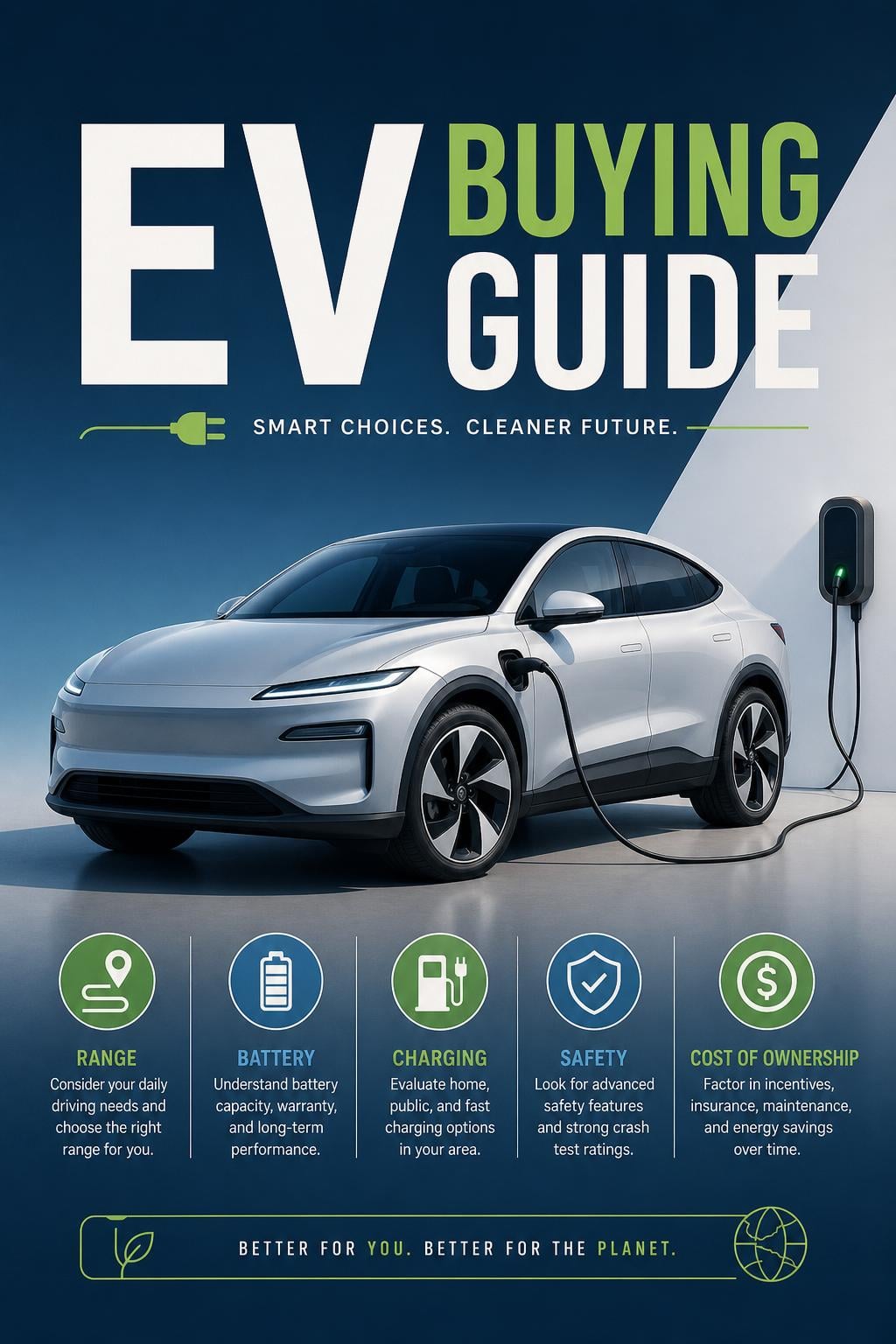
If you are reading this EV buying guide, chances are you have noticed how many electric vehicles are on the road these days. The market has shifted dramatically since 2026, with more models, better technology, and a charging infrastructure that looks nothing like it did just a couple of years ago.
According to BloombergNEF data, global EV sales reached approximately 22 million units, representing 25 percent growth from the prior year. China accounts for roughly two-thirds of those sales, while the United States sits at around 7 percent of the global total. Those numbers tell a clear story: electric vehicles are no longer a niche experiment but a mainstream transportation choice worldwide.
But buying an EV in 2026 comes with a different set of considerations than it did even two years ago. The federal tax credit that once knocked thousands off the purchase price has expired. New charging standards have emerged. Battery ranges have climbed past 300 miles on many models. And insurance, maintenance, and depreciation all play into the real cost of ownership in ways that might surprise you.
This guide walks you through every angle of the decision, from range and charging to costs, incentives, insurance, and whether to buy new, used, or lease. Whether you are a first-time EV buyer or someone who has been watching the market and waiting for the right moment, the goal here is to give you the clearest, most honest picture possible.
What you will find in this guide:
The case for going electric has never been stronger, even with the changing incentive landscape. The average transaction price for an EV sits around $57,245 according to KBB data, compared to $49,077 for the overall new car market. That gap has narrowed considerably as manufacturers scale production and battery costs continue falling.
What has really changed is the variety. You can now find everything from budget-friendly options like the Chevy Equinox EV in the mid-$30,000 range to the redesigned Nissan Leaf, the Hyundai Ioniq 5, the Kia EV4, and the Tesla Model 3 and Model Y that dominate sales charts. Three hundred miles of range used to be a luxury feature. Now it is becoming the baseline expectation for new models.
Electric vehicles produce zero tailpipe emissions, which means no exhaust pipe pumping carbon monoxide, nitrogen oxides, or particulate matter into the air. For city dwellers, this translates directly into cleaner air and reduced smog levels. The environmental benefit is immediate and measurable in dense urban areas where vehicle emissions concentrate.
EVs also pair naturally with renewable energy. If you charge your vehicle using electricity from solar panels or wind power, the carbon footprint of driving drops dramatically compared to burning gasoline. Many EV owners who also install home solar find that their effective fuel cost approaches zero over time.
There is also the noise factor. Electric motors are nearly silent at low speeds, which reduces noise pollution in residential areas and dense city centers. This might seem minor, but studies have linked chronic traffic noise to stress, sleep disruption, and cardiovascular issues. Quieter streets are a genuine quality-of-life improvement.
That said, it pays to be a critical consumer. Not every environmental claim from automakers holds up to scrutiny. If you want to evaluate whether a manufacturer’s green credentials are genuine or just marketing spin, it helps to understand how to spot greenwashing in EV marketing claims before committing to a purchase.
The shift from gasoline to electric feels similar to the transition from flip phones to smartphones. Once a technology reaches a tipping point of adoption, infrastructure investment accelerates, costs come down, and the old way of doing things starts to feel outdated. That is where we are with EVs in 2026.
Regenerative braking, once a novel feature, is now standard across essentially every electric vehicle. Home charging while you sleep has become a routine part of ownership for those with a garage or driveway. Battery prices have fallen roughly 90 percent over the past decade, and automakers have committed hundreds of billions of dollars to electrification through the end of this decade.
Even the charging landscape has transformed. The adoption of the NACS connector (North American Charging Standard) by virtually every major automaker means that Tesla’s extensive Supercharger network, with over 75,000 stalls globally, is increasingly accessible to non-Tesla EVs. This was the single biggest infrastructure development of the past two years and it changes the practical calculus for anyone considering an EV.
For a broader look at how electric vehicles fit into a sustainable lifestyle, our comprehensive guide to going green covers additional eco-friendly choices you can make alongside your vehicle purchase.
Range anxiety is the fear that your battery will die before you reach a charger, and it remains one of the top concerns for first-time EV buyers. But the reality is that most drivers dramatically overestimate how much range they actually need on a daily basis.
The EPA range estimate is the number you will see on a vehicle’s window sticker and in marketing materials. It represents the distance the car can travel on a full charge under standardized testing conditions. Real-world range typically runs 20 to 30 percent lower than the EPA number, especially in cold weather, at highway speeds, or when running the climate control heavily.
Several factors eat into your actual driving range. Speed is the biggest one: aerodynamic drag increases exponentially above 60 mph, so sustained highway speeds will deplete your battery noticeably faster than city driving. Temperature plays a major role as well. Cold weather can reduce range by 30 to 40 percent, particularly in vehicles without a heat pump. Hot weather takes a smaller toll but still requires energy for battery cooling and cabin air conditioning.
Rather than chasing the highest range number available, it is far more useful to match your vehicle’s range to your actual driving patterns. Here is a practical breakdown based on common driver profiles:
The key insight from experienced EV owners on Reddit and other forums is consistent: if you can charge at home, your daily range needs drop dramatically. Home charging means you start each day with a full battery, so you only need enough range to cover your longest typical day plus a safety margin.
For those who cannot charge at home, such as apartment dwellers, the calculation changes. Without reliable overnight charging, you will want a longer range vehicle and will need to plan around public charging, which adds cost and inconvenience. Many forum users consider the inability to charge at home to be the number one dealbreaker for EV ownership.
Charging is the part of EV ownership that requires the biggest mental shift compared to a gas car. Instead of visiting a fuel station weekly, you plug in at home, at work, or at public chargers as needed. Understanding the charging landscape is essential for anyone using this EV buying guide.
EV charging happens at three distinct power levels, each with different speeds, costs, and use cases:
One important note: DC fast charging slows dramatically after 80 percent state of charge. This is by design, to protect the battery. That final 20 percent can take as long as the first 80 percent, which is why most EV drivers on road trips unplug at 80 percent and move on.
The biggest charging development of the past two years is the industry-wide adoption of the NACS connector, which is the charging plug originally designed by Tesla and now formally known as the North American Charging Standard. Nearly every major automaker, including Ford, General Motors, Hyundai, Kia, BMW, Mercedes, and others, has committed to equipping new vehicles with the NACS port or providing adapters.
This matters because Tesla’s Supercharger network is widely regarded as the most reliable, fastest, and best-distributed charging network in the country. With over 75,000 stalls globally, Superchargers are located along major highways and in urban centers with consistent uptime and integrated payment through the Tesla app. For non-Tesla EVs with NACS access, this removes one of the biggest historical barriers to EV adoption: unreliable public charging.
If you are buying a used EV with the older CCS (Combined Charging System) connector, adapters are available to access the Supercharger network. But if you are buying new in 2026, most vehicles now come with NACS natively, which simplifies the entire charging experience.
Beyond Tesla Superchargers, several major networks provide public charging across the country:
Most EV owners download several of these apps before their first road trip. Each network has its own account and payment system, though some vehicles and charging networks now support plug-and-charge, which automatically handles payment when you plug in.
For most EV owners, home charging is where the real convenience and savings happen. Plugging in overnight means you wake up to a full battery every morning without ever visiting a fuel station or public charger.
A Level 2 home charger installation involves mounting a charging unit on a wall or pedestal and running a dedicated 240V circuit from your electrical panel. Total installation costs range from about $200 if your panel is close to the charging location and already has capacity, up to $2,000 or more if you need a panel upgrade or a long wire run. Many utility companies offer rebates that can offset a significant portion of this cost.
If you are setting up home charging, it is also an excellent time to think about your broader home energy setup. Consider making your home EV-ready and eco-friendly by upgrading insulation, installing smart energy management, or planning for future solar integration.
One of the most impactful things you can do for charging cost savings is to sign up for a Time of Use (TOU) electricity plan through your utility. These plans charge significantly less for electricity during off-peak hours, typically overnight. Many EV owners report cutting their effective charging cost by 50 percent or more simply by scheduling charging for midnight to 6 AM.
How long it takes to charge your EV depends on the battery size, how depleted it is, and the power level of the charger you are using. Here is a practical breakdown:
Battery size plays a role too. A larger battery pack takes longer to fill, but it also means you need to charge less often. Temperature affects charging speed as well: extreme cold slows down DC fast charging because the battery needs to warm up before it can accept maximum power. Many modern EVs include battery preconditioning, which warms the battery en route to a fast charger to minimize this delay.
Planning your charging around these realities is the same as planning fuel stops for a gas car, just with different timing. Most EV owners find that after a few weeks, charging becomes a background habit rather than a conscious effort.
The sticker price of an EV is only part of the financial picture. To understand what an electric vehicle actually costs to own, you need to look at total cost of ownership (TCO), which includes purchase price, fuel or charging costs, maintenance, insurance, and depreciation.
Let us start with the purchase price. The average EV transaction price sits at approximately $57,245 according to KBB data, compared to $49,077 for the average new car across all categories. That is a gap of roughly $8,000. However, this gap narrows considerably when you look at specific segments. Mass-market EVs like the Chevy Equinox EV and Kia EV4 are priced in the mid-$30,000 to high-$30,000 range, which is directly competitive with comparable gas SUVs.
Charging an EV at home is significantly cheaper than buying gasoline for a comparable vehicle. The average cost of electricity in the United States is about 16 cents per kilowatt-hour (kWh), though this varies widely by region. An EV typically consumes about 3 to 4 miles per kWh, meaning home charging costs roughly 4 to 5 cents per mile.
A gas car averaging 30 mpg with fuel at $3.50 per gallon costs about 12 cents per mile. Over 15,000 miles per year, that is a difference of approximately $1,200 annually in fuel savings for the EV owner. With off-peak electricity rates, the savings can be even greater.
Public DC fast charging is more expensive per kWh than home charging, often ranging from 40 to 60 cents per kWh depending on the network and location. If you rely exclusively on public fast charging, your fuel savings shrink considerably. This is why forum users consistently emphasize that home charging access is the single most important factor in EV cost savings.
For even greater savings, consider pairing your EV with home solar panels to charge with clean, renewable energy at a fraction of grid electricity costs over the long term.
When you factor in purchase price, fuel savings, maintenance, insurance, and depreciation, the crossover point where an EV becomes cheaper than a comparable gas car is approximately six years for the average driver, according to industry analysis. After that point, the EV continues to pull ahead as fuel and maintenance savings accumulate.
Depreciation is a mixed bag for EVs. Early-generation electric vehicles have experienced steeper depreciation than gas cars, which is bad news for original owners but great news for used EV buyers. As the used EV market matures and more off-lease vehicles become available, depreciation rates are beginning to stabilize. Still, if you are buying new and planning to sell within three to four years, expect the EV to lose a higher percentage of its value than a comparable gas vehicle.
Here is a quick comparison of estimated five-year costs for an EV versus a comparable gas vehicle:
As you can see, the EV’s higher purchase price and insurance costs are nearly offset by fuel and maintenance savings within five years. The longer you keep the vehicle, the more favorable the math becomes for electric.
One of the most pleasant surprises for new EV owners is how little maintenance these vehicles require. Electric motors have a fraction of the moving parts found in an internal combustion engine, which means fewer things that can break, wear out, or need servicing.
Industry estimates put EV maintenance costs at 40 to 50 percent lower than comparable gas vehicles. Here is what you can expect to skip entirely: oil changes, spark plug replacement, timing belt service, transmission fluid changes, and exhaust system repairs. Even brake pads last longer thanks to regenerative braking, which uses the motor to slow the car and sends energy back to the battery, dramatically reducing wear on physical brake components.
What you will still need to maintain includes tires, cabin air filters, wiper blades, brake fluid, and coolant (for battery thermal management in most EVs). Tire wear can actually be slightly faster on EVs because they are heavier than comparable gas cars due to the battery pack, and because electric motors deliver instant torque. Budget for tire replacements a bit more frequently than you might be used to.
The battery pack is the most expensive single component in an EV, and it is also the one that causes the most anxiety for buyers. The good news is that federal regulations require automakers to warranty EV batteries for at least 8 years or 100,000 miles, whichever comes first. Many manufacturers go beyond this minimum.
Battery degradation is a natural process where the battery gradually loses capacity over time and charging cycles. Most modern EV batteries retain 80 to 90 percent of their original capacity after 100,000 miles, which means a vehicle that started with 300 miles of range might have 240 to 270 miles after a decade of use. This is a manageable reduction for most drivers.
If you are shopping for a used EV, battery health should be your top inspection priority. Some manufacturers provide battery health reports through their mobile apps or dealership service departments. Third-party diagnostic tools are also available. Avoid used EVs whose batteries have degraded below 80 percent of original capacity unless the price reflects it.
Following the 80 percent charging rule helps preserve battery health over the long term. For daily use, charge only to 80 percent and reserve full 100 percent charging for road trips or when you genuinely need maximum range. DC fast charging also contributes to faster degradation, so rely on Level 2 home charging for daily needs and save fast charging for travel.
Let us break down how electric and gasoline vehicles compare across the categories that matter most to buyers.
Electric vehicles deliver power differently from gas cars. An electric motor produces maximum torque instantly, from zero RPM, which means acceleration is immediate and smooth. There is no waiting for the engine to rev up and no transmission to shift through gears. For most drivers, this translates to a more responsive and enjoyable driving experience, particularly in city traffic and during merging or passing on highways.
Gasoline cars have their own appeal, particularly for driving enthusiasts who enjoy the sound, feel, and mechanical engagement of an engine. But for everyday commuting and family transportation, the smooth, quiet, and responsive nature of electric drive is hard to beat.
EVs typically cost more upfront than comparable gas vehicles, though the gap is closing. Mass-market EVs in the $35,000 to $45,000 range are now competitive with similarly equipped gas cars. Luxury EVs remain more expensive than their gas counterparts, but they also tend to include more standard technology and features.
Electric vehicles win decisively on fuel and maintenance costs. Home charging at off-peak rates costs roughly a third as much per mile as gasoline. Maintenance is 40 to 50 percent cheaper over the life of the vehicle. However, EVs typically cost more to insure due to higher repair costs and specialized components.
For owners with home charging, an EV is actually more convenient than a gas car. You plug in at home and wake up to a full battery. No detours to gas stations, no standing in the cold pumping fuel. On road trips, charging takes longer than refueling, adding 20 to 40 minutes per stop. But most EV owners use that time to eat, rest, or use facilities, so it feels less like an inconvenience and more like a planned break.
The bottom line is that for drivers who can charge at home and whose daily driving fits within the vehicle’s real-world range, an EV offers a superior ownership experience with lower long-term costs. For those who cannot charge at home, drive very long distances regularly, or need maximum towing capacity, a gas or hybrid vehicle may still be the better choice.
The incentive landscape for electric vehicles has changed significantly. If you have read older EV buying guides mentioning a generous federal tax credit, that information is now outdated.
The federal EV tax credit of up to $7,500 expired on September 30, 2025, under the One Big Beautiful Bill Act. This credit is no longer available for new EV purchases. If you encounter any resource that still references this credit as active, that information is incorrect. Buyers in 2026 must factor the full purchase price into their budget without counting on federal tax relief.
A federal tax credit for home charging equipment installation is still available but is set to expire June 30, 2026. This credit covers 30 percent of the cost of charging equipment and installation, up to $1,000. If you are planning to install a Level 2 home charger, take advantage of this credit before it sunsets.
Even with the federal credit gone, many states, cities, and utility companies continue to offer EV incentives. These vary widely by location but can include:
Always check current programs in your specific state and utility territory before finalizing your purchase, as these incentives change frequently and some have income limits or vehicle eligibility requirements.
One of the biggest decisions you will face is whether to buy or lease your electric vehicle. This is a particularly important question for EVs because the technology is evolving so rapidly that a car purchased today may feel dated in three years.
Leasing is frequently recommended for first-time EV buyers, and the reasoning is sound. A two or three-year lease lets you experience EV ownership without committing to a vehicle that might have significantly less range, slower charging, or fewer features than models released a year or two later. Battery degradation is also less of a concern with a lease since you return the car before significant aging occurs.
Leasing companies can sometimes pass through manufacturer incentives that are not available to buyers, which can result in surprisingly low monthly payments. Forum users frequently report zero-down lease deals on popular EVs that make leasing significantly cheaper on a monthly basis than financing a purchase.
The main downside of leasing is that you build no equity. At the end of the lease, you return the vehicle and walk away with nothing. If you tend to keep vehicles for seven to ten years and want to minimize lifetime ownership costs, buying is likely the better financial choice.
Buying makes sense if you plan to keep the vehicle long-term, want to modify it, drive more miles than lease limits allow, or simply prefer to own your cars outright. Once an EV is paid off, the low maintenance and fuel costs make it an exceptionally economical vehicle to run for years. Many owners report that their only routine expenses are tires, wiper fluid, and cabin air filters.
Insurance is one area where EVs can cost more than comparable gas vehicles, and it catches many buyers by surprise. On average, EV insurance premiums run 15 to 25 percent higher than coverage for similar gas cars, though the exact difference depends on the model, your location, and your driving record.
The higher cost comes down to repair expenses. EVs use specialized components, particularly battery packs and advanced driver assistance sensors, that are expensive to replace after an accident. A minor fender-bender that would cost $2,000 to fix on a gas car might cost $5,000 or more on an EV if sensors or battery components are involved. Fewer shops are certified to work on EVs, which can also drive up labor costs.
To manage insurance costs, shop around and get quotes from multiple providers before buying. Some insurance companies offer EV-specific discounts or policies that account for the lower overall repair frequency of electric vehicles. Also consider that as more EVs hit the road and repair networks expand, insurance pricing should become more competitive over time.
Not all EVs are created equal. Beyond range and price, several advanced features can significantly affect your ownership experience, and some are worth specifically shopping for.
A heat pump is one of the most valuable features for EV owners in cold climates. Traditional EVs use resistive heating, which draws significant power from the battery and can reduce winter range by 30 to 40 percent. A heat pump works more like a reverse air conditioner, moving existing heat into the cabin far more efficiently. Vehicles with heat pumps typically lose only 15 to 20 percent of range in cold weather, a meaningful difference if you live somewhere with harsh winters.
Bi-directional charging allows your EV to send power back out rather than only receiving it. There are three levels of this technology:
Not every EV supports bi-directional charging, so check specifications carefully if this feature matters to you. The Hyundai Ioniq 5, Kia EV6, and Ford F-150 Lightning are among the models known for strong V2L capabilities.
Battery preconditioning warms or cools the battery pack to its ideal operating temperature before you start driving or arrive at a DC fast charger. This feature is especially valuable in cold weather, where a cold battery accepts charge much more slowly. Vehicles with navigation-based preconditioning automatically prepare the battery when you navigate to a fast charger, saving you significant time on road trips.
Cabin preconditioning is also worth having. This lets you heat or cool the interior while the vehicle is still plugged in at home, drawing power from the grid rather than the battery. You step into a comfortable car without sacrificing range.
Over-the-air updates allow the manufacturer to improve your vehicle remotely, adding features, fixing bugs, and enhancing performance without a visit to the service center. Tesla pioneered this approach, but most major manufacturers now support OTA updates to varying degrees. Vehicles with robust OTA capability tend to improve over time, which adds long-term value to your purchase.
Modern EVs frequently come equipped with advanced driver assistance features that were luxury options just a few years ago. Look for adaptive cruise control, lane keeping assist, automatic emergency braking, blind spot monitoring, and rear cross-traffic alert. Some EVs offer more advanced features like hands-free highway driving or automated parking. These systems reduce driver fatigue on long trips and add an extra layer of safety.
Choosing between a new and used electric vehicle involves different considerations than the same decision for a gas car. The rapid pace of EV technology advancement means newer models generally offer meaningful improvements in range, charging speed, and features.
When upgrading to an electric vehicle, consider responsibly recycling your old gas car rather than leaving it to deteriorate. Proper recycling ensures that valuable metals and components are recovered and that hazardous materials are disposed of safely.
Finding the right EV is about matching the vehicle to your actual life, not just picking the one with the best specs on paper. Here are the key questions to ask yourself before making a decision:
Answering these questions honestly before you start shopping will save you time and help you avoid overpaying for features or range you do not actually need.
Before you sign anything, make sure you have checked these items:
Yes, 2026 is a strong time to buy an EV. You have more model choices than ever, 300+ mile ranges are becoming standard, and the NACS connector gives most new EVs access to Tesla’s reliable Supercharger network. The trade-off is that the federal tax credit has expired, so factor the full purchase price into your budget. Used EVs from off-lease are also hitting the market at attractive prices as early models depreciate.
The 80% rule means charging your EV to 80% of full capacity for daily driving rather than 100%. This preserves long-term battery health because lithium-ion batteries experience less stress at moderate charge levels. Reserve 100% charging for road trips or days when you need maximum range. DC fast chargers also naturally slow down after 80%, so stopping there saves time on travel days.
Avoid early-generation EVs with sub-150 mile ranges, models with DC fast charging under 100 kW, and used vehicles with batteries degraded below 80% capacity. Also be cautious with brands that have limited service networks or uncertain long-term support. Research reliability ratings and check that replacement parts are readily available before committing to any EV purchase.
The most common insights from experienced owners are: home charging is essential and changes the entire ownership experience, real-world range drops 20-30% in cold weather, insurance costs run higher than expected, DC fast charging on road trips costs significantly more than home charging, off-peak electricity rates make a big difference in monthly costs, and maintenance is genuinely cheaper with fewer surprises.
Charging time depends on the charger type. Level 1 (standard outlet) takes 24+ hours for a full charge. Level 2 (240V home or public) takes 4 to 10 hours for most EVs. DC fast charging at 150+ kW can reach 80% in about 30 minutes, with the remaining 20% taking considerably longer. Most owners use Level 2 overnight and DC fast charging only on road trips.
Yes. With the industry-wide adoption of the NACS connector, most major automakers now have access to the Tesla Supercharger network. Newer vehicles come with a NACS port built in. Older EVs with CCS connectors can use adapters. Tesla has opened many Supercharger locations to non-Tesla vehicles through the Tesla app, which handles payment and stall availability.
Yes, most EV owners save on fuel and maintenance. Home charging costs roughly 4 to 5 cents per mile compared to about 12 cents per mile for a gas car averaging 30 mpg. Maintenance runs 40 to 50% lower. However, higher purchase prices and insurance premiums offset some of those savings. The total cost of ownership crossover point is typically around six years for the average driver.
Many experts recommend leasing for first-time EV buyers because the technology evolves rapidly, battery improvements come each model year, and leasing eliminates concerns about battery degradation and resale value. Leasing can also offer lower monthly payments when manufacturers pass through incentives. Buying makes more sense if you plan to keep the vehicle long-term and want to benefit from years of low running costs after the loan is paid off.
Making the switch to an electric vehicle is one of the most impactful decisions you can make for both your transportation costs and your environmental footprint. This EV buying guide has walked through the major factors you need to weigh: range matching your real driving habits, charging options from home Level 2 to DC fast charging and the NACS revolution, the true costs of ownership including insurance and depreciation, and the advanced features that separate a good EV from a great one.
The landscape in 2026 is different from even a year ago. The federal tax credit has expired, but state and local incentives plus the home charger credit can still reduce your costs. Charging infrastructure is more reliable and accessible than ever thanks to NACS adoption and the opening of the Tesla Supercharger network. Vehicle ranges are longer, prices on mass-market models are competitive with gas cars, and the used EV market offers genuine value for savvy shoppers.
If there is one takeaway from this guide, it is that the right EV for you depends entirely on your specific situation. How far you drive, whether you can charge at home, your budget, and your tolerance for new technology all shape the decision. Take the time to answer those questions honestly, test drive several models, and you will find an electric vehicle that fits your life and saves you money for years to come.
An electric vehicle is also just one part of a broader sustainable lifestyle. For more ways to reduce your environmental impact at home and beyond, check out our comprehensive guide to going green for practical, actionable eco-friendly tips.
