
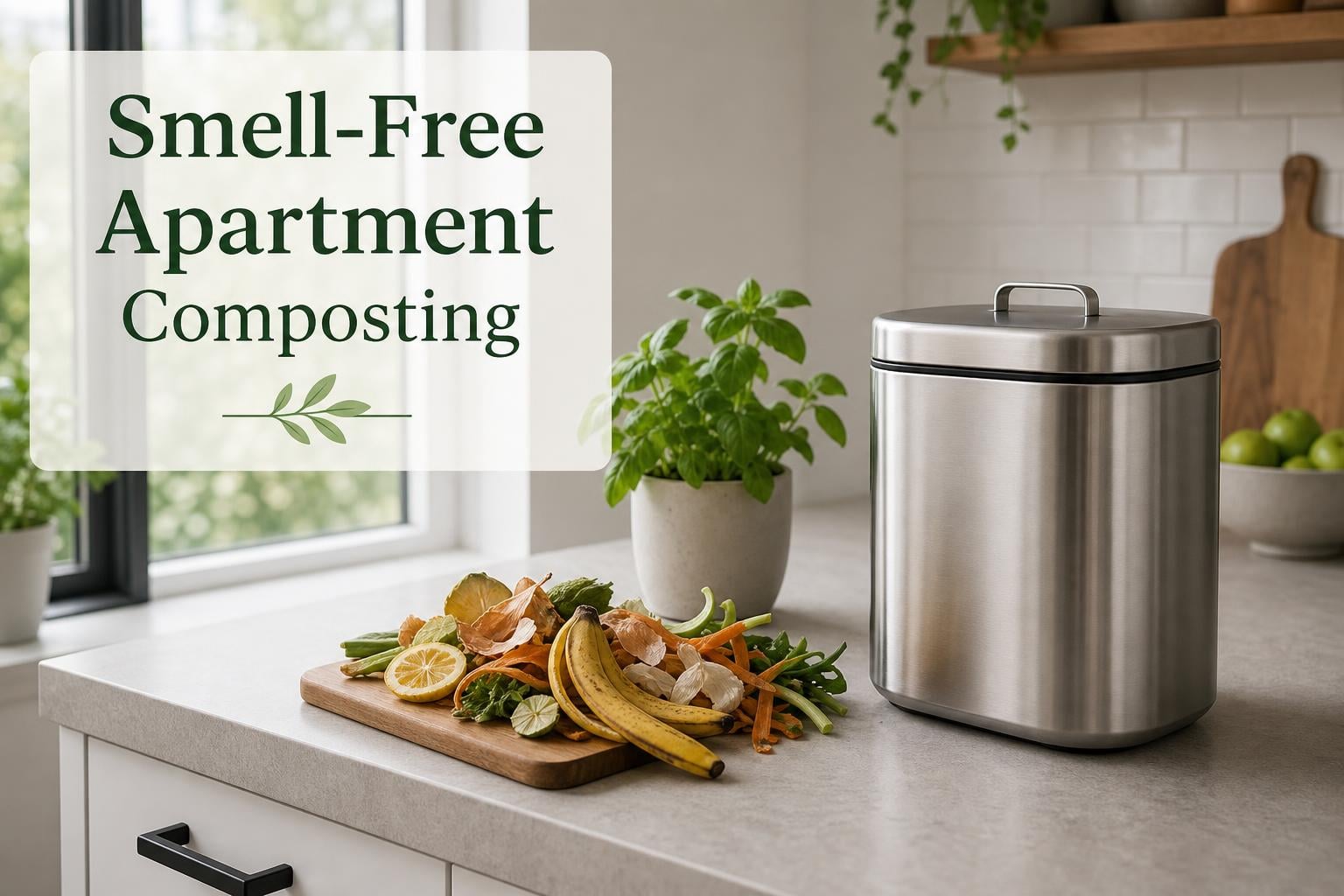
If you live in an apartment, you have probably wondered whether composting is even possible without a backyard. The good news is that smell-free apartment composting has become one of the fastest-growing sustainable living trends in 2026, driven by new indoor composter technology, expanding municipal programs, and a growing awareness of how much food waste ends up in landfills. You do not need a garden, a balcony, or even much counter space to get started.
The key is knowing which method fits your living situation and how to manage it so odors never become an issue. Whether you choose a simple freezer collection system, a worm bin tucked under the sink, an electric food recycler on the counter, or a bokashi bucket in the pantry, there is an approach that works for nearly every apartment layout. Throughout this guide, you will learn exactly how to set up, maintain, and troubleshoot a system that keeps your kitchen smelling fresh.
For a broader overview before diving in, check out our guide on 10 ways to compost at home for beginners. It covers additional methods that go beyond apartment-specific setups. Now let us walk through everything you need to know about smell-free apartment composting, from choosing the right method to avoiding the most common mistakes renters make.
Here is what this guide covers:
Food waste is one of the largest contributors to landfill volume in the United States. According to the EPA, roughly one-third of all household waste consists of organic material that could be composted instead of thrown away. When this material sits in a landfill under layers of trash, it decomposes without oxygen through a process called anaerobic decomposition, which releases methane. Methane is a greenhouse gas that traps significantly more heat in the atmosphere than carbon dioxide, making food waste a serious climate issue.
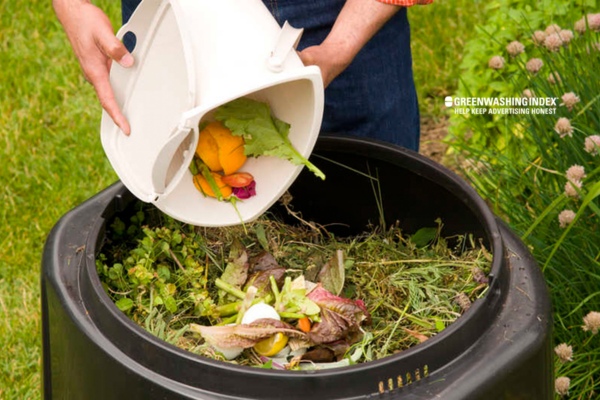
Composting at home changes that equation entirely. When you compost aerobically, meaning with proper airflow and moisture, the same food scraps break down into nutrient-rich soil without producing methane. That soil amendment can then feed houseplants, balcony gardens, or community green spaces. It is a closed-loop system that turns waste into a resource right inside your apartment.
Why does this matter specifically for renters and apartment dwellers? Because the majority of urban food waste comes from multi-unit residential buildings. Houses with yards have long had access to backyard compost piles, but apartment residents have historically had no easy option. That has changed dramatically in the past few years with the rise of indoor composting tools and municipal collection mandates.
You might wonder whether one apartment dweller diverting food scraps actually moves the needle. The numbers say yes. A typical household of two produces roughly 300 to 400 pounds of food waste per year. If even half of that gets composted, you are keeping over a hundred pounds of organic material out of landfills annually. Multiply that across an apartment building with dozens or hundreds of units, and the impact becomes substantial.
Here are the specific ways your composting habit contributes to change:
Even if you never use the finished compost yourself, the act of diverting organic waste from landfills is worth the small effort. You can always donate finished compost to community gardens or give it to friends with plants.
Smell-free apartment composting works because it relies on the same natural decomposition process that happens in forests every day. Leaves, fruit, and plant material fall to the ground and are broken down by bacteria, fungi, and organisms like worms. The result is dark, crumbly, earthy-smelling soil that feeds new growth. The process only becomes smelly when something goes wrong, usually too much moisture or too little airflow.
Understanding what materials belong in your bin and which methods suit your space is the foundation of success. Let us start with the basics of what you can and cannot compost, then move into choosing the right setup.
The first rule of odor-free composting is knowing exactly what goes in the bin and what stays out. Every compost system relies on a balance of two material types: greens and browns. Greens are nitrogen-rich materials like fruit and vegetable scraps that provide the moisture and nutrients microbes need. Browns are carbon-rich materials like dry leaves, shredded paper, and cardboard that add structure and airflow. Getting this balance right prevents almost all odor problems.
What you can compost in any indoor system:
What to keep out of most indoor systems:
That last point surprises many people. Items labeled “compostable” on store shelves, including bioplastic bags, cups, and utensils, are usually designed for commercial composting facilities that reach sustained high temperatures. They will not break down in a home worm bin or electric composter. If you want to learn more about composting specific kitchen scraps, see our guide on composting runner beans as a practical example of how to handle individual food items.
There are five primary methods for indoor composting in an apartment, each with its own strengths, costs, and space requirements. The right choice depends on your budget, how much food waste you produce, and whether you want finished compost or just an easy way to divert scraps from the landfill. Here is a detailed look at each method.
1. Countertop and Indoor Bins
A countertop compost bin is the simplest and most affordable starting point. These compact containers sit on your kitchen counter or under the sink and hold food scraps for a few days to a week before you transfer them elsewhere. Most modern indoor bins come with a charcoal filter lid that traps odors, and they typically hold one to two gallons of material. They are not designed to produce finished compost on their own but rather to collect scraps for a larger system or a community drop-off.
If you are looking for a ready-made container, check out our roundup of the best compost bins we tested. Look for models with tight-sealing lids and replaceable charcoal filters. Stainless steel and ceramic bins resist staining and are easier to clean than plastic alternatives.
2. The Freezer Method
This is the absolute simplest way to collect food scraps without any odor whatsoever, and it is the technique the featured snippet winner for “how to compost indoors without smell” recommends. You keep a container, which can be a dedicated compost caddy, a reusable silicone bag, or even a simple Tupperware container, in your freezer. Every time you cook, you toss scraps in. Freezing halts all decomposition, meaning zero smell, zero fruit flies, and zero mess.
Once the container is full, you have several options. You can take the frozen scraps to a municipal drop-off site, bring them to a community garden, or transfer them to a worm bin or outdoor system if one becomes available later. The freezer method is ideal for people who want to start reducing food waste immediately without investing in equipment or learning a new skill. It is also a perfect interim solution while you research a more permanent composting system.
Many apartment dwellers on Reddit report that the freezer method is the single most effective odor-prevention strategy they have tried. One common approach is to keep a small countertop bin with a charcoal filter for daily use during cooking, then transfer its contents to the freezer container every evening.
3. Vermicomposting, or Worm Composting
Vermicomposting uses red wiggler worms, scientifically known as Eisenia fetida, to break down food scraps into worm castings. These castings are one of the most potent natural fertilizers you can produce at home. A well-maintained worm bin is genuinely odorless because the worms consume food waste faster than it can rot. The bins are compact enough to fit under a sink, in a closet, or on a balcony.
A typical worm bin costs between $40 and $120 for a ready-made stackable tray system, though you can build one yourself for under $30 using plastic storage totes. Red wigglers eat roughly half their body weight in food each day, so a pound of worms can process about a half pound of scraps daily. The finished castings are ready in two to three months and can be used directly on houseplants. If you want to explore this option further, see our guide to the best worm composter models for apartment use.
Reddit users in the r/composting community consistently recommend vermicomposting for apartments. One frequent comment notes that worm bins can sit conveniently under the sink with no detectable smell when managed correctly. The main learning curve is getting the moisture level right, since a bin that is too wet can attract pests and one that is too dry will slow the worms down.
4. Electric Composters and Food Recyclers
Electric composters, sometimes called electric food recyclers, are countertop appliances that use heat and grinding to break down food waste in a matter of hours. Popular models include the Vitamix FoodCycler and the Lomi composter. You load scraps into the chamber, press a button, and the machine dries and grinds everything into a dry, sterile, soil-like material in roughly four to eight hours.
It is worth being transparent about what these machines produce. The output of an electric composter is not technically finished compost. It is dehydrated, ground food waste that still needs to interact with soil microbes before it becomes true compost. However, it is reduced in volume by up to 90 percent, is completely odorless, and can be mixed into potting soil or added to a worm bin for final processing. For many apartment dwellers, that convenience is worth the tradeoff.
Electric composters typically cost between $300 and $550, which is a significant investment. Forum users who own them report they are genuinely odorless and extremely convenient for busy households. The main drawbacks are the price, the counter space they occupy, and the energy consumption. If budget is not a barrier and you want the most hands-off option available, an electric composter is an excellent choice.
5. Bokashi Fermentation
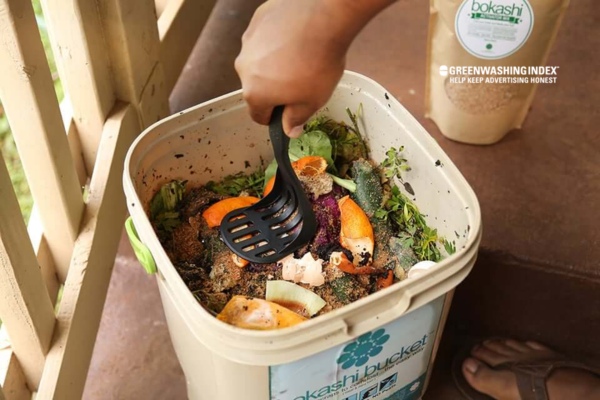
Bokashi is a Japanese fermentation method that uses specialized bran inoculated with beneficial microorganisms to pickle food waste anaerobically. You layer food scraps and bokashi bran in an airtight bucket, seal it, and let fermentation occur over two to three weeks. The process produces a mildly sour, pickled mass that can then be buried in soil to finish decomposing.
What makes bokashi unique is that it can handle materials other indoor methods cannot, including meat, dairy, bones, and oily foods. This makes it attractive for apartment dwellers who want to divert all of their kitchen waste. The bucket produces a liquid called bokashi tea, which drains through a spigot at the bottom and can be diluted as a fertilizer for plants.
The challenge for apartment dwellers is the second step. After fermentation, bokashi pre-compost must be buried in soil for another two to four weeks to finish breaking down. Without access to outdoor soil, you need to find a community garden, a friend with a yard, or a municipal facility that accepts bokashi output. Some renters solve this by keeping a large planter of soil on a balcony specifically for finishing bokashi.
A bokashi starter kit typically costs between $40 and $60 and includes the bucket, bran, and a pressing tool to remove air pockets. Ongoing costs include replacing the bran every few months. The bucket itself produces a fermenting odor that some describe as similar to sauerkraut or apple cider vinegar. Most people find it tolerable, but it is stronger than the neutral smell of a worm bin.
To help you choose, here is a side-by-side comparison of the five main apartment composting methods. Each one is rated on cost, processing speed, odor level, space requirements, and what type of apartment dweller it suits best.
If you are just starting out, the freezer method combined with a countertop collection bin is the lowest-risk way to begin. You can always upgrade to vermicomposting or an electric composter later once you have built the habit of saving scraps. Many people start with the freezer method, then transition to a worm bin once they feel confident.
Once you have chosen a method, the actual process of starting is straightforward. The two most important technical skills are layering your bin correctly and maintaining the right balance of moisture, airflow, and temperature. Get these right and you will rarely encounter odor problems.
Before diving into setup, here is a concise answer to the question that brings most people to this guide. To compost indoors without smell, line your collection container with a layer of brown material like shredded paper or dry leaves, add your food scraps on top, cover each addition with more brown material, keep the moisture level similar to a wrung-out sponge, and aerate the bin by stirring it every few days. A charcoal filter in the lid handles any residual odors. That is the entire technique in a nutshell.
Layering is the foundation of odor-free composting. The goal is to create an environment where aerobic bacteria thrive and anaerobic bacteria cannot take hold. Aerobic decomposition produces earthy-smelling, healthy compost. Anaerobic decomposition produces the rotten, sulfur smell most people associate with decomposing food.
The three components of every compost layer are greens, browns, and a microbial starter:
The ideal carbon-to-nitrogen ratio for smell-free composting is roughly two parts brown to one part green by volume. Experienced composters on Reddit recommend going even further, suggesting a four-to-one brown-to-green ratio for foolproof odor prevention. The principle is simple: it is always better to have too much brown material than too little. Extra browns just take longer to break down. Too few browns means your pile goes anaerobic and starts to smell.
Step-by-step layering process:
Every time you add fresh scraps, dig a small hole in the center of the bin, deposit the scraps, and cover them completely with brown material. Never leave green scraps exposed on the surface. That single habit prevents most odor and pest issues.
Beyond layering, three environmental parameters determine whether your compost stays fresh or turns foul. Monitoring moisture, airflow, and temperature takes only a few minutes per week but makes the difference between success and frustration.
A simple weekly habit keeps everything balanced. One composting expert offers a memorable mantra: take a peek, take a whiff, dig in. Open the bin, look at the moisture and color, smell for any off odors, and give it a quick stir. This thirty-second check catches problems before they become noticeable.
Even with perfect layering and parameter management, two additional tools can elevate your smell-free apartment composting from good to flawless. Activated charcoal filters handle the faint odors that escape when you open the bin, and red wiggler worms accelerate decomposition so dramatically that food waste disappears before it has a chance to smell.
Activated charcoal, also called activated carbon, is a form of carbon that has been treated to create an extraordinarily porous surface. A single gram of activated charcoal can have a surface area of hundreds of square meters. That massive surface area is what makes it so effective at trapping odor molecules.
In composting, activated charcoal filters are typically installed in the lid of a countertop bin. As air passes through the filter, odor-causing compounds like hydrogen sulfide, ammonia, and volatile organic compounds get physically trapped in the carbon pores. The result is that even when your bin contains decomposing food scraps, the air around it stays neutral.
Here is what makes activated charcoal so useful for apartment composting:
When shopping for an indoor bin, prioritize models with a charcoal filter lid built into the design. The filter should fit snugly with no gaps around the edges. If you are using a DIY bin, you can purchase adhesive charcoal filter sheets and attach them to the underside of any lid.
Vermicomposting with red wigglers is arguably the most effective method for producing finished compost in an apartment setting. These small, red worms are surface dwellers that thrive in the top few inches of decaying organic matter, which makes them perfectly suited for shallow indoor bins. They are not the earthworms you see after rain. Red wigglers specifically evolved to consume decomposing plant material at a remarkable pace.
Here is why experienced apartment composters consistently recommend red wigglers:
The key to a successful worm bin is bedding material. Coco coir, shredded cardboard, and aged compost all work well as bedding that retains moisture without becoming waterlogged. Feed your worms by burying small amounts of food scraps in a different corner of the bin each time. Avoid overfeeding, since uneaten food will decompose on its own and create odor. A good rule is to wait until the previous feeding has mostly disappeared before adding more.
Combined, activated charcoal filters and red wiggler worms form a powerful dual-defense system. The worms prevent odor at the source by consuming waste quickly, and the charcoal filter captures any trace odors that might escape when you open the bin. Together, they make indoor composting virtually undetectable.
Not every apartment dweller wants to manage a home composting system. Fortunately, municipal composting programs have expanded rapidly in recent years, making it easier than ever to divert food waste without processing it yourself. If home composting is not for you, there are likely collection options available in your area.
New York City: NYC implemented mandatory curbside composting through Local Law 85, which requires all residential buildings with five or more units to separate food waste for collection. The program rolled out borough by borough beginning in late 2024. Residents receive brown organics bins, and building management is responsible for providing accessible collection areas. If you live in a NYC apartment, check the Department of Sanitation website to confirm your building’s participation and collection schedule.
California: California’s SB 1383 is the most ambitious organic waste reduction law in the country. It requires all cities and counties to provide organic waste collection services to all residents, including apartment buildings. Multifamily properties must have organics collection service, and landlords are legally obligated to provide tenants with appropriate bins and educational materials. If you rent in California, ask your property manager about your building’s organics program.
Other cities and programs: Seattle, San Francisco, Portland, and Boulder have had curbside composting for years. Many smaller cities are launching programs modeled on these pioneers. Even if your city does not offer curbside collection, you may have access to community drop-off sites.
Even if you compost at home, these programs serve as a backup for materials your system cannot handle, like the output from a bokashi bucket or large volumes of scraps when you host gatherings.
Even the best-managed compost system occasionally hits a snag. The good news is that every common problem has a straightforward fix. Here are solutions to the issues apartment composters encounter most frequently.

Limited space is the most common reason apartment dwellers hesitate to start composting. The reality is that every method described in this guide fits within a typical apartment footprint. Countertop bins take up no more room than a coffee maker. The freezer method uses space you already have. Worm bins fit under sinks or in closets. Electric composters sit on the counter like a toaster oven.
For studio apartments with truly minimal counter space, the freezer method combined with weekly drop-off at a community site is the most space-efficient option. If you have a balcony, a small compost tumbler can be surprisingly effective and takes up only a few square feet. The key is matching the method to your available square footage rather than assuming composting requires more room than you have.
When an indoor bin starts to smell, it is almost always fixable within a day. The first step is identifying the cause. The three most common culprits are too much moisture, insufficient brown material, and lack of aeration.
A healthy compost bin should smell like a walk through a forest after rain. If you notice any sharp, sour, or rotten odors, address them immediately rather than hoping they resolve on their own.
Fruit flies are the number one complaint among apartment composters, and forum discussions make clear that even sealed bins sometimes attract them. The flies are drawn to the scent of fermenting fruit, not to the compost itself. Prevention is far more effective than treatment.
If you already have an infestation, the vinegar trap combined with strict burial of all scraps will resolve it within a week. Be patient and consistent, and the population will collapse.
Social dynamics are an often-overlooked challenge in apartment composting. Roommates or partners may resist having a compost bin in shared kitchen space, and some landlords have restrictions on what tenants can keep in their units.
The best approach with housemates is to start small and demonstrate that the system is odorless. Begin with a countertop bin that has a charcoal filter and let them see that it does not smell. Frame it as reducing how often you take out the trash, which is a benefit everyone can appreciate. Involve them in choosing the bin location so they feel they have a say.
For landlord concerns, most indoor composting systems do not require any modification to the apartment and are no different from keeping a houseplant or a pet. Vermicomposting bins are enclosed and do not produce odors or attract pests when maintained properly. If you anticipate resistance, the freezer method is completely invisible and raises no concerns.
One of the most common questions from new apartment composters is what to do with the finished product when you do not have a garden. Fortunately, there are plenty of options that keep your compost out of the landfill and put it to good use.
If you want to understand how compost compares to other soil products, learn more about the difference between compost and topsoil in our complete guide. Knowing the distinction helps you use each product correctly.
To compost indoors without smell, line your bin with brown material like shredded paper or dry leaves, add food scraps, and cover each addition with more browns at a 2-to-1 or 4-to-1 brown-to-green ratio. Keep the moisture level similar to a wrung-out sponge and stir the bin every few days for airflow. Use a bin with a charcoal filter lid to trap residual odors. The freezer method, where you store scraps in a container in your freezer, is the simplest way to guarantee zero smell.
Electric composters like the Vitamix FoodCycler and Lomi are the most odorless options because they dehydrate and grind food waste in a sealed chamber within hours. For a budget-friendly option, a countertop bin with an activated charcoal filter lid paired with the freezer method is extremely effective. Vermicomposting bins are also virtually odorless when properly maintained, since red wiggler worms consume scraps before they can rot.
Yes, several compost bins are designed specifically to be odor-free. Look for bins with tight-sealing lids and built-in activated charcoal filters, such as those from OXO, Epica, and Miracle-Gro. Electric food recyclizers like the Vitamix FoodCycler are completely sealed during operation and produce no odor at all. Vermicomposting bins are also odorless when the green-to-brown ratio and moisture levels are properly maintained.
Start by choosing a method that fits your space and budget. The freezer method costs nothing and guarantees zero odor. A countertop bin with a charcoal filter collects scraps for drop-off at a community site. Vermicomposting uses red wiggler worms to produce finished compost in two to three months. Electric composters process scraps in hours but cost $300 to $550. Bokashi fermentation handles meat and dairy but requires a second burial step. Most beginners start with the freezer method and upgrade once they build the habit.
If your bin develops an odor, the cause is almost always too much moisture or too little brown material. Add a generous layer of shredded paper, dry leaves, or cardboard and turn the pile thoroughly to introduce air. If the bin is soggy, leave the lid off for a few hours to let moisture evaporate. Going forward, increase your brown-to-green ratio to at least 2-to-1 by volume and bury every addition of scraps under a layer of browns.
Most kitchen scraps are compostable, including fruit and vegetable peels, coffee grounds, tea bags without plastic, and eggshells. However, you should avoid adding meat, bones, dairy, oils, and greasy foods to standard indoor bins and worm bins, as they attract pests and create odors. The exception is bokashi fermentation, which can handle meat and dairy. Also avoid compostable bioplastics and compostable packaging, since most require industrial composting facilities to break down.
Finished compost has many uses even without a garden. Mix it into houseplant soil as fertilizer, brew it into compost tea for watering plants, donate it to a community garden, share it with friends who garden, or use it in balcony planters. You can also list it for free on local gardening groups, where members will often pick it up from you.
Electric composters like the Vitamix FoodCycler and Lomi are genuinely odorless and extremely convenient, processing food waste in four to eight hours. They reduce waste volume by up to 90 percent and produce a dry, sterile material that can be mixed into soil. The main drawbacks are cost, typically $300 to $550, and counter space requirements. For busy renters who can afford the upfront cost, they are widely considered worth the investment.
Smell-free apartment composting is no longer a niche experiment. In 2026, it is a practical, accessible practice that anyone can adopt, regardless of square footage or budget. Whether you start with a free container in your freezer, invest in a countertop electric composter, or set up a worm bin under your sink, the most important step is simply beginning.
The environmental case is clear. Diverting food waste from landfills reduces methane emissions, cuts garbage volume, and produces a valuable soil amendment. The practical case is equally strong. Modern composting tools are compact, affordable, and designed specifically to prevent odors and pests. With proper layering, a balanced green-to-brown ratio, and a charcoal filter, your kitchen will smell exactly the same as it does today.
Key Takeaway Points
Start small, be consistent, and adjust as you learn what works in your space. Before long, smell-free apartment composting will feel like second nature, and you will wonder why you ever threw food scraps in the trash.
