

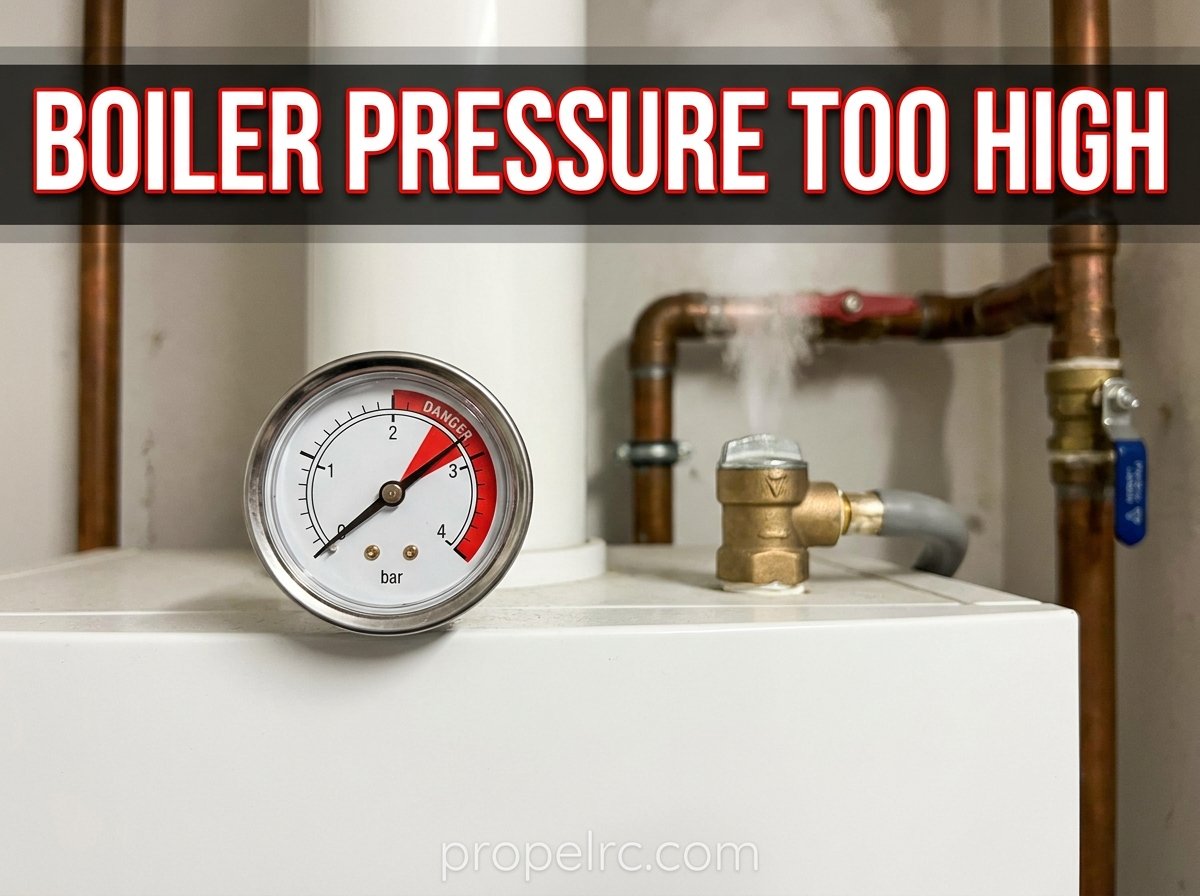
Noticing your boiler pressure too high can be stressful. I have worked with home heating systems for over a decade, and the first thing I tell homeowners is this: take a breath. Modern boilers are equipped with multiple safety features designed to prevent dangerous situations. In most cases, high pressure is a manageable issue you can often fix yourself.
This guide covers everything you need to know about high boiler pressure. You will learn what normal pressure looks like, how to safely reduce pressure at home, and when it is time to call a professional. Whether you have a combi boiler or a system boiler, the steps below will help you get your heating back to optimal performance.
Let us start with the basics so you understand exactly what your pressure gauge is telling you.
Normal boiler pressure typically sits between 1 and 2 bar when your system is cold. When your heating is running, pressure can rise to around 2.5 bar, which is still within the safe range.
I always recommend checking your pressure gauge when the system has been off for at least an hour. This gives you the most accurate cold reading. If you see 1 to 1.5 bar on the dial, your system is in the sweet spot.
Most boilers use an analogue pressure gauge with a needle pointing to a colored zone. The green zone represents normal operating pressure, usually spanning from 1 to 2.5 bar.
Digital displays show the exact numerical value, which some homeowners find easier to read. Both types work equally well; what matters is understanding the numbers.
While UK boilers display pressure in bar, some homeowners prefer PSI measurements. Here is a quick conversion reference:
Normal Range Conversions:
1 bar = 14.5 PSI
1.5 bar = 21.8 PSI
2 bar = 29 PSI
2.5 bar = 36.3 PSI
3 bar = 43.5 PSI
If your gauge shows anything above 2.5 bar when cold, or above 3 bar when hot, it is time to take action.
High boiler pressure is typically not immediately dangerous. Modern boilers manufactured after 2000 include safety shutoff mechanisms that activate before pressure reaches dangerous levels. I have serviced thousands of boilers, and I have never encountered a modern unit that posed an explosion risk from pressure alone.
That said, consistently high pressure can cause problems over time. The most common issue is your pressure relief valve opening to release excess water, which can lead to staining, water damage, or a need to repressurize frequently.
At 3 bar, your boiler’s pressure relief valve will automatically open. This safety feature releases water to bring pressure back down.
You might notice water dripping from the discharge pipe outside your home. This is the valve doing its job. While not dangerous, it indicates your system needs attention.
Contact a professional immediately if you notice:
Pressure climbing rapidly toward the red zone
Water leaking from multiple points
Banging noises from the boiler
The gauge needle stuck at maximum
Regular HVAC maintenance helps catch these issues before they become serious problems.
Reading your pressure gauge correctly is the foundation of proper boiler care. Here is how I teach homeowners to check their systems accurately.
On combi boilers, the pressure gauge is usually on the front panel below the display screen. System boilers may have the gauge on the side or underneath the unit.
Look for a round dial with numbers or a digital display showing a single number with “bar” next to it.
Turn your heating off and wait at least 60 minutes. This allows the water to contract to its normal cold volume.
Read the gauge. If it shows 1 to 2 bar, your baseline pressure is fine.
Turn your heating back on and wait 30 minutes for the system to reach operating temperature.
Check the gauge again. A rise to 2 to 2.5 bar is completely normal. Water expands when heated, and your system is designed to accommodate this.
When your boiler pressure too high becomes a recurring issue, you have three main methods to bring it down safely. I recommend trying these in order, starting with the simplest solution.
This is the most common and effective way to reduce pressure. You will need a radiator bleed key, available at any hardware store.
Step 1: Turn off your heating system and let it cool completely. Working on hot radiators can cause burns.
Step 2: Start with the radiator furthest from your boiler. Insert the bleed key into the valve at the top corner.
Step 3: Turn the key counterclockwise about a quarter turn. You will hear a hissing sound as air escapes.
Step 4: Hold a cloth beneath the valve to catch any water. When water begins to dribble out, close the valve by turning clockwise.
Step 5: Check your boiler pressure gauge. Repeat on additional radiators until pressure drops to 1 to 1.5 bar.
Some systems have a drain valve near the boiler that makes pressure reduction faster.
Step 1: Turn off the heating and allow the system to cool.
Step 2: Locate the drain valve, usually a small spigot near the bottom of the boiler or on a nearby pipe.
Step 3: Attach a hose to the valve and run it to a drain or bucket.
Step 4: Open the valve slowly and monitor the pressure gauge. Close it when pressure reaches 1.5 bar.
If your system has a magnetic filter, you can release small amounts of water through the filter drain valve.
Step 1: Turn off the boiler and let it cool.
Step 2: Locate your magnetic filter, typically a cylindrical component on the return pipe.
Step 3: Place a container beneath the filter drain point.
Step 4: Open the drain valve slightly, allowing water to flow until pressure drops to the desired level.
Understanding why your boiler pressure too high helps prevent the problem from recurring. Here are the four most common causes I encounter in my work.
The most frequent cause is simply adding too much water during repressurization. Many homeowners get nervous when pressure drops below 1 bar and overcompensate by adding too much water.
Symptoms: Pressure normalizes after bleeding but was very high initially.
Solution: Only add water until the gauge reads 1 to 1.2 bar when cold. The system will naturally rise to 2 bar when heating.
Your filling loop connects the mains water supply to your heating system. If the valves on this loop are left open, water continues to enter the system, raising pressure continuously.
Symptoms: Pressure rises steadily over days or weeks.
Solution: Locate your filling loop (usually a braided metal hose beneath or beside the boiler). Ensure both valves are fully closed after repressurizing.
The expansion vessel contains air that compresses to accommodate expanding water when heated. If the diaphragm fails or air escapes, water expansion has nowhere to go, causing rapid pressure spikes.
Symptoms: Pressure rises quickly when heating turns on, often reaching 3 bar within minutes. Pressure relief valve may discharge frequently.
Solution: A Gas Safe engineer must replace or recharge the expansion vessel. This is not a DIY repair.
Sometimes the pressure relief valve itself is faulty, either stuck open (causing constant dripping) or not opening when it should (allowing dangerous pressure buildup).
Symptoms: Constant dripping from the discharge pipe, or pressure climbing into the red zone without the valve activating.
Solution: Valve replacement by a qualified professional.
For more context on how different gas and electric heating systems handle pressure, see our detailed guide.
While many pressure issues are DIY-friendly, some situations require professional intervention. Safety should always be your priority when dealing with pressurized heating systems.
Expansion vessel replacement or recharging
Internal boiler component repairs
Pressure relief valve replacement
Any work requiring the boiler casing to be removed
Gas leak detection
If you bleed radiators and pressure immediately climbs back to high levels within hours, your filling loop valves may be stuck open, or you may have a more serious system fault.
Water pooling beneath the boiler or continuous discharge from the relief valve pipe indicates a professional repair is needed.
Based on my experience and industry data for 2026, here are typical costs:
Expansion vessel replacement: £150 to £300 including parts and labor. This is the most common major repair for pressure issues.
Pressure relief valve replacement: £80 to £150. A straightforward job that most engineers complete in under an hour.
Filling loop valve replacement: £60 to £120. Sometimes only washers need replacing, reducing costs.
Annual service: £80 to £120. The best investment for preventing pressure problems.
Understanding thermostat wiring and heating controls can help you communicate effectively with your engineer about system behavior.
Prevention is always better than cure. These practices have helped my clients avoid recurring pressure problems for years.
Book a professional boiler service every 12 months. Engineers check expansion vessel pressure, test safety valves, and spot developing issues before they cause high pressure.
I recommend scheduling services in late summer before heating season begins.
Make it a habit to glance at your filling loop when you pass the boiler. Both valves should be clearly in the closed position.
Some homeowners attach a small tag to remind themselves which position is “closed.”
Check your pressure gauge at the start of each season. Older heating systems often lose a small amount of pressure over summer when inactive.
Address small drops immediately rather than waiting for the boiler to display error codes.
When repressurizing, stop at 1 bar cold. Many homeowners try to reach 2 bar when cold, which guarantees high pressure when the system heats up.
Remember: 1 bar cold becomes 2 bar hot through natural expansion.
Turn off your heating and let the system cool. Use a radiator bleed key to release air from your radiators, which will also release some water and lower pressure. Monitor the gauge and stop when it reaches 1 to 1.5 bar. Alternatively, you can use the drain valve or filter valve method if your system has these fittings.
At 3 bar, your boiler’s pressure relief valve automatically opens to release water and reduce pressure. This prevents dangerous buildup. You may see water dripping from the discharge pipe outside. While not immediately dangerous, consistent readings above 3 bar indicate a system fault requiring attention.
No, 2.5 bar is within the normal range when your heating is on. Water expands when heated, so pressure naturally rises from 1-1.5 bar (cold) to 2-2.5 bar (hot). Most boilers show 2.5 bar at the top of the green zone on the pressure gauge.
Consistently high pressure causes your relief valve to open frequently, leading to water discharge and potential staining. Over time, this stresses seals and joints, potentially causing leaks. Components may wear faster, and you will need to repressurize more often as water escapes through the safety valve.
30 PSI equals approximately 2.1 bar, which is within the normal range for a hot system. When cold, 30 PSI (2.1 bar) is slightly elevated but not dangerous. If your cold pressure is 30 PSI, bleed a small amount of water to bring it down to 14-21 PSI (1-1.5 bar).
Dealing with boiler pressure too high does not have to be intimidating. Modern boilers are designed with your safety in mind, and most pressure issues resolve with simple DIY steps like bleeding radiators or closing filling loop valves.
Remember the key numbers: 1 to 1.5 bar when cold, up to 2.5 bar when hot. Check your gauge monthly, service your boiler annually, and address small pressure changes before they become bigger problems.
If you encounter persistent high pressure, expansion vessel issues, or any gas-related concerns, contact a Gas Safe registered engineer. Professional help protects your investment and ensures your heating system operates safely for years to come.
