

There’s something deeply satisfying about being self-reliant in the outdoors. After spending years hiking and camping, I realized I was depending entirely on modern gear.
If something broke or I forgot something, I was helpless. Bushcraft skills changed that relationship completely.
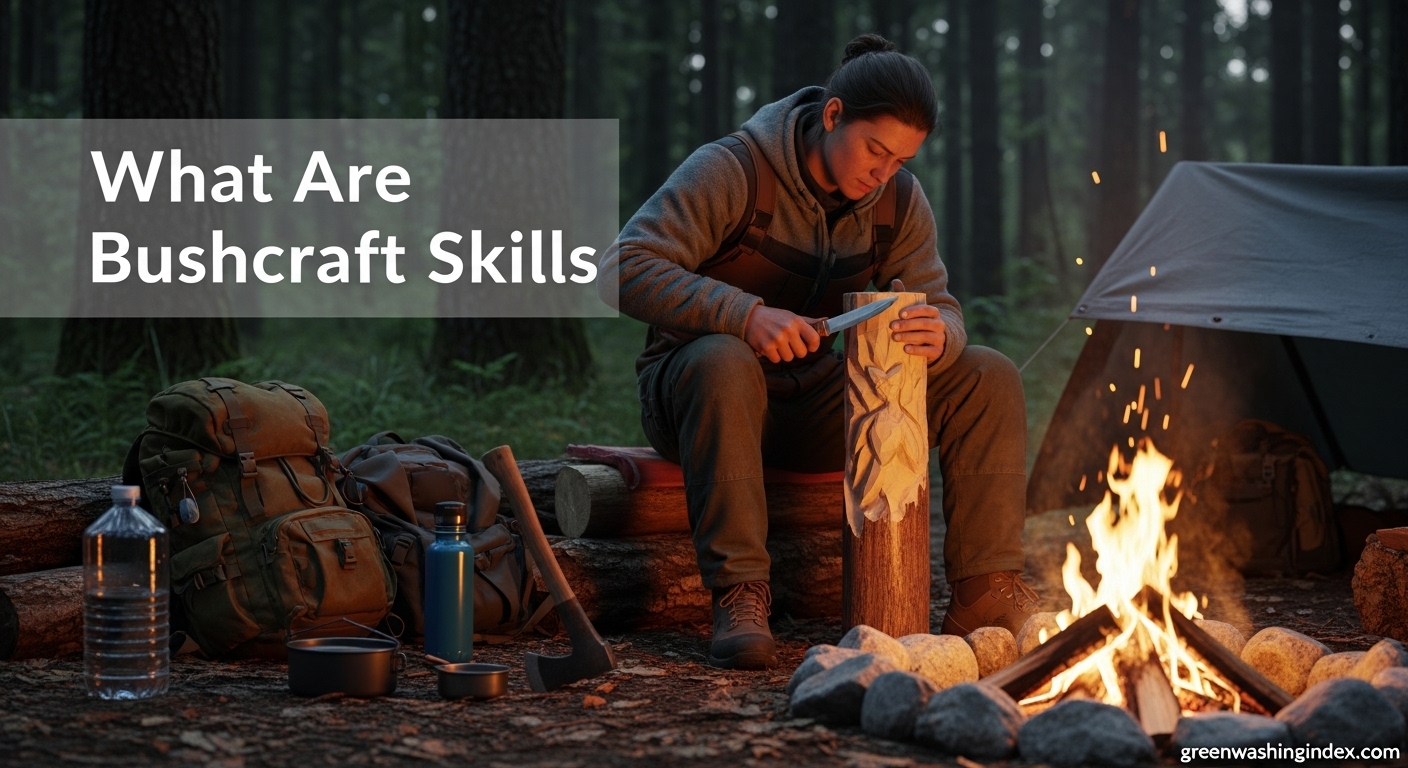
Bushcraft skills are the traditional wilderness living techniques that enable self-reliance in nature through fire craft, shelter building, water procurement, foraging, knife craft, navigation, cordage making, and outdoor cooking.
Unlike survival skills which focus on emergency situations, bushcraft is about thriving in the wilderness with minimal modern equipment.
The term comes from the Australian “bush” referring to remote wilderness areas, combined with “craft” meaning skill or expertise.
These skills have been practiced by indigenous peoples, frontiersmen, and outdoor enthusiasts for generations.
In 2026, more people are discovering bushcraft as a way to connect with nature and build genuine confidence outdoors.
Understanding the distinction between bushcraft and survival clarifies the purpose of each.
Survival skills are emergency techniques designed to get you through life-threatening situations until rescue or help arrives.
The mindset is reactive, focused on short-term survival in worst-case scenarios.
Bushcraft, by contrast, is proactive and intentional.
It’s about choosing to spend time in the wilderness with the skills to live comfortably, not desperately.
Think of it this way: survival is what you do when things go wrong; bushcraft is how you live when things go right.
Both skill sets overlap considerably – fire, shelter, and water are essential to both.
But the attitude and application differ significantly.
Survival training often emphasizes speed and efficiency under extreme stress.
Bushcraft emphasizes patience, practice, and refinement of techniques over time.
When I teach beginners, I explain that survival skills are your insurance policy while bushcraft skills are your lifestyle choice.
Both have value, and knowing bushcraft actually makes survival situations much less frightening.
Quick Summary: Survival skills get you alive through emergencies. Bushcraft skills let you live comfortably outdoors by choice. The techniques overlap, but the mindset and purpose differ significantly.
The benefits of learning bushcraft extend far beyond practical utility.
There’s a profound confidence that comes from knowing you can provide for your basic needs in nature.
After learning friction fire, I stopped feeling anxious about being in remote areas without modern conveniences.
Bushcraft also deepens your connection to the natural world.
You start seeing the landscape differently – trees become potential shelter materials, plants become food or medicine, dead wood becomes fuel.
This awareness transforms outdoor experiences from passive observation to active participation.
The mental health benefits are significant too.
Many practitioners report reduced stress and increased mental clarity from focused, purposeful outdoor activity.
In our digital age, the tactile, hands-on nature of bushcraft provides a necessary counterbalance.
Working with natural materials using simple tools grounds you in the present moment.
The skills you learn also provide backup for emergency situations.
While not the primary focus, knowing you can build a shelter or start a fire without matches is genuine security.
Based on expert consensus and beginner experiences, certain skills form the foundation of bushcraft practice. Attempting to learn everything at once is the most common mistake newcomers make.

After seeing countless beginners overwhelmed by trying to master multiple skills simultaneously, I recommend a sequential approach.
Start with fire and shelter, then add water skills, then food procurement, then tool craft.
This progression matches survival priorities and builds confidence naturally.
Each skill builds on previous knowledge, creating a solid foundation for advanced techniques.
The following eight skills represent the essential toolkit for any bushcraft practitioner.
I’ve included difficulty levels and estimated learning time for each, based on my experience teaching beginners.
| Skill | Difficulty | Practice Time to Basic Competence | Priority |
|---|---|---|---|
| Fire Craft | Beginner | 10-20 hours | First |
| Shelter Building | Beginner | 15-25 hours | First |
| Water Purification | Beginner | 5-10 hours | Second |
| Knife Skills | Beginner | 20-30 hours | Second |
| Cordage Making | Intermediate | 15-20 hours | Third |
| Foraging | Advanced | 100+ hours with expert guidance | Fourth |
| Navigation | Intermediate | 20-30 hours | Third |
| Outdoor Cooking | Beginner | 10-15 hours | Second |
Fire is arguably the most fundamental bushcraft skill.
It provides warmth, light, protection, a method to purify water, and the ability to cook food.
Fire craft begins with understanding the fire triangle: heat, fuel, and oxygen.
Remove any one of these elements and fire cannot exist.
This fundamental principle guides every fire-making technique.
Every fire starts with proper material preparation, regardless of ignition method.
You need tinder, kindling, and fuel wood, each progressively larger.
Tinder catches the initial spark and ignites easily – dry grass, birch bark, cotton balls, fatwood shavings.
Kindling bridges the gap between tinder and fuel – small twigs from pencil size to thumb thickness.
Fuel wood sustains the fire – anything larger than your thumb, split for better burning.
Preparation is everything.
I always gather at least three times more material than I think I need before striking a spark.
Beginners should start with ferro rods, also known as fire steel.
A ferro rod throws a shower of sparks at 3000 degrees when scraped with a striker.
With good tinder preparation, almost anyone can achieve fire with this tool.
Lighters and matches work too, but developing ferro rod proficiency builds essential fire-starting confidence.
The key skill here is tinder preparation and fire lay construction, not the ignition method itself.
Friction fire methods create fire through the mechanical generation of heat from wood rubbing against wood.
The bow drill is the most accessible friction fire technique for beginners.
It uses a bow to spin a drill against a hearth board, creating a coal that can be transferred to a tinder bundle.
After helping over 50 people achieve their first friction fire, I’ve learned it typically takes 15-30 hours of dedicated practice.
The learning curve frustrates many beginners, but the breakthrough moment creates lasting confidence.
⚠️ Safety Warning: Fire safety is non-negotiable. Clear your fire circle of flammable materials. Never leave a fire unattended. Always fully extinguish fires before leaving by dousing with water and stirring until cold to touch. Follow local fire regulations and burn restrictions.
Most beginners fail due to inadequate material preparation, not poor technique.
Your tinder must be bone dry and finely processed.
Your kindling must be properly graded from smallest to slightly larger.
Rushing preparation is the single biggest cause of fire failure.
Another common error is not protecting the fire from wind and moisture during ignition.
Use your body or build a wind block while the fire catches.
Shelter protects from wind, rain, and cold – the primary causes of wilderness exposure deaths.
A proper shelter can keep you warm in surprisingly cold conditions, even without a fire.
The human body loses heat through conduction, convection, radiation, and evaporation.
Good shelter addresses all these mechanisms simultaneously.
The debris hut is the simplest effective shelter for beginners to learn.
It consists of a ridgepole supported at one end, with ribs leaning against it to create a framework.
This framework is then piled with leaves, pine needles, or grass for insulation.
The insulation thickness determines warmth – think 2-3 feet minimum for cold weather.
I’ve slept comfortably in freezing temperatures in a well-built debris hut with no fire.
A simple tarp, combined with cordage skills, creates versatile shelter options.
The A-frame, lean-to, and diamond config are the three basic tarp shelter designs.
Each has advantages depending on conditions and terrain.
A 10×10 foot tarp provides enough coverage for most solo camping scenarios.
Learning to pitch tarp shelters efficiently is one of the most practical bushcraft skills.
The key is tension and angle – a tight pitch sheds rain and resists wind effectively.
Location selection matters more than construction technique.
Avoid widowmakers – dead trees or branches that could fall on your shelter.
Choose flat, well-drained ground.
Consider wind direction and orient your shelter appropriately.
In cold conditions, avoid valley bottoms where cold air settles.
In warm conditions, seek breezy ridges for insect relief.
The biggest mistake is making shelters too large.
Your body heat warms a small space efficiently; large shelters remain cold.
Another common error is inadequate insulation thickness on the ground and overhead.
Ground insulation is actually more important than overhead insulation.
The earth sucks heat away from your body through conduction.
I recommend a minimum of 6 inches of compressed insulation beneath you in any weather.
The human body can survive roughly three days without water, less in hot conditions.
However, dehydration affects performance and judgment long before survival becomes a concern.
In 2026, with increasing awareness of waterborne pathogens, purification knowledge is essential.
Learn to read the landscape for water indicators.
Vegetation is often denser in areas with subsurface water.
Animal trails frequently lead to water sources.
Rock crevices and depressions can collect rainwater.
Dew can be collected from grasses in the early morning using a cloth.
Solar stills and transpiration bags are emergency techniques, but they’re labor-intensive and produce minimal water.
For extended wilderness living, knowing natural spring locations becomes valuable.
A metal container allows you to boil water – the simplest purification method.
Plastic bags or tarps can create rain catchments.
For those practicing primitive skills, wooden bowls can be burned and carved to hold water.
I carry a metal canteen and cup specifically for water collection and purification.
Having multiple collection methods provides redundancy.
Boiling remains the most reliable purification method.
Bring water to a rolling boil for one minute at sea level, three minutes at higher elevations.
Chemical treatment using iodine or chlorine dioxide tablets works but leaves an aftertaste.
Filters remove most pathogens but can clog and don’t remove viruses.
In North America, filters are generally sufficient as waterborne viruses are rare.
UV purifiers like the SteriPEN work quickly but require batteries.
For bushcraft practice, I prefer boiling as it requires no modern equipment.
⚠️ Critical Warning: Never drink untreated water from natural sources. Giardia, Cryptosporidium, and E. coli can cause serious illness. Symptoms may not appear for weeks, making it difficult to trace the source. When in doubt, always purify.
A good knife is the most essential bushcraft tool.
It processes firewood, carves tools, prepares food, and performs countless other tasks.
But a knife is only useful if you know how to use it safely and effectively.
A bushcraft knife typically has a blade length of 3-5 inches.
High carbon steel holds an edge well but requires maintenance to prevent rust.
Stainless steel resists corrosion but may be harder to sharpen.
The scandi grind – a flat primary bevel – is preferred by many bushcraft practitioners.
It excels at woodworking tasks and is relatively easy to sharpen in the field.
A full tang construction, where the steel extends through the handle, provides strength and durability.
Spend $60-120 on a quality knife from reputable manufacturers.
Cheap knives are frustrating to use and potentially dangerous.
The blood circle is the most important safety concept.
Your knife should never be closer to anyone than the distance it could travel if you slipped.
Keep your knife sharp – a dull knife requires more force and is more likely to slip.
Always cut away from your body, never toward it.
Never try to catch a falling knife – let it hit the ground.
When not in use, sheath your knife immediately.
These habits must become automatic before you focus on advanced techniques.
The basic cutting techniques form the foundation of all knife work.
Chest lever carving provides control by pulling the blade into a workpiece braced against your chest.
Push cutting with your thumb behind the blade gives precision for detail work.
Batoning – using your knife as a splitting wedge by striking the spine – is controversial but useful when done correctly.
Never baton with your knife perpendicular to the grain; the wood should split with the grain, not across it.
Feather sticks create fine curls of wood for excellent tinder.
Mastering this technique transforms difficult fire-starting scenarios.
Advanced knife skills include making other tools.
Cooking spoons, bowls, digging sticks, and trap triggers can all be fashioned with a knife.
Furniture like pot hooks and tripods improve camp comfort and efficiency.
Learning to make cordage from natural fibers expands your capabilities exponentially.
The ability to craft what you need from available materials is the essence of bushcraft self-reliance.
Foraging – identifying and harvesting wild plants – is one of the most rewarding bushcraft skills.
However, it’s also the most dangerous to learn without proper guidance.
Misidentification can have serious consequences.
Never eat a plant unless you can positively identify it with 100% certainty.
Use multiple identification features: leaves, bark, flowers, berries, growth pattern, habitat.
Some deadly plants have lookalikes that are edible.
The rule is simple: if in doubt, leave it out.
Learn local poisonous species first, then edible plants.
Knowing what to avoid is as important as knowing what to harvest.
In 2026, foraging laws vary by location and species.
National parks typically prohibit all plant collection.
Private land always requires permission.
Start with plants that have no poisonous lookalikes or distinctive characteristics.
Dandelions are entirely edible and ubiquitous.
Cattails provide food throughout multiple seasons – roots in winter, shoots in spring, pollen in summer.
Pine needles make vitamin C-rich tea, and inner bark can be eaten as survival food.
Acorns require processing to remove tannins but provide a reliable staple food.
Blackberries, raspberries, and blueberries are relatively easy to identify safely.
Focus on learning 5-10 plants thoroughly rather than 100 plants superficially.
Spring offers tender greens and shoots.
Summer brings berries and flowers.
Fall provides nuts, fruits, and roots.
Winter is the most challenging season but some roots and bark remain harvestable.
Learn the seasonal availability of plants in your region.
This knowledge helps plan foraging outings and understand what’s available when.
Never harvest more than 10% of a stand or patch.
Leave enough for wildlife and plant reproduction.
Be especially cautious with rare or slow-growing species.
Consider the impact of your harvest on the ecosystem.
Respect private property and protected areas.
⚠️ Critical Warning: Foraging requires expert guidance to learn safely. Books and online resources are no substitute for in-person instruction from experienced foragers. Some poisonous plants can cause serious illness or death with small amounts. Start with expert-identified plants and never experiment without verification.
Cordage – rope or string – is one of the most useful materials in bushcraft.
It binds shelter frames, hangs food, creates trap triggers, and serves countless other functions.
The ability to make cordage from natural materials dramatically expands your capabilities.
Plant fibers are the primary source of natural cordage.
Nettles, dogbane, milkweed, yucca, and cedar roots all provide excellent fiber.
The key is identifying plants with strong, flexible fibers in the bark or stalk.
Harvesting involves removing the outer bark to access the fibrous inner layer.
Dry the fibers, then rehydrate slightly before working for maximum strength and flexibility.
Animal sinew and rawhide also make exceptionally strong cordage.
The reverse-wrap technique is the fundamental method for creating natural cordage.
Fibers are twisted in one direction, then the entire bundle is twisted in the opposite direction.
This counter-twist locks the fibers together, creating a strong continuous rope.
Splicing new fibers as you go allows creation of cordage of any length.
It takes practice to achieve consistent tension and strength.
My first attempts fell apart immediately, but after about 10 hours of practice, I was making functional cordage.
You only need a few knots to handle most bushcraft situations.
The bowline creates a fixed loop that won’t slip under load – perfect for hanging tarps or bear bags.
The taut-line hitch is an adjustable knot ideal for guylines on shelters.
The square knot joins two ropes of similar diameter.
The clove hitch secures rope to poles or trees quickly.
Learn these four knots thoroughly before exploring more complex options.
Shelter building requires cordage to bind frame elements.
Clothing lines, pot hangers, and tripod lantern stands all need rope.
Trap triggers rely on precisely knotted cordage to function.
Fire bows require strong cordage that won’t stretch under tension.
Net making and basket weaving both use cordage techniques.
The more you practice with natural cordage, the more applications you’ll discover.
Navigation skills prevent getting lost and enable exploration with confidence.
Modern GPS devices are useful tools but should never be your only method.
Batteries die and electronics fail in the field.
Traditional navigation using map and compass is both practical and deeply satisfying.
A topographic map shows elevation through contour lines.
Learning to read these contours reveals the shape of the terrain before you see it.
Steep slopes have closely spaced lines; flat areas have widely spaced lines.
The compass indicates magnetic north, which must be corrected for declination to find true north.
Declination is the difference between magnetic and true north, varying by location.
Your map will indicate the local declination adjustment.
Practice orienting your map to match the landscape and identifying features from both perspectives.
The sun provides consistent navigation cues in the northern hemisphere.
It rises in the east and sets in the west, being due south at noon.
Shadow tip methods use the sun’s movement to determine direction.
Moss grows on the north side of trees in dense forests due to reduced sunlight.
However, this method is unreliable in open areas or certain conditions.
The North Star (Polaris) indicates true north in the northern hemisphere night sky.
Find the Big Dipper and use the pointer stars to locate Polaris.
These natural methods provide general orientation but lack the precision of map and compass.
Terrain association means knowing your location by recognizing landscape features.
Ridges, valleys, streams, and peaks all serve as reference points.
Practice identifying these features on your map and in the real world simultaneously.
This skill develops with time and conscious attention to your surroundings.
I make a habit of noting my position periodically even on familiar trails.
This constant awareness prevents disorientation from developing unnoticed.
The most reliable navigation method is staying found in the first place.
Regularly check your position and maintain awareness of your route.
Mark significant landmarks and note your direction of travel.
If you do become lost, the universal protocol is STOP: Sit, Think, Observe, Plan.
Panic is your enemy; rational thinking is your best tool.
Most lost people are found within a mile of their last known position.
Staying put often makes more sense than continuing to move.
Cooking over an open fire transforms raw ingredients into satisfying meals in the wilderness.
It’s a skill that combines fire management, tool use, and food preparation.
The flavor of food cooked over a wood fire is incomparable to other methods.
Cooking fires differ from warming fires.
You need hot coals rather than large flames for most cooking methods.
Let your fire burn down to a bed of glowing embers before beginning to cook.
A reflector wall behind the fire directs heat toward your cooking area.
Creating a cooking platform of green wood allows pot suspension and stability.
Different cooking methods require different fire arrangements.
A keyhole fire separates the cooking coals from the main fire.
Direct grilling uses a grate or green sticks suspended over coals.
Dutch oven cooking allows baking, stewing, and frying using hot coals above and below.
Rock frying uses a flat heated rock as a cooking surface.
Plank cooking secures fish to a green hardwood plank leaned near the fire.
Spit cooking suspends meat on a rotating spit over the fire.
Each method has advantages depending on what you’re cooking and available materials.
Foil packet cooking (hobo packets) seals ingredients in foil for easy cooking.
While aluminum foil is a modern material, this technique deserves mention for its practicality.
Stone boiling heats water in a container using hot stones dropped in.
This method works with wooden containers and demonstrates primitive ingenuity.
Clay baking encases food in clay and cooks it in the fire.
The clay hardens and seals, retaining moisture and flavor.
Proper food handling prevents illness in the field.
Keep raw meat separate from other foods and cook thoroughly.
Clean hands and utensils after handling raw ingredients.
Wild game requires careful field dressing and thorough cooking.
Heat-resistant gloves or pot holders prevent burns when handling hot cookware.
Always extinguish cooking fires completely before breaking camp.
The path to bushcraft proficiency is a journey, not a destination.
I’ve taught complete beginners and watched them develop impressive skills over months and years.
The key is structured progression and consistent practice.
Rushing to advanced techniques without solid fundamentals leads to frustration and failure.
Focus exclusively on fire, shelter, and water during your first three months.
These skills address survival priorities and build confidence for more advanced techniques.
Spend at least 5 hours per week practicing, with weekend sessions when possible.
Master ferro rod fire lighting before attempting friction fire.
Build multiple debris shelters and tarp configurations.
Practice water collection and purification until it becomes second nature.
Invest in a quality knife and learn its safe use.
By the end of three months, you should feel comfortable spending a night outdoors with minimal gear.
Once fundamentals are solid, expand into knife craft, cordage, and navigation.
Begin carving useful items: spoons, pot hooks, tent stakes.
Learn to make natural cordage and practice essential knots.
Take a map and compass course or practice extensively with experienced navigators.
Start experimenting with outdoor cooking over open fire.
Begin learning plant identification, focusing on a few species at a time.
Consider attending a bushcraft course for hands-on instruction.
After a year of consistent practice, you’re ready for advanced techniques.
Friction fire requires significant dedication but represents a major milestone.
Expanded foraging knowledge provides greater food independence.
Primitive shelter techniques like wickiups and wikiups become accessible.
Advanced tool craft includes bow making and primitive traps.
At this stage, specialization based on interest becomes appropriate.
Some practitioners focus on primitive skills, others on survival applications.
Books and online resources provide information but have significant limitations.
Nothing replaces hands-on instruction from experienced practitioners.
Local bushcraft schools offer weekend workshops and multi-day courses.
Georgia Bushcraft and similar organizations provide structured learning environments.
Online communities like r/Bushcraft on Reddit offer advice and connection.
Meetup groups and outdoor clubs often include experienced bushcraft practitioners.
I’ve learned more in one weekend workshop than months of solo practice.
In-person instruction corrects bad habits and accelerates learning dramatically.
Trying to learn too much at once is the most common error.
Focus on one skill at a time and master fundamentals before advancing.
Buying excessive gear before developing skills is another widespread mistake.
You need surprisingly little equipment to practice bushcraft effectively.
Skipping safety precautions seems faster but can have serious consequences.
Every advanced practitioner I know has stories of near-misses from carelessness.
Practicing only in perfect weather conditions limits skill development.
True confidence comes from skills that work in challenging conditions.
Finally, giving up too early prevents breakthroughs.
Many skills seem impossible until they suddenly click, often after extended practice.
✅ Pro Tip: Keep a skills journal documenting your practice sessions. Note what works, what doesn’t, and what you want to improve. Reviewing your progress is motivating and helps identify areas needing attention. Track weather conditions, materials used, and time spent on each session.
Bushcraft practitioners have a special responsibility to the natural world.
We interact more intimately with the environment than most outdoor users.
This interaction requires ethical consideration and careful practice.
Leave No Trace principles provide a framework for responsible wilderness behavior.
Harvest materials selectively and sparingly.
Never strip all bark from a tree or clear-cut an area.
Spread your impact rather than concentrating it in one location.
Respect wildlife and observe from a distance.
Properly dispose of waste, including human waste.
Minimize campfire impacts and follow all fire regulations.
Teach responsible practices to others, especially beginners and children.
While bushcraft emphasizes skills over gear, quality tools make practice more effective and enjoyable.
A few carefully chosen items provide tremendous capability without excessive weight or cost.
Your primary tool deserves careful selection and investment.
Look for a full tang, scandi grind blade in the 3-5 inch range.
High carbon steel requires maintenance but outperforms stainless for woodworking tasks.
A quality sheath is essential for safe carry.
Expect to spend $80-150 for a reliable knife that will last decades with proper care.
A ferro rod and striker provide reliable fire ignition in all conditions.
Carry tinder as backup – cotton balls soaked in petroleum jelly work excellently.
A small folding saw processes firewood much more efficiently than a knife alone.
These items weigh little but significantly expand your capabilities.
A 10×10 silnylon or canvas tarp provides versatile shelter options.
Learn various tarp configurations to suit different conditions.
A quality wool blanket can substitute for a sleeping bag in many conditions.
A comfortable ground pad makes a tremendous difference in sleep quality.
A metal canteen or bottle enables boiling for purification.
A metal cup allows cooking and drinking from the same container.
Basic water treatment tablets provide backup purification methods.
A small metal pot expands cooking options significantly.
Bushcraft is the practice of wilderness living skills that enable self-reliance in nature. It includes fire craft, shelter building, water procurement, foraging, knife skills, navigation, cordage making, and outdoor cooking. Unlike survival skills which focus on emergency situations, bushcraft emphasizes thriving in the outdoors through intentional practice of traditional techniques.
Survival skills are emergency techniques designed to keep you alive during unexpected wilderness situations until rescue. Bushcraft skills are intentional techniques for comfortable outdoor living by choice. While both use similar techniques like fire, shelter, and water procurement, the mindset differs: survival is reactive and short-term, bushcraft is proactive and long-term. Learning bushcraft actually makes survival situations less intimidating.
Start with the survival priorities: fire, shelter, and water. Master ferro rod fire lighting before attempting friction fire. Learn basic shelter configurations like debris huts and tarp setups. Practice water purification methods, especially boiling. After these fundamentals, add knife skills and safety, then expand to cordage, navigation, and foraging. This progression builds confidence and capability systematically.
Basic competence in core skills takes 3-6 months of regular practice. You can expect fire and shelter fundamentals in 20-40 hours each. Knife skills require similar time investment. Advanced skills like friction fire may take 30-50 hours to achieve consistently. Proficiency develops over years of practice. The learning never really ends – there’s always refinement and new techniques to explore. Focus on steady progress rather than rapid advancement.
You need surprisingly little to begin. A quality bushcraft knife ($80-150) is your primary tool. A ferro rod ($15-30) provides reliable fire lighting. A metal water bottle or canteen ($15-40) enables boiling for purification. A 10×10 tarp ($30-80) creates versatile shelter options. That’s roughly $150-300 for a complete starter kit. Avoid buying excessive gear upfront – focus on developing skills with basic equipment first.
Bushcraft involves risks but can be practiced safely with proper precautions. Knife work requires learning safety fundamentals and maintaining respect for sharp tools. Fire making demands attention to fire safety protocols. Foraging carries risk of misidentification – never eat without 100% certainty. Start with experienced instructors, practice in safe environments, and never push beyond your comfort level. Many schools offer beginner courses that teach safety as the foundation of all skills.
Absolutely. Many skills can be practiced in backyards, local parks, or urban green spaces. Knife work, knot tying, and cordage making require minimal space. Fire practice may require designated areas but can often be done legally with proper preparation. Plant identification works anywhere vegetation grows. Navigation practice begins with map study and local application. The skills transfer to wilderness settings once developed closer to home.
Friction fire is best learned through in-person instruction from experienced practitioners. Books and videos help but nothing replaces hands-on coaching. Start with bow drill rather than hand drill – it’s more accessible for beginners. Expect 15-30 hours of practice before your first successful coal. Common mistakes include inadequate pressure, poor form, improper materials, and impatience. Take a workshop if possible, and practice with dry, proven materials before harvesting your own.
Bushcraft skills offer a path to genuine self-reliance and deeper connection with the natural world.
The journey from inexperienced beginner to confident practitioner is incredibly rewarding.
Start with fire this weekend – practice ferro rod ignition until you can light a fire consistently.
Build a simple shelter in your backyard and spend a night in it.
Learn three knots and practice them until they become automatic.
Small consistent steps lead to substantial capability over time.
Remember that every expert was once a complete beginner.
The skills may seem intimidating at first, but they’re eminently learnable with patience and practice.
Your bushcraft journey begins with a single step – take it this weekend.