

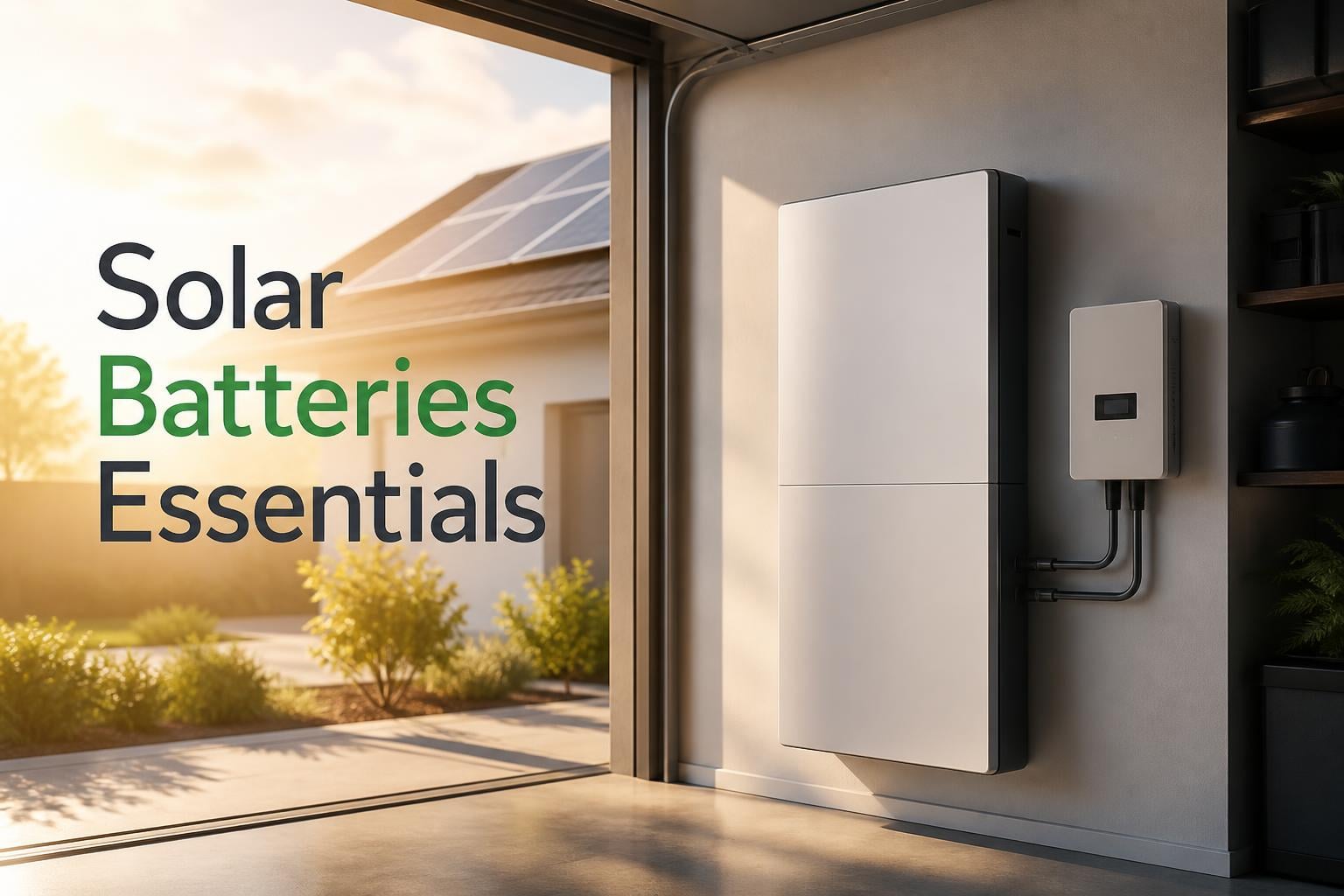
Home energy storage has shifted from a niche curiosity to a mainstream investment. In the first quarter of 2026 alone, the United States deployed a record 3.3 gigawatts and 8.4 gigawatt-hours of energy storage, with residential installations jumping 86 percent year over year. That explosive growth reflects a fundamental change in how homeowners think about electricity reliability, rate structures, and energy independence.
Choosing the right solar batteries for your home means understanding chemistry types, sizing requirements, coupling options, and financial incentives. The landscape in 2026 looks dramatically different from even two years ago, with lithium iron phosphate (LFP) dominating new installations, NEM 3.0 reshaping the economics of solar plus storage, and consumption-only batteries emerging as a cost-effective alternative to full backup systems.
This guide breaks down everything a savvy shopper needs to know before investing in residential energy storage. From comparing battery chemistries to calculating your capacity needs and decoding warranty fine print, we cover the technical details that separate a smart purchase from an expensive mistake.
Whether you are adding storage to an existing photovoltaic (PV) system or designing a new solar installation from scratch, the decisions you make about battery chemistry, capacity, and configuration will affect your energy bills and resilience for the next decade. For a broader look at how storage fits into the sustainability picture, see our analysis on solar and battery storage sustainability claims.
Solar batteries store excess electricity generated by your solar panels so it remains available when production drops or demand spikes. During peak sunlight hours, a typical residential PV array often produces more electricity than the household consumes. Without storage, that surplus flows back to the grid, often at a fraction of the retail rate under modern net metering policies. With storage, the surplus charges your battery and powers your home after sundown or during an outage.
The four main types of solar batteries on the residential market are lead-acid, lithium-ion, nickel-cadmium, and flow batteries. Lithium-ion dominates home solar installations, and within that category, the lithium iron phosphate (LFP) sub-chemistry has become the preferred choice for residential energy storage due to its superior safety profile and cycle life.
A complete residential energy storage system includes the battery module, a battery management system (BMS) that monitors voltage and temperature, an inverter that converts direct current to alternating current, and often a hybrid inverter that integrates solar input and battery management in a single unit. The BMS plays a critical role in preventing overcharging, balancing cells, and protecting against thermal runaway.
Grid-tied solar batteries remain connected to the utility grid and can draw from or feed into it as needed. These systems typically include automatic transfer switches that isolate your home during a grid outage, allowing the battery to power essential circuits safely. Off-grid systems, by contrast, operate independently and require sufficient battery capacity to cover multiple days of consumption without solar recharge. Understanding solar panel energy production helps determine how much storage you actually need.
Battery storage also enables participation in virtual power plant (VPP) programs, where utility companies aggregate hundreds of residential batteries to balance grid demand. Homeowners who enroll their batteries in VPP programs receive compensation for allowing the utility to draw small amounts of stored energy during peak demand events, creating an additional revenue stream from the investment.
Also Read: How Much Energy Does A Solar Panel Produce? Find Now!
The solar battery market offers several distinct chemistries, each with trade-offs in cost, lifespan, depth of discharge, and safety. Understanding these differences is the foundation of making an informed purchase. The dominant residential choices in 2026 are lithium-ion variants, particularly LFP, but lead-acid, flow, nickel-cadmium, and saltwater batteries each serve specific niches.
Lithium-ion batteries have become the default technology for residential solar storage, and for good reason. They offer high energy density, meaning they pack more usable capacity into a smaller physical footprint than lead-acid alternatives. Most lithium-ion solar batteries deliver round-trip efficiencies of 90 to 95 percent, so very little stored energy is lost between charging and discharging.
Within the lithium-ion family, two sub-chemistries dominate the solar market: nickel manganese cobalt (NMC) and lithium iron phosphate (LFP). NMC batteries, used in products like the LG RESU Prime and some Tesla Powerwall generations, offer slightly higher energy density. LFP batteries trade a small amount of density for dramatically improved thermal stability and cycle life.
Key advantages of lithium-ion solar batteries include high depth of discharge (80 to 95 percent for NMC, up to 100 percent for LFP), minimal maintenance requirements, compact form factors, and fast charging capabilities. Most quality lithium-ion solar batteries now carry warranties of 10 years or 6,000 to 10,000 cycles, reflecting manufacturer confidence in long-term durability.
The primary drawback remains cost. Lithium-ion batteries typically run between $8,000 and $12,000 installed for a residential system, though prices continue to decline as manufacturing scales. For homeowners who prioritize longevity and performance, the higher upfront investment generally pays off over the battery’s lifespan compared to cheaper alternatives.
Major brands dominating the 2026 residential lithium-ion market include the Tesla Powerwall 3, Enphase IQ Battery 5P, FranklinWH aPower 2, LG RESU Prime, and Panasonic EverVolt. Each offers different capacity options, power ratings, and integration features, so comparing specifications against your specific energy profile matters.
Lithium iron phosphate, also written as LiFePO4, deserves separate treatment because it has become the dominant chemistry for new residential solar storage installations. LFP batteries use an iron phosphate cathode instead of the cobalt and nickel found in NMC cells, which fundamentally changes their safety and longevity characteristics.
The thermal runaway risk with LFP is significantly lower than with NMC or other lithium-ion sub-chemistries. LFP cells remain stable at temperatures up to 270 degrees Celsius, compared to roughly 210 degrees for NMC. This means LFP batteries are far less likely to experience the catastrophic failures that have occasionally made headlines with other lithium chemistries, making them particularly suitable for indoor residential installations.
Cycle life is where LFP truly separates itself. A quality LFP battery delivers 4,000 to 10,000 cycles before reaching 80 percent of original capacity, compared to 500 to 1,500 cycles for typical NMC cells. Translated to real-world terms, an LFP battery cycled once daily could last 10 to 25 years, which often exceeds the warranty period and the expected lifespan of the solar panels themselves.
LFP batteries also support depth of discharge up to 100 percent without significant degradation, meaning you can use nearly all the rated capacity on each cycle. NMC and lead-acid batteries typically recommend limiting discharge to 80 to 90 percent and 50 percent respectively to preserve lifespan.
The trade-off is energy density. LFP cells pack roughly 15 to 20 percent less energy per unit of volume than NMC, which means LFP batteries are slightly larger for the same capacity. For most residential installations where the battery sits on a garage wall or in a utility closet, this size difference is negligible compared to the safety and longevity benefits.
Products like the Enphase IQ Battery 5P, FranklinWH aPower 2, and many EG4 and BigBattery systems use LFP chemistry. The Tesla Powerwall 3 also moved toward LFP in its latest generation, signaling the industry’s consensus that iron phosphate is the right chemistry for home storage.
Lead-acid batteries have served off-grid and backup power applications for decades, and they remain relevant for budget-conscious buyers. Their proven track record, wide availability, and low upfront cost make them attractive for cabins, RVs, and small off-grid systems where the economics of lithium-ion do not pencil out.
The technology splits into two main categories relevant to solar: flooded (or wet cell) and sealed. Flooded lead-acid batteries require regular maintenance, including topping off electrolyte levels with distilled water and ensuring proper ventilation. Sealed variants, which include gel and AGM batteries, eliminate maintenance at the cost of higher purchase prices and slightly shorter lifespans.
Lead-acid batteries suffer from several limitations compared to lithium-ion. Their depth of discharge should stay around 50 percent to avoid rapid capacity loss, meaning a 10 kWh lead-acid battery only provides about 5 kWh of usable energy. They deliver roughly 500 cycles before significant degradation, and their round-trip efficiency sits at 70 to 85 percent, meaning more solar energy is wasted during storage.
For small off-grid applications, deep-cycle batteries for DIY solar projects remain a practical choice. Brands like Trojan, Crown, and Deka have served this market for decades with reliable products. However, for whole-home residential storage, the total cost of ownership over a decade typically favors lithium-ion despite the lower upfront lead-acid price.
Flow batteries use liquid electrolytes stored in external tanks that pump through a cell stack to generate electricity. This architecture gives them a unique advantage: capacity scales simply by adding larger tanks, while power scales by adding more cell stacks. For homeowners who need very large storage capacities, flow batteries offer an elegant solution.
The technology supports 100 percent depth of discharge without degradation and can deliver 10,000 or more cycles over a 20 to 30 year lifespan. Flow batteries also carry zero thermal runaway risk because the electrolyte is water-based, which is a significant safety advantage for indoor installations.
The main drawback is low energy density. Flow battery systems are large and heavy relative to the energy they store, making them impractical for space-constrained residential installations. They also tend to cost more than lithium-ion on a per-kWh basis for typical residential sizes. As a result, flow batteries currently see more deployment in commercial and utility-scale applications than in homes, though residential products are beginning to appear.
Gel and AGM (Absorbed Glass Mat) batteries are sealed lead-acid variants that eliminate the maintenance requirements of flooded batteries. In gel batteries, the electrolyte is suspended in a silica-based jelly. In AGM batteries, fiberglass mats absorb the electrolyte between lead plates. Both designs are spill-proof and can operate in any orientation.
Gel batteries excel in high-temperature environments and offer good cycle life for sealed lead-acid technology. They are popular for off-grid cabins and small solar installations where minimal maintenance matters. AGM batteries handle cold weather better than gel and can deliver higher burst currents, making them suitable for applications that occasionally need to start motors or run high-draw appliances.
Both technologies share the fundamental lead-acid limitations of 50 percent recommended depth of discharge and relatively short cycle life. For portable and small-scale solar applications, they remain cost-effective. For whole-home storage, lithium-ion LFP batteries offer better value over their lifespan.
Nickel-cadmium (NiCd) batteries have served industrial and utility-scale applications for decades. They tolerate extreme temperatures, deliver long cycle life, and require minimal maintenance. Their wide operating temperature range makes them suitable for harsh environments where other chemistries struggle.
However, cadmium is a toxic heavy metal, which creates disposal and environmental concerns. NiCd batteries also suffer from memory effect, where repeated partial discharges reduce effective capacity unless the battery is periodically fully discharged. For residential solar, these drawbacks combined with higher cost have made NiCd batteries largely irrelevant. They see some use in utility-scale and aircraft applications where their ruggedness justifies the trade-offs.
Saltwater batteries represent the newest entrant in the solar storage market. They use a saline electrolyte and avoid the heavy metals and toxic materials found in other chemistries. This makes them the most environmentally friendly option, as they can be recycled or disposed of without specialized hazardous waste handling.
The technology offers decent cycle life and zero thermal runaway risk. However, saltwater batteries have lower energy density than lithium-ion, meaning they require more physical space for the same capacity. They also remain relatively expensive on a per-kWh basis because the technology has not yet achieved the manufacturing scale of lithium-ion.
As of 2026, saltwater batteries occupy a small niche in the residential market. Their environmental credentials appeal to buyers who prioritize sustainability over maximum performance, and ongoing development may improve their competitiveness. For most homeowners, the combination of higher cost and lower density makes lithium-ion LFP a more practical choice today.
Also Read: Solar Power Basics: Unlock Clean Energy Mysteries!
Selecting the right solar battery requires matching technical specifications to your specific energy profile, budget, and goals. The following factors determine whether a battery will serve your needs well or leave you frustrated with underperformance.
Battery capacity, measured in kilowatt-hours (kWh), determines how much energy your battery can store. The right capacity depends on your daily energy consumption, the critical loads you want to back up, and how many hours or days of autonomy you need. A typical American household uses 25 to 30 kWh per day, but a battery rarely needs to cover full consumption.
Most residential solar batteries come in capacities ranging from 5 kWh to 20 kWh per unit, with expandable systems allowing you to add modules later. A 10 to 15 kWh battery typically covers essential loads (refrigeration, lighting, internet, medical devices) for 24 to 48 hours during an outage. For full-home backup including air conditioning, expect to need 20 kWh or more.
To calculate your needs, list the appliances you want powered during an outage or overnight, note their wattage, and multiply by the hours of expected runtime. Add a 20 percent buffer to account for inefficiencies and unexpected draw. This exercise prevents both undersizing, which leaves you without power, and oversizing, which wastes money on capacity you will never use.
Many homeowners on Reddit’s solar communities report regretting not sizing their systems larger initially. Expandable battery systems address this concern by allowing capacity additions after installation, which is worth prioritizing if your budget is tight today but may grow later.
While capacity measures how much energy a battery holds, power rating measures how quickly it can deliver that energy, expressed in kilowatts (kW). A battery with 10 kWh capacity and 5 kW power rating can run appliances drawing 5 kW simultaneously for about two hours. The same battery with a 3 kW rating could only support loads totaling 3 kW, even though it has energy to spare.
Power rating matters when multiple appliances run simultaneously. Air conditioners, electric water heaters, and electric vehicle chargers all draw significant power. If your battery’s continuous power rating cannot meet peak demand, circuits will trip or appliances will fail to start. Look for both continuous rating (sustained output) and peak or surge rating (brief bursts for motor startup).
Modern residential batteries like the Enphase IQ Battery 5P deliver 7.6 kW peak power from a single unit, while the FranklinWH aPower 2 offers an impressive 10 kW peak. Stack multiple units and total system power scales accordingly, which is critical for whole-home backup scenarios.
Round-trip efficiency measures the percentage of energy that makes it back out of the battery relative to what went in. If you send 10 kWh of solar energy into a battery with 90 percent round-trip efficiency, you get 9 kWh back when discharging. The lost energy dissipates as heat during the conversion and storage process.
This specification matters because it directly affects your energy bills. A battery with 95 percent efficiency wastes half as much energy as one with 90 percent. Over thousands of cycles, that difference compounds significantly. Most lithium-ion solar batteries deliver round-trip efficiencies between 90 and 95 percent, while lead-acid batteries typically achieve 70 to 85 percent.
Coupling architecture significantly affects system-level round-trip efficiency. AC-coupled batteries, which connect to the same AC bus as your home electrical panel, require two inverter conversions: DC solar to AC, then AC back to DC for charging. This double conversion typically yields 85 to 90 percent system-level efficiency. DC-coupled batteries connect directly to the solar array’s DC output, avoiding the extra conversion and achieving up to 97.5 percent efficiency.
The choice between AC and DC coupling also affects installation flexibility. AC-coupled batteries retrofit easily to existing solar installations because they connect on the AC side and do not require changes to the solar array’s DC wiring. DC-coupled systems are more efficient but typically need a hybrid inverter and are easier to integrate during a new solar installation rather than as a retrofit.
Depth of discharge measures how much of a battery’s rated capacity you can safely use on each cycle. A battery with 10 kWh total capacity and 90 percent DoD provides 9 kWh of usable energy. Pushing beyond the recommended DoD accelerates degradation and shortens the battery’s lifespan.
Different chemistries support different DoD levels. LFP batteries allow up to 100 percent discharge without significant penalty, making their full rated capacity usable. NMC lithium-ion batteries typically recommend 80 to 95 percent DoD. Lead-acid batteries should be limited to about 50 percent DoD to preserve cycle life, which effectively halves their usable capacity.
When comparing batteries, always look at usable capacity rather than total capacity. A 10 kWh lead-acid battery with 50 percent DoD provides the same usable energy as a 5 kWh LFP battery with 100 percent DoD, despite the lead-acid unit being larger and heavier. This is why comparing cost per usable kWh provides a more accurate picture than comparing cost per total kWh.
Battery lifespan is defined by two related metrics: cycle life and throughput. Cycle life counts how many complete charge-discharge cycles a battery can deliver before degrading to a specified percentage of original capacity, typically 70 or 80 percent. Throughput measures the total energy in kWh that passes through the battery over its lifetime.
LFP batteries lead the market with 4,000 to 10,000 cycles, translating to 10 to 25 years of daily cycling. NMC lithium-ion batteries deliver 500 to 1,500 cycles under similar conditions. Lead-acid batteries typically manage 300 to 500 deep cycles before requiring replacement.
Real-world lifespan depends heavily on usage patterns. Batteries that cycle deeply every day will degrade faster than those that shallow-cycle and remain topped off. Operating temperature also matters significantly; batteries in hot environments degrade faster than those in temperature-controlled spaces. Quality battery management systems help optimize cycle depth and temperature to maximize lifespan.
When evaluating warranties, pay attention to throughput guarantees rather than just year-based coverage. A 10-year warranty with a 30,000 kWh throughput guarantee provides a concrete performance commitment, while a bare 10-year warranty says nothing about expected capacity at the end of that period.
Choosing the right chemistry means weighing cost, safety, lifespan, depth of discharge, and energy density against your specific application. For most homeowners in 2026, LFP lithium-ion represents the best balance. Its long cycle life, high depth of discharge, superior thermal stability, and declining costs make it the chemistry of choice for major manufacturers.
NMC lithium-ion suits applications where space is maximally constrained and slightly higher energy density justifies the cost premium and reduced cycle life. Lead-acid remains viable for small off-grid budgets where the total cost of ownership math favors low upfront spending over long-term value. Flow batteries suit very large capacity needs where their scalability and longevity overcome the size disadvantage.
Nickel-cadmium and saltwater batteries occupy narrow niches. NiCd makes sense only in extreme temperature environments where other chemistries fail. Saltwater appeals to environmentally focused buyers willing to accept lower performance and higher cost for the cleanest lifecycle footprint.
Safety should rank near the top of every buyer’s priority list. Lithium-ion batteries store significant energy in compact packages, and failures, while rare with quality products, can be serious. Thermal runaway occurs when a cell overheats and the heat triggers exothermic reactions that release more heat, creating a self-sustaining cascade that can lead to fire or explosion.
LFP chemistry dramatically reduces thermal runaway risk compared to NMC and other lithium-ion sub-chemistries. The iron phosphate cathode remains structurally stable at much higher temperatures, making thermal runaway extremely unlikely under normal operating conditions. This is why LFP has become the residential standard and why insurers and code officials view it more favorably.
Look for batteries with UL 9540 certification, which tests residential battery systems for fire safety under abuse conditions. UL 1973 and UL 9540A provide additional safety validation. Quality battery management systems that monitor individual cell voltage and temperature provide early warning of potential issues before they escalate.
Installer quality matters as much as battery brand. Proper installation, including correct electrical connections, adequate ventilation, and appropriate placement away from living spaces, reduces risk significantly. Forum discussions consistently show that most battery incidents trace back to installation errors rather than product defects.
The rise of NEM 3.0 in California and similar net metering reforms elsewhere has created a new category: consumption-only batteries. These systems optimize for daily energy shifting, charging from solar during the day and discharging during expensive evening rate periods, but they do not provide backup power during grid outages.
Consumption-only batteries typically cost about one-third less than full backup systems because they omit the automatic transfer switch, sub-panel, and other components needed for seamless outage support. For homeowners primarily motivated by reducing electricity bills rather than outage protection, this represents significant savings.
Full backup batteries include the hardware needed to island your home from the grid during outages, powering essential or entire-home circuits automatically. These systems cost more but provide peace of mind during storms, wildfires, and utility shutoffs. Some homeowners choose a hybrid approach: a smaller backup battery for critical loads plus a consumption-only battery for daily bill optimization.
Under NEM 3.0, California homeowners receive dramatically reduced compensation for exporting solar energy to the grid, making self-consumption far more valuable. This shift makes batteries economically attractive even for homeowners who previously found storage unnecessary, because storing and using your own solar energy now saves more than selling it back to the utility.
Also Read: Solar Panel Cleaning Made Easy – Top Tips Revealed!
The financial case for solar batteries has strengthened considerably in 2026. Declining battery costs, rising electricity rates, the 30 percent federal tax credit, and NEM 3.0 policies have all shifted the economics in favor of storage. Understanding the numbers helps you evaluate whether a battery makes sense for your situation.
Residential solar battery systems typically cost between $8,000 and $12,000 per battery installed, with variation based on capacity, brand, and installation complexity. The Tesla Powerwall 3 with installation commonly runs around $16,000 for a complete system. Smaller or budget-oriented batteries from brands like Renogy, ECO-WORTHY, and Rich Solar can be found for $200 to $2,000 for portable and small-scale applications.
Cost per kilowatt-hour of usable capacity provides a useful comparison metric. Quality LFP residential batteries currently land around $600 to $1,000 per kWh installed. Lead-acid systems appear cheaper per total kWh but cost roughly the same per usable kWh once depth of discharge is factored in, and they require replacement far sooner.
Installation labor, electrical work, permitting, and the hybrid inverter or transfer switch all add to the total project cost. Retrofitting a battery to an existing solar installation typically costs more than including storage in a new solar project, because the existing system may need electrical upgrades or an AC-coupling kit.
The federal Investment Tax Credit (ITC) provides a 30 percent credit on the cost of residential solar battery systems, applicable to both the battery and installation costs. This credit directly reduces your federal tax liability dollar for dollar. A $12,000 battery system qualifying for the full credit saves $3,600 in taxes.
To qualify for the federal credit, the battery must be charged by the solar panels at least 75 percent of the time. Standalone batteries not connected to solar may not qualify, so coordinate your solar and battery purchases accordingly. The 30 percent credit runs through 2032 under current law, then steps down in subsequent years.
State and local incentives can stack on top of the federal credit. California’s Self-Generation Incentive Program (SGIP) provides rebates for residential batteries, with enhanced rates for equity and resilience customers. Many utility companies offer time-of-use rate plans that make battery storage more valuable by paying premium rates during peak demand hours or charging lower rates when charging from the grid.
Virtual power plant programs offer another financial stream. Utilities and third-party aggregators pay homeowners for allowing them to draw energy from residential batteries during grid stress events. Participation is voluntary, and programs vary by region, but enrollment can offset a meaningful portion of the battery investment over time.
The cheapest battery is rarely the best value. Evaluating price against performance requires looking at cost per usable kWh delivered over the warranty period, accounting for round-trip efficiency, depth of discharge, cycle life, and warranty terms. A battery that costs 20 percent more but lasts twice as long represents better value despite the higher initial price.
For example, a $10,000 LFP battery with 13.5 kWh capacity, 100 percent DoD, 95 percent efficiency, and a 10-year warranty delivers usable energy at roughly $0.07 per kWh over its warranted life, before accounting for the 30 percent tax credit. After the credit, the effective cost drops below $0.05 per kWh. Compare that to retail electricity rates exceeding $0.30 per kWh in many parts of California and the Northeast, and the savings become clear.
For homeowners in areas with favorable net metering, the financial case for batteries may be weaker unless outage protection or time-of-use optimization adds significant value. Run the numbers specific to your utility rates, solar production, and consumption patterns before committing. Tools like EnergySage and solar.com provide free quotes and comparisons that help quantify the investment.
Warranties reveal how much confidence manufacturers have in their products. The industry standard for residential lithium-ion solar batteries is 10 years or a specified number of cycles, whichever comes first. Look beyond the headline period to the specific terms that define coverage.
End-of-warranty capacity guarantees specify the minimum capacity the battery will retain at the end of the warranty period. Most quality batteries guarantee 70 percent of original capacity at 10 years, meaning a 13.5 kWh battery will still provide at least 9.45 kWh after a decade of use. Some premium products guarantee higher retention levels.
Throughput warranties cap the total energy the battery can deliver before coverage expires, regardless of time. A 10-year, 30,000 kWh warranty means if you cycle the battery aggressively and reach 30,000 kWh in seven years, the warranty ends even though the time period has not expired. Understand which limit applies first for your usage pattern.
Read the fine print for exclusions and conditions. Some warranties void coverage if the battery is installed outside specified temperature ranges, if unauthorized equipment is connected, or if the system is not maintained according to manufacturer specifications. Transferability matters if you plan to sell your home; a non-transferable warranty reduces the battery’s value to a buyer.
Brand longevity also matters for warranty claims. Forum users consistently express concern about honoring warranties if a manufacturer goes bankrupt. Established brands like Tesla, Enphase, LG, and Panasonic provide more confidence than newer entrants, though smaller companies may offer innovative products at competitive prices. Checking the installer’s reputation is equally important, since many warranty issues route through the installation company rather than the manufacturer directly.
Also Read: Solar Generators 101: Harness Sun Power Now!
Before investing in solar batteries, take time to evaluate your needs, research your options, and get multiple quotes. The right battery system depends on your energy consumption, rate structure, outage history, and budget, and no single product fits every home.
Start by analyzing your electricity bills to understand your daily and seasonal consumption patterns. Identify which appliances and circuits you consider essential during an outage. Determine whether your primary motivation is backup power, bill optimization, or energy independence, since each goal points toward different system configurations.
Get quotes from at least three installers and compare not just price but equipment brands, warranty terms, system design, and installer reputation. Ask about the specific chemistry (LFP versus NMC), coupling architecture (AC versus DC), and whether the system supports future capacity expansion. A reputable installer will explain these options clearly and help you understand the trade-offs.
If you are exploring top solar generators with built-in batteries for portable or smaller-scale needs, the same principles of chemistry, capacity, and cycle life apply. For larger permanent installations, work with licensed solar professionals who handle permitting, inspection, and interconnection with your utility.
Remember that battery technology continues to improve and costs continue to decline. Buying a system today does not mean waiting forever for something better, but it also does not mean overpaying for features you will not use. Focus on proven technology from established brands, sized appropriately for your needs, with warranties that provide real performance guarantees.
Solar batteries represent a significant investment, but for the right homeowner in the right situation, they deliver reliable backup power, lower electricity bills, and greater energy independence for a decade or more. The key is matching the technology to your specific needs rather than buying on marketing claims alone. To understand how batteries fit into the broader ecosystem, our solar generators guide provides additional context on integrated power solutions.
Most quality residential solar batteries last 10 to 15 years under normal use. LFP lithium-ion batteries typically deliver 4,000 to 10,000 cycles, translating to 10 to 25 years of daily cycling before reaching 80 percent of original capacity. Most manufacturers warranty their batteries for 10 years with a guaranteed minimum capacity retention of 70 percent.
The main types are lithium-ion (including LFP and NMC sub-chemistries), lead-acid (including flooded, gel, and AGM variants), flow batteries, nickel-cadmium, and saltwater batteries. Lithium-ion, particularly LFP, dominates residential installations due to its balance of performance, safety, and longevity.
A typical American household uses 25 to 30 kWh per day. A single 13.5 kWh battery like the Tesla Powerwall 3 can power essential loads (refrigeration, lighting, internet) for 24 to 48 hours. For full-home backup including air conditioning, most homes need 20 to 40 kWh of total battery capacity, which usually means two to three battery units.
No, not all batteries work well with solar panels. You need a deep-cycle battery designed for renewable energy storage, not a car battery or standard household battery. The battery must be compatible with your solar inverter or charge controller, and it should be sized appropriately for your solar array’s output and your home’s energy needs.
For most residential applications in 2026, lithium iron phosphate (LFP) batteries offer the best combination of cycle life, safety, depth of discharge, and value. Products like the Tesla Powerwall 3, Enphase IQ Battery, and FranklinWH aPower use LFP chemistry. Lead-acid batteries remain a budget option for small off-grid systems.
Solar batteries store excess DC electricity generated by your solar panels. When your panels produce more energy than your home consumes, the surplus charges the battery through a charge controller or hybrid inverter. When production drops or demand rises, the battery discharges through an inverter that converts the stored DC energy back to AC for household use.
AC-coupled batteries connect to your home’s AC electrical panel and require two inverter conversions (DC to AC from solar, then AC back to DC for charging), achieving about 85 to 90 percent system efficiency. DC-coupled batteries connect directly to the solar array’s DC output, achieving up to 97.5 percent efficiency but typically requiring installation during a new solar project rather than as a retrofit.
Solar batteries are worth the investment for homeowners who experience frequent outages, live in areas with time-of-use rates or NEM 3.0 policies, or value energy independence. The 30 percent federal tax credit significantly improves the financial case. However, in areas with favorable net metering and reliable grid power, the payback may be longer. A typical system pays for itself in 7 to 12 years depending on local rates and usage.
Yes, residential solar batteries qualify for the 30 percent federal Investment Tax Credit if they are charged by solar panels at least 75 percent of the time. The credit applies to the full installed cost of the battery system and runs through 2032 before stepping down. State and local incentives like California’s SGIP may provide additional savings.
Yes, if your battery system includes an automatic transfer switch or hybrid inverter with islanding capability, it will detect the grid outage, disconnect from the grid, and begin powering your home from stored energy. Without this hardware, most grid-tied battery systems shut down during outages for safety reasons. Full backup systems cost more than consumption-only systems that lack outage support.
Solar batteries have evolved from a luxury add-on to a practical investment for many homeowners. The convergence of LFP chemistry advances, the 30 percent federal tax credit, NEM 3.0 rate reforms, and declining manufacturing costs has made residential energy storage more accessible and more valuable than ever before.
The key to a smart purchase lies in understanding your specific energy needs and matching them to the right chemistry, capacity, and configuration. LFP batteries deliver the best overall value for most homes, with cycle life and safety characteristics that justify the investment over a decade or more of service. Proper sizing, appropriate coupling architecture, and quality installation round out the factors that determine whether your system delivers reliable performance or falls short.
Take time to research, get multiple quotes, and verify warranty terms before committing. For powering your home with solar energy storage, the right battery system provides lower bills, outage resilience, and greater energy independence for years to come. The technology is proven, the incentives are strong, and the path to energy self-sufficiency has never been clearer.
