

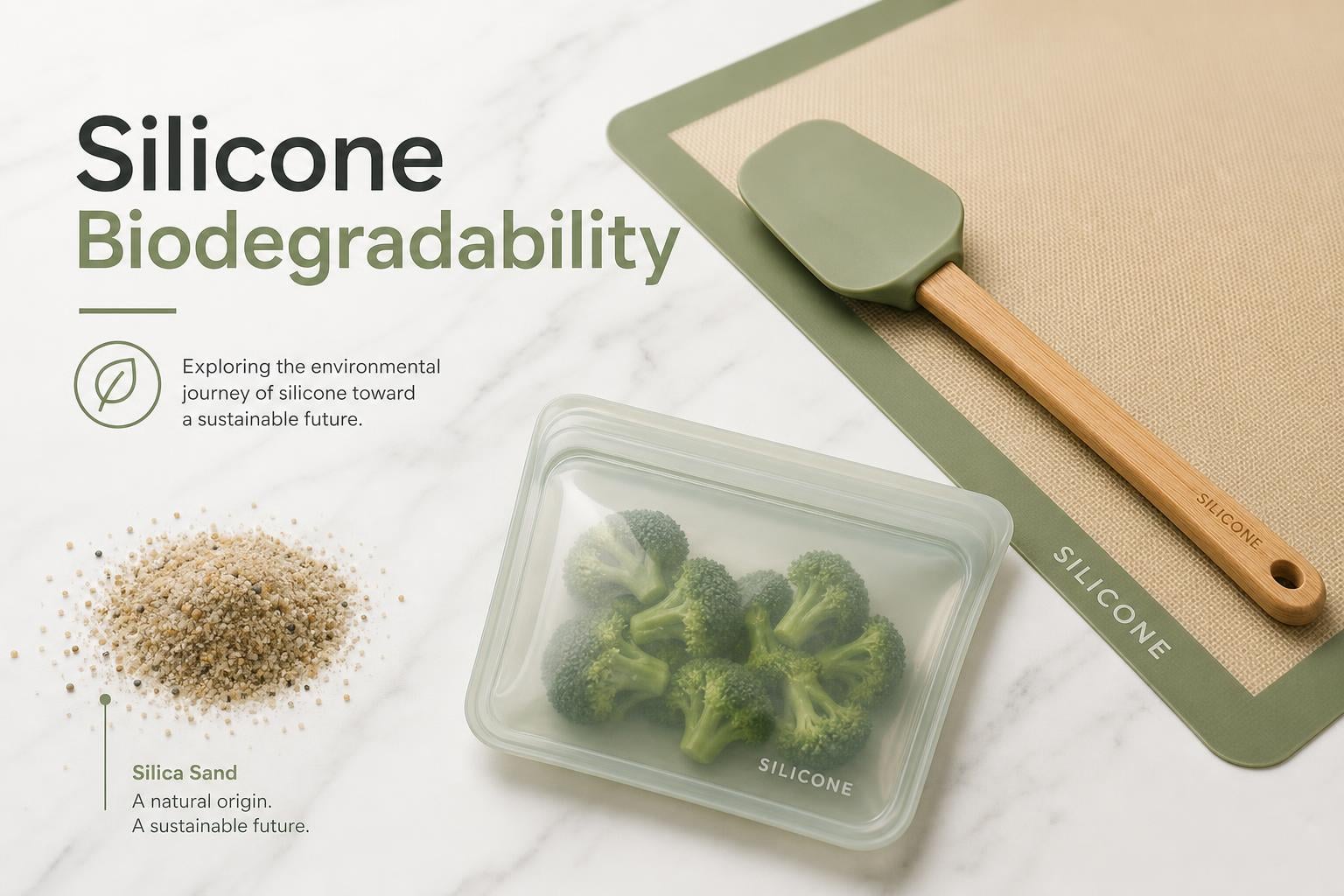
Silicone has become the go-to material for eco-conscious consumers looking to ditch single-use plastic. You will find it in reusable food storage bags, baking mats, menstrual cups, baby bottle nipples, phone cases, and kitchen spatulas. But a question that keeps surfacing in sustainability circles is whether silicone biodegradability lives up to the marketing hype.
The short answer is no. Silicone does not biodegrade in any meaningful human timeframe. It is a synthetic polymer built on a silicon-oxygen backbone that resists microbial breakdown, photodegradation, and hydrolysis under normal environmental conditions. Products made from silicone can persist in landfills and natural environments for hundreds of years.
That said, the full picture is more nuanced than a simple pass-or-fail test. Silicone does offer genuine environmental advantages over single-use plastic during its use phase, particularly when a single durable item replaces thousands of disposable counterparts. The problem arises at end of life, where silicone neither decomposes nor fits into standard recycling streams.
This guide breaks down what silicone actually is, how it is manufactured, whether it decomposes in nature, what recent research reveals about microplastic release, and how its carbon footprint compares to other materials. We also cover recycling realities, human health safety, bio-based innovations, and practical alternatives so you can make informed choices for 2026.
Silicone is not plastic, and it is not natural rubber. It occupies a chemical middle ground that shares properties with both while belonging to neither family. At the molecular level, silicone is a synthetic polymer built on alternating silicon and oxygen atoms, with organic methyl groups attached to the silicon atoms. This siloxane backbone gives silicone its characteristic heat resistance, flexibility, and chemical stability.
The most common form of silicone used in consumer products is polydimethylsiloxane, or PDMS. If you have ever used a silicone baking mat, a reusable food bag, or a menstrual cup, you have handled PDMS. Other silicone formulations exist for industrial sealants, medical implants, automotive gaskets, and wind turbine blade coatings, but PDMS dominates the consumer market.
Silicone starts with silica sand, one of the most abundant materials on Earth. Silica is quartz, the same mineral that makes up beach sand and glass. This origin point is why silicone is often marketed as natural or sand-derived. The reality, however, is that transforming silica sand into usable silicone requires an energy-intensive chemical process that bears no resemblance to anything found in nature.
The finished polymer chain contains silicon, oxygen, carbon, and hydrogen. Those silicon-oxygen bonds are exceptionally strong, far stronger than the carbon-carbon bonds found in conventional plastics. This molecular strength is exactly what makes silicone so durable, and exactly what prevents it from breaking down in the environment.
Understanding silicone biodegradability requires understanding how the material is made. The production process explains both its environmental footprint and its resistance to decomposition.
Step one involves extracting metallurgical-grade silicon from silica sand in an electric arc furnace heated to approximately 3,600 degrees Fahrenheit. This furnace heating accounts for roughly 66 percent of the total greenhouse gas emissions associated with silicone production. The energy demands are enormous, and the process consumes significant electricity, much of which still comes from fossil fuel sources.
Step two converts that silicon into methyl chloride gas through a reaction with methanol and hydrochloric acid. This intermediate compound, known as methylchlorosilane, is then distilled and refined through a series of chemical reactions.
Step three polymerizes the refined siloxane compounds into long-chain PDMS polymers. The length and structure of these chains determine whether the final product is a liquid silicone oil, a flexible elastomer, or a rigid resin. Catalysts, crosslinking agents, and sometimes platinum are added to achieve specific material properties.
The result is a material that is chemically inert, thermally stable up to 500 degrees Fahrenheit or higher, and highly resistant to oxidation, UV radiation, and microbial attack. These same properties that make silicone so useful in kitchens, hospitals, and industrial applications are precisely the properties that prevent silicone biodegradability.
Silicone is frequently lumped together with plastic and rubber, but the three materials differ significantly in composition, origin, and environmental behavior. Here is how they stack up.
Natural rubber is harvested as latex from rubber trees. It is a plant-based polymer that microorganisms can break down over time, especially under warm, humid conditions. Natural rubber does degrade, though the process can take years depending on the environment. You can learn more about natural rubber biodegradability in our dedicated guide.
Synthetic rubber is derived from petroleum, much like conventional plastic. It shares plastic’s durability and environmental persistence, making it difficult to break down naturally. Most commercial rubber products, including car tires, are synthetic or a blend of natural and synthetic rubber.
Conventional plastic is made entirely from petroleum feedstocks. Polyethylene, polypropylene, and polystyrene dominate consumer packaging. These materials persist for hundreds of years, fragment into microplastics, and leach additives like BPA and phthalates into the environment. For a deeper comparison, see our guide on silicone-coated baking paper safety and how it relates to kitchen materials.
Silicone sits apart from both rubber and plastic. It is derived from sand rather than petroleum, which gives it an advantage in raw material sourcing. But its siloxane backbone makes it even more resistant to environmental breakdown than most plastics. While plastics at least fragment into smaller pieces over time, silicone maintains its structural integrity almost indefinitely.
The comparison matters because consumers often choose silicone believing it is the sustainable alternative to plastic. In terms of reusability and human health, that belief has merit. But when the question is whether silicone decomposes in nature, silicone actually performs worse than many petroleum plastics.
No, silicone is not biodegradable. Silicone does not decompose or biodegrade in a traditional sense. Its silicon-oxygen backbone resists the hydrolysis, enzymatic attack, and microbial digestion that break down organic materials and even some petroleum plastics. Silicone persists in the environment for hundreds of years without meaningful degradation, resisting extreme temperatures, UV exposure, and chemical breakdown.
This direct answer is the one most consumers are searching for. The marketing surrounding silicone often implies environmental responsibility, with phrases like “made from sand” and “ocean-friendly” appearing on product packaging. But the scientific reality is unambiguous: silicone biodegradability does not exist in any practical sense.
When silicone products reach landfills or natural environments, they remain largely unchanged. Research on PDMS degradation in soil shows extremely slow breakdown rates. A study by Lehmann et al. (2000) found that PDMS in soil degrades only under very specific conditions involving clay minerals and adequate moisture, and even then, the process takes decades rather than years.
Hydrolysis, the chemical breakdown caused by water, can theoretically cleave siloxane bonds. However, research by Ducom et al. (2013) demonstrated that hydrolysis of PDMS occurs at rates so slow that it has no practical environmental significance under normal conditions. The process requires either strongly acidic or alkaline environments and elevated temperatures to proceed at measurable speeds.
Photodegradation from sunlight exposure can cause surface oxidation and minor changes in mechanical properties over time. But photodegradation does not mineralize silicone into harmless components. Instead, it merely causes the surface to become brittle, potentially leading to fragmentation rather than true decomposition.
The bottom line is that a silicone spatula tossed into a landfill today will still be recognizable as a silicone spatula when your great-grandchildren are adults. This is the core problem with silicone biodegradability claims.
No. Silicone is not compostable in either backyard or commercial composting systems. Composting requires organic materials that microorganisms can consume and convert into humus. Silicone contains no organic carbon that composting organisms can metabolize.
Even high-temperature commercial composting facilities that handle biodegradable polymers like polylactic acid (PLA) cannot process silicone. The thermophilic bacteria that drive commercial composting simply have no enzymatic pathway to break siloxane bonds.
If you place a silicone food storage bag in your compost bin, it will still be there years later, completely intact. This is an important distinction for consumers who assume that anything plant-derived or plastic-alternative must be compostable.
This is one of the most pressing questions in current silicone research, and the answer is more concerning than many consumers realize. Multiple academic studies published between 2023 and 2024 have documented microplastic and nanoplastic release from silicone products under various conditions.
A 2023 study by Fang et al. examined silicone sealants and found that mechanical stress, UV exposure, and temperature cycling all contributed to the release of microplastic particles. These particles ranged from a few micrometers down to sub-micron sizes, small enough to enter aquatic ecosystems and potentially accumulate in living organisms.
Research by Ekvall et al. (2023) investigated nanoparticle release from silicone baby pacifiers. The study found that mechanical stress during normal use, including biting and sucking, caused measurable nanoparticle shedding. While the health implications of silicone nanoparticle ingestion remain under investigation, the findings raise questions about the assumption that silicone is inert during use.
A follow-up study by Fang et al. (2024) expanded this research to silicone syringes used in medical settings. The results showed detectable microplastic contamination in liquids stored in or passed through silicone components. Giannattasio et al. (2024) further documented PDMS debris in seawater environments, confirming that silicone products reaching marine ecosystems do contribute to the microplastic pollution load.
These findings complicate the narrative that silicone is environmentally harmless. While it may not fragment as readily as conventional plastic, it does eventually break into smaller pieces rather than chemically decomposing. Those pieces persist as microplastic and nanoplastic contamination, joining the broader pollution problem in oceans and waterways.
Consumers on forums like Reddit’s r/ZeroWaste frequently express frustration about this issue. Many note that silicone is marketed as a clean alternative to plastic while sharing plastic’s most problematic end-of-life trait: fragmentation into persistent microplastics.
Silicone’s defining characteristic is its extraordinary durability. Products made from silicone can last decades, and some industrial applications are rated for 50 years or more of service life. This durability is both silicone’s greatest environmental asset and its greatest environmental liability.
Specific lifespan data helps contextualize the sustainability equation. Here is what the research and industry data tell us about how long silicone products actually last.
These numbers reveal an important tension. The long lifespan of silicone sealants, roof coatings, and structural glazing means those products deliver substantial functional value over decades. But it also means that every ounce of silicone ever produced for these applications is either still in use or sitting somewhere in the environment, unchanged.
Silicone does undergo changes under certain conditions, even if those changes do not constitute true biodegradation. Understanding these factors helps explain why silicone persists so stubbornly.
None of these factors result in true mineralization, the process by which a material is fully converted into carbon dioxide, water, and inorganic compounds. Instead, silicone merely fragments or undergoes minor surface changes while its fundamental polymer structure remains intact.
While silicone biodegradability is a significant environmental concern, human health safety is a separate question where silicone generally performs well. Food-grade and medical-grade silicone is widely considered safe for consumer use, and it offers clear advantages over conventional plastic in this regard.
The FDA approves food-grade silicone for food-contact applications. Unlike many plastics, silicone does not contain bisphenol A (BPA), phthalates, or other known endocrine-disrupting chemicals. It does not leach harmful compounds when heated, which makes it preferable to plastic containers for microwave and oven use.
Medical-grade silicone has been used for decades in implants, tubing, and surgical applications. Its biocompatibility is well established, meaning it does not trigger significant immune responses or toxic reactions when in contact with human tissue. This is why silicone is the material of choice for menstrual cups, baby bottle nipples, and medical devices.
However, not all silicone products are created equal. Lower-quality silicone items may contain fillers, plasticizers, or other additives that compromise both safety and durability. Consumers can perform a simple pinch-and-twist test to check for fillers: pinch and twist a piece of the silicone. If the stressed area turns white, the product likely contains fillers. Pure food-grade silicone will maintain its original color.
Questions about cyclic siloxane compounds also deserve attention. D4 (octamethylcyclotetrasiloxane), D5 (decamethylcyclopentasiloxane), and D6 (dodecamethylcyclohexasiloxane) are small cyclic molecules used in silicone manufacturing. Some of these compounds have been identified as potential endocrine disruptors and have been found to bioaccumulate in aquatic organisms. The European Union has placed restrictions on D4 and D5 in certain personal care products due to these concerns.
While finished silicone products contain very low levels of residual cyclic siloxanes, the manufacturing process and initial polymerization can release these compounds into the environment. This is a concern primarily at the production stage rather than during consumer use, but it adds to the overall environmental footprint of silicone.
If silicone is not biodegradable and not compostable, then recycling becomes the critical end-of-life question. Unfortunately, silicone recycling is far more limited than most consumers assume.
Yes, technically. But almost never through your curbside bin. Standard municipal recycling facilities are not equipped to process silicone. The material does not melt at the same temperatures as common recyclable plastics, and it cannot be sorted by the optical systems used in Materials Recovery Facilities.
Silicone recycling requires a chemical process called depolymerization. In this process, the long PDMS polymer chains are broken back down into shorter oligomer segments, which can then be repolymerized into new silicone products. This is fundamentally different from mechanical recycling used for PET bottles or aluminum cans.
According to industry data, approximately 35,000 to 45,000 metric tons of silicone were recycled globally in 2024 through specialized chemical recycling operations. While this number is growing, it represents only a small fraction of total silicone production and consumption.
If you want to keep your worn-out silicone items out of landfills, here are the realistic options available to you.
The reality is that most silicone products currently end up in landfills. The recycling infrastructure for silicone is in its early stages, and consumer access remains limited. This is one of the strongest arguments against treating silicone as a fully sustainable material.
To fairly assess silicone biodegradability and overall environmental impact, we need quantitative data. Vague claims about being “better than plastic” are not sufficient. Here is what the numbers actually show.
The production of polydimethylsiloxane generates approximately 6.3 kilograms of CO2 equivalent per kilogram of material. This figure comes from life cycle assessment data and includes the energy-intensive electric arc furnace process, chemical synthesis, and polymerization steps.
How does this compare to other materials? Polyethylene production emits roughly 2.15 kg CO2e per kg, and polypropylene emits about 2.73 kg CO2e per kg. This means silicone production has a carbon footprint roughly two to three times higher than conventional plastic on a per-kilogram basis.
Aluminum, by comparison, emits approximately 14.8 kg CO2e per kg, making it more than twice as carbon-intensive as silicone. Glass falls somewhere in between plastic and silicone, depending on the type and recycled content.
However, raw per-kilogram comparisons can be misleading. A single silicone food storage bag can replace thousands of disposable plastic bags over its lifetime. When calculated on a per-use basis, the carbon footprint of a durable silicone product can be dramatically lower than the cumulative footprint of the disposable alternatives it replaces.
This concept is known as net positive greenhouse gas impact. Industry research suggests that silicone used in renewable energy applications, such as wind turbine blade coatings and solar panel encapsulants, can deliver greenhouse gas benefits up to 14 times greater than the production emissions. A wind turbine blade coated with silicone generates clean energy for decades, offsetting far more carbon than was emitted during the silicone’s production.
Beyond CO2 emissions, silicone manufacturing raises concerns about cyclic siloxane compounds. D4, D5, and D6 are volatile cyclic molecules that can be released during the polymerization process and from finished products during their early use phase.
These compounds have been detected in wastewater, soil, and aquatic organisms. Studies have shown that D4 and D5 can bioaccumulate in fish and other aquatic species, meaning they build up in tissue faster than they can be eliminated. The European Chemicals Agency has classified D4 as a substance of very high concern and has restricted its use in personal care products.
The EU has gone further than most jurisdictions in regulating cyclic siloxanes. Restrictions on D4 and D5 in rinse-off cosmetic products took effect in 2020, and additional regulatory actions are under consideration. The United States has not implemented comparable federal restrictions, though some states are beginning to evaluate these compounds.
Bringing together the full picture of silicone’s environmental impact, here is a balanced assessment of the advantages and drawbacks.
Environmental advantages of silicone:
Environmental disadvantages of silicone:
The honest assessment is that silicone is neither an environmental savior nor an environmental villain. It is a tool whose sustainability depends entirely on how it is used. When a durable silicone product replaces hundreds of single-use plastic items, it delivers a net environmental benefit. When it is used once and sent to a landfill, it is worse than the plastic it replaced.
If silicone biodegradability falls short and recycling options are limited, what should environmentally conscious consumers choose instead? The answer depends on the specific use case, because no single material is perfect across every application.
For kitchenware: Bamboo utensils offer a biodegradable alternative for spatulas, cutting boards, and cooking tools. Bamboo grows rapidly without pesticides, and finished bamboo products decompose naturally at end of life. Stainless steel provides another option for pots, pans, and food storage containers. It is infinitely recyclable and does not degrade through repeated use. Glass containers with silicone-free lids work well for food storage and reheating.
For baby products: Natural rubber pacifiers and teething rings are plant-based and biodegradable. They decompose over time, unlike their silicone counterparts, though they may need more frequent replacement due to faster material degradation.
For sealants and adhesives: Some companies now produce biodegradable polymer sealants that break down naturally without leaving persistent residues. These products are not yet as durable or versatile as silicone sealants, but they are improving rapidly. If you are also interested in sustainable cork products, cork-based sealants and fillers offer another natural alternative.
For menstrual products: While silicone menstrual cups are reusable for up to 10 years, natural rubber alternatives exist. Additionally, organic cotton tampons and pads, period underwear, and other reusable fabric options provide biodegradable or long-lasting alternatives.
Researchers are actively working on making silicone itself more sustainable. The RISD Biodesign program has experimented with bio-silicone formulations that incorporate potato starch, arrowroot starch, agar, glycerin, and other renewable ingredients. These experimental materials aim to maintain silicone’s useful properties while introducing biodegradability.
Companies like Agood.com are developing bio-based silicones using renewable resources that show promising potential for reduced environmental impact. These innovations are still in early stages and are not yet commercially available at scale, but they represent a potential path toward truly biodegradable silicone products.
Chemical recycling advances also offer hope. Improved depolymerization processes could make closed-loop silicone recycling economically viable, reducing the need for virgin silicone production and keeping post-consumer silicone out of landfills. The 35,000 to 45,000 metric tons recycled in 2024 represents progress, but the industry needs substantial growth to make a meaningful difference.
Until bio-based alternatives mature and recycling infrastructure expands, the most practical strategy for most consumers is to choose silicone selectively for applications where its durability delivers maximum benefit, and choose biodegradable alternatives for everything else. For more ideas, explore our guide to eco-friendly zero waste alternatives.
No, silicone is not biodegradable. It does not break down through microbial action, enzymatic processes, or natural decomposition in any practical timeframe. Silicone products persist in landfills and natural environments for hundreds of years without meaningful degradation due to the strength of their silicon-oxygen polymer backbone.
Silicone is eco-friendly only in specific contexts. It offers environmental benefits when a single durable silicone product replaces hundreds of single-use plastic items, reducing overall waste and consumption. However, silicone is not biodegradable, not compostable, and difficult to recycle, which means it is not eco-friendly at end of life. Its sustainability depends entirely on how long it is used and what it replaces.
Yes, food-grade and medical-grade silicone is generally healthier than conventional plastic for consumer use. Silicone is BPA-free, phthalate-free, and does not leach endocrine-disrupting chemicals when heated. The FDA approves food-grade silicone for food-contact applications. However, consumers should watch for lower-quality silicone products containing fillers and perform a pinch-and-twist test to verify purity.
No, silicone does not decompose in nature. Its silicon-oxygen bonds are stronger than the carbon-carbon bonds in conventional plastics, making silicone even more resistant to environmental breakdown. Silicone products dropped in soil, oceans, or landfills remain structurally intact for centuries, only undergoing minor surface changes from UV exposure or mechanical stress.
Yes, recent research shows that silicone does fragment into microplastics and nanoplastics under mechanical stress, UV exposure, and temperature cycling. Studies published in 2023 and 2024 documented microplastic release from silicone sealants, baby pacifiers, and medical syringes. While silicone may fragment more slowly than conventional plastic, it contributes to microplastic pollution rather than chemically decomposing.
Silicone effectively never decomposes within any practical human timeframe. It persists for hundreds of years in landfills and natural environments. Under very specific soil conditions involving clay minerals and adequate moisture, PDMS silicone can undergo slow degradation measured in decades, but this does not occur in typical landfill or compost environments.
No, silicone is not compostable in either backyard or commercial composting systems. Composting requires organic materials that microorganisms can metabolize, and silicone contains no organic carbon accessible to composting organisms. A silicone product placed in a compost bin will remain intact and unchanged indefinitely.
Silicone can be recycled through specialized chemical depolymerization, but it is not accepted by standard curbside recycling programs. Specialized companies like TerraCycle and Eco USA process silicone, and some manufacturers offer take-back programs. Approximately 35,000 to 45,000 metric tons of silicone were recycled globally in 2024, representing only a small fraction of total production.
Silicone biodegradability is not a gray area. The science is clear: silicone does not biodegrade, does not compost, and does not decompose in nature within any meaningful timeframe. Every silicone product ever manufactured is either still in use or sitting somewhere in a landfill, essentially unchanged.
That does not mean silicone has no place in a sustainable lifestyle. When used strategically to replace single-use plastic, a durable silicone product can prevent hundreds of disposable items from entering the waste stream. The environmental math favors silicone when the use phase is long enough to offset its higher production footprint. A silicone baking mat used 2,000 times is a net environmental win. A silicone phone case replaced after six months is not.
The key is intentionality. Choose silicone for applications where its durability and heat resistance deliver genuine value over many years of use. Choose biodegradable alternatives like bamboo, glass, stainless steel, or natural rubber when those materials can do the job equally well. And when a silicone product reaches the end of its useful life, make the effort to find a specialized recycling program rather than tossing it in the trash.
For more guidance on building a genuinely sustainable lifestyle, explore our resources on environmentally friendly choices and discover eco-friendly zero waste gifts that align with your values. Making informed material choices is one of the most powerful things each of us can do for the planet, and understanding the truth about silicone biodegradability is an essential part of that process.
