

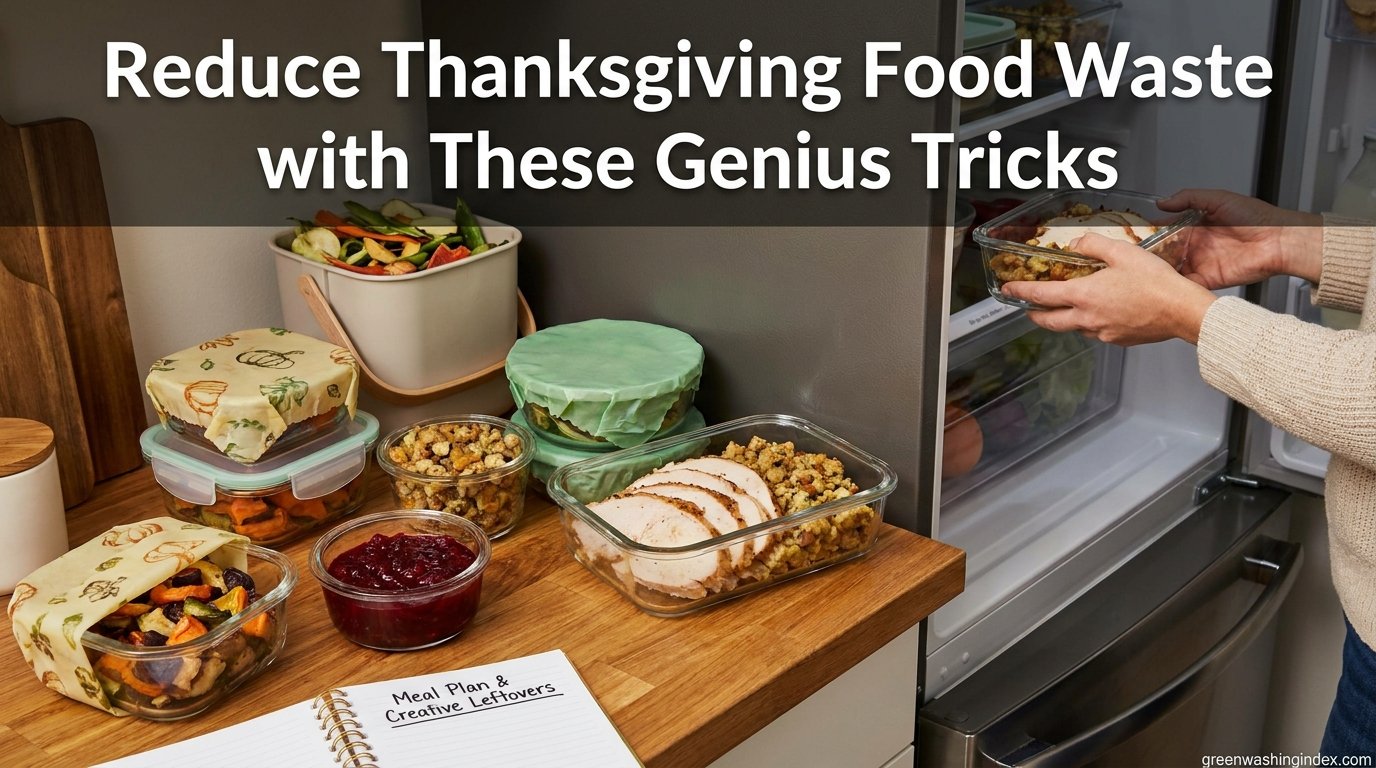
Every year, American households toss out staggering amounts of perfectly good food on Thanksgiving. ReFED’s 2024 report puts the number at over 320 million pounds of wasted holiday food worth more than $550 million. That kind of waste doesn’t just hurt your grocery budget. It also carries a real environmental cost that experts from the USDA, WWF, and Tufts Nutrition have been highlighting for years. The good news? A few intentional choices before, during, and after the meal can transform your Thanksgiving from a waste-generator into a model of sustainable celebration. Whether you are hosting ten people or just two, the strategies in this guide will help you serve a memorable meal while keeping food out of the trash.
For readers looking for year-round food waste reduction strategies beyond Thanksgiving, check out our comprehensive guide to food waste reduction.
Calculate portion sizes based on actual guest count before shopping
Use every part of your ingredients, from vegetable peels to turkey bones
Store leftovers promptly at the correct temperature and use within safe timeframes
Donate surplus prepared food to local shelters following USDA safety guidelines
Compost organic scraps instead of sending them to a landfill
Thanksgiving sits at the center of American food culture, and for good reason. The holiday brings families together around tables laden with dishes that often represent hours of planning, shopping, and cooking. But that abundance comes with a hidden cost. Between the planning, shopping, cooking, and cleanup, most hosts end the day with more food than anyone can reasonably eat. Leftovers fill the fridge, then gradually migrate to the trash bin over the following weeks.
Food waste reduction at Thanksgiving doesn’t require drastic lifestyle changes or complicated systems. It simply demands a more deliberate approach to how much you prepare, how you cook, and what you do with the extras. The strategies below come from research by the USDA, WWF, ReFED, and Tufts Nutrition, and they reflect what the latest data tells us about where waste happens and how to stop it.

Understanding the scale of the problem makes it easier to stay motivated about making changes. According to ReFED’s 2024 U.S. Food Waste Report, Americans generate 88 million tons of food waste annually. Thanksgiving alone accounts for over 320 million pounds of discarded food, valued at more than $550 million. The average household throws away approximately 25 percent of the turkey it purchases during the holiday. That means roughly one in every four slices of cooked bird ends up uneaten. Globally, food waste reaches an estimated 1.3 billion tons per year, as the World Wildlife Fund has documented.
The Thanksgiving holiday week alone produces more than five million tons of food waste across the country. Each discarded pound represents not just the raw ingredients but also the water, energy, labor, and transportation embedded in bringing that food from farm to table. The financial hit to families averages around $80 per Thanksgiving meal when you factor in purchased ingredients that never get eaten. These numbers aren’t meant to induce guilt. They exist to show that even modest changes at the household level can add up to meaningful impact when millions of people participate.
When food ends up in a landfill, it doesn’t simply decompose harmlessly. Organic waste buried underground breaks down without oxygen, a process that produces methane. Methane has roughly 28 to 36 times the warming potential of carbon dioxide over a 100-year period, making it one of the most damaging greenhouse gases in the short term. The EPA estimates that food waste accounts for roughly 8 percent of total U.S. methane emissions, and the Thanksgiving and holiday season creates a dramatic seasonal spike in organic material entering landfills. Every discarded turkey, scoop of stuffing, and slice of pie that goes uneaten contributes to that total. WWF research further explains that food waste squanders the natural resources invested in producing it.
A single Thanksgiving turkey requires hundreds of gallons of water during its lifecycle, along with significant land use for feed production. When that turkey ends up in the trash, all those embedded resources are lost. Food production accounts for approximately 10 percent of all U.S. greenhouse gas emissions when you factor in farming, processing, transportation, and refrigeration. Every pound of food that doesn’t get thrown away represents a small but real reduction in that total.
Composting Thanksgiving organic waste instead of landfilling it can cut methane output dramatically and produces nutrient-rich soil amendments that reduce the need for synthetic fertilizers. Many cities across the country have expanded their curbside composting programs, making participation easier than ever before. Reducing holiday food waste isn’t just a personal finance tip. It’s a tangible climate action that anyone hosting a meal can take.
Also Read: Maggots in Compost: Why They’re Actually Good!
The foundation of a low-waste Thanksgiving is a solid plan. Taking the time to think through your menu, guest count, and portion sizes before you ever set foot in a grocery store sets the tone for everything that follows. Hosts who plan carefully almost always end the holiday with less food in the trash. The planning phase covers three main areas: understanding what your guests actually want to eat, calculating appropriate portion sizes, and building flexibility into your menu so that unexpected situations don’t result in waste.
One of the most common sources of Thanksgiving waste is cooking dishes that nobody ends up eating. A fancy side dish that sounded exciting on paper might not appeal to your particular group of guests. The easiest way to avoid this problem is to ask people what they want before you start planning. Send a quick message to your guest list a week or two before the holiday. Ask about favorite dishes, dietary restrictions, and any strong dislikes. Knowing that one guest is vegetarian, another needs gluten-free options, and a third really loves Brussels sprouts helps you build a menu that actually gets eaten.
Pay attention to how many people are in each category. If three out of eight guests are vegetarian, don’t prepare three separate full vegetarian meals. Plan one or two excellent vegetarian sides that everyone can enjoy. The same logic applies to traditional favorites. If half your guests don’t like cranberry sauce, make a smaller batch or skip it entirely. Consider offering a few build-your-own options like a mashed potato bar or a salad station.
These formats give guests control over what ends up on their plates, which naturally reduces plate waste. For beverages, avoid over-pouring by offering a self-serve drink station rather than pre-filling glasses. Skip elaborate garnishes that most people push to the side and that end up in the trash. The more precisely you match your preparation to actual demand, the less you will end up throwing away.
Cooking the right amount is one of the most powerful tools you have for preventing Thanksgiving waste. Most people significantly overestimate how much food their guests will eat. The USDA provides portion guidelines that serve as reliable starting points, and adjusting them based on your knowledge of your specific guests makes them even more effective. The key categories to plan are turkey, side dishes, vegetables, gravy, and desserts. Each has a different typical consumption pattern, and planning each one individually prevents the common mistake of cooking too much of everything.
For turkey specifically, the standard guideline is one pound of whole bird per guest. If you are buying a pre-cooked or portioned product, plan for roughly six ounces of edible meat per person. This accounts for bones, weight loss during cooking, and the fact that not everyone will take a large serving. Side dishes such as stuffing or mashed potatoes typically come in at about one-half cup per person per variety.
If you are making two different stuffing recipes, plan for one-half cup of each rather than doubling the total. Vegetables are lighter at roughly one-quarter cup per person per type. Gravy works out to about one-quarter cup per person. For desserts, budget one small slice per guest and limit yourself to one or two options rather than spreading yourself thin across five different pies. These numbers are starting points, not strict rules.
Adjust upward if your crowd includes teenage athletes or known big eaters. Dial back to about three-quarters of a pound of turkey per person if most of your guests have smaller appetites or if many children will be present. The goal is to cook enough for a generous, satisfying meal without ending the night with a refrigerator full of food that won’t get eaten.
For a party of ten, the practical numbers look like this. Plan for 10 pounds of whole turkey, 5 cups of stuffing, 5 cups of mashed potatoes, 2.5 cups each of green bean casserole and roasted carrots, 2.5 cups of gravy, and 10 small dessert slices. Scaling up or down follows the same ratio. For 12 guests, that becomes 9 pounds of turkey, 6 cups of stuffing, 6 cups of mashed potatoes, 3 cups each of vegetables, 3 cups of gravy, and 12 dessert slices. For six guests, drop to 6 pounds of turkey, 3 cups each of the main sides, and 6 dessert slices. These guidelines help you shop with precision and give you confidence that you are neither short-changing your guests nor drowning in surplus.
Many Reddit home cooks report that planning for three-quarters of a pound of turkey per person is often more realistic than the full pound guideline, especially for mixed groups with children and lighter eaters. That adjustment alone can reduce your turkey purchase by 25 percent for a ten-person gathering. Building flexibility into your menu helps too. Dishes like stuffing, cranberry sauce, and gravy store well and can be scaled up slightly without much waste risk. Foods that don’t keep, like fried onions or crispy garnishes, are better kept modest. The table below provides a quick reference for portion planning at different guest counts.
Thanksgiving Portion Planning Reference Table
| Food Category | Amount Per Person | Total for 6 Guests | Total for 10 Guests | Total for 12 Guests |
|---|---|---|---|---|
| Whole Turkey | 1 pound per person | 6 lbs | 10 lbs | 12 lbs |
| Stuffing | 1/2 cup per person | 3 cups | 5 cups | 6 cups |
| Mashed Potatoes | 1/2 cup per person | 3 cups | 5 cups | 6 cups |
| Green Vegetables | 1/4 cup per person | 1.5 cups | 2.5 cups | 3 cups |
| Gravy | 1/4 cup per person | 1.5 cups | 2.5 cups | 3 cups |
| Pie (1 slice per guest) | 1 small slice | 6 slices | 10 slices | 12 slices |
Shopping for Thanksgiving without creating excess is a skill that comes down to preparation and discipline. The difference between a wasteful shopping trip and an efficient one usually traces back to how much planning happened before leaving the house. Taking the time to build a detailed ingredient list and think strategically about where and when to shop makes a measurable difference in how much food ends up going to waste.
A detailed shopping list is the single most effective tool for buying only what you need. Start by writing down every dish you plan to make. Then, for each dish, list every single ingredient right down to the teaspoon of salt. Once the full inventory is written, go through your pantry, refrigerator, and freezer and cross off anything you already have on hand. What remains becomes your actual shopping list.
Organize that list by store layout to avoid wandering the aisles and making impulse purchases. This step also reveals whether you need to buy ingredients in quantities that will leave you with partial packages. If a recipe calls for one cup of chicken broth but you only need half a carton, note that and look for another recipe that uses the rest, or freeze the surplus. The USDA recommends checking your inventory at least twice before shopping: once when you build your list and again before you leave the house. Many shopping list apps can help you track quantities and flag items that you already own. Taking inventory before buying prevents the common scenario of returning home with duplicates that will eventually spoil.
Sustainable shopping principles from the Mediterranean Diet can help you plan a zero-waste Thanksgiving feast by emphasizing seasonal, whole ingredients purchased in precise quantities.
Bulk bins offer a simple but powerful way to buy exactly what you need without the surplus that comes with pre-packaged goods. Nuts, grains, spices, dried fruit, and even baking supplies are often available in bulk sections at grocery stores. Weigh out the exact quantity your recipe calls for and no more. This approach reduces packaging waste and ensures you aren’t paying for food you won’t use. Many bulk sections also offer lower per-unit pricing on items like nuts and grains, which can help offset the cost of your Thanksgiving ingredients. Buying from farmers markets adds another layer of precision.
Produce at farmers markets tends to be fresher and has a longer shelf life than supermarket equivalents, giving you more time to use it before it spoils. Farmers themselves can offer guidance on how much produce to buy for a specific number of guests. Many are happy to tell you that a five-pound bag of carrots will comfortably serve twelve people, for example, saving you from overbuying. Seasonal fall produce like squash, Brussels sprouts, and apples are at their peak during Thanksgiving week and often cost less than off-season alternatives. When you combine bulk bin precision with the freshness and expert advice available at farmers markets, your shopping becomes both more sustainable and more cost-effective.
How you cook matters as much as how much you cook. Mindful preparation techniques that prioritize using every part of every ingredient can dramatically reduce the volume of waste your kitchen generates. This approach, sometimes called whole-ingredient cooking or root-to-stem cooking, starts with a simple shift in perspective: before discarding any part of a vegetable, herb, or protein, ask yourself whether it has another use. The answer is usually yes. The techniques below come from nutrition experts at Tufts University, sustainability researchers at WWF, and food waste organizations including ReFED. They are practical enough for any home cook to implement without special equipment or advanced skills.

The way you apply heat to your ingredients can either preserve or discard valuable nutrients and flavors. Steaming vegetables instead of boiling them keeps nutrients in the food rather than leaching them into cooking water. Any leftover steaming liquid is packed with flavor and can be used as a base for soups or gravies. Roasting root vegetables like sweet potatoes and carrots brings out their natural sugars, reducing the need for added sweeteners and making even humble vegetables taste decadent. Roasting also uses less oil than frying, which cuts down on cooking fat waste.
Baking on parchment paper prevents sticking and reduces the need for excess butter or oil on baking sheets. Cooking in smaller, staggered batches rather than all at once keeps food at its best quality and reduces the amount that sits uneaten while waiting to be served. For mashed potatoes, consider leaving the skins on. Potato skins contain significant fiber and nutrients, and they add a pleasant texture to the finished dish.
If you do peel potatoes, save the peels for stock or roast them with olive oil and salt for crispy snacks. When making gravy, use every bit of the turkey drippings. Pour off the fat, deglaze the pan with broth or wine, and scrape up every browned bit from the bottom of the roasting pan. Those browned bits, called fond, are packed with flavor and represent concentrated cooking effort that you don’t want to throw away.
For more sustainable cooking techniques and seasonal ingredient ideas, explore our New Nordic Diet Guide, which shares root-to-stem principles applicable to any holiday meal.
Whole-ingredient cooking is one of the most effective strategies for reducing food waste in the kitchen. Almost every fruit and vegetable has multiple usable parts, and learning to identify them takes only a little practice. Start with vegetable peels and trimmings. Carrot peels, celery ends, onion skins, leek tops, and herb stems all contain flavor and nutrients. Collect them in a bag in your freezer and, when you have enough, simmer them with water for an hour to make a free, flavorful vegetable stock. The stock can be used for soups, gravies, or risottos, and you can freeze it in portion-sized containers for months. Carrot tops, often discarded, make excellent pesto when blended with olive oil, garlic, nuts, and Parmesan. Celery leaves have a more concentrated flavor than the stalks and work well in salads, soups, or as a garnish.
Herb stems from thyme, rosemary, and parsley may be too tough to eat whole, but they release excellent flavor when simmered in oils, soups, or stocks. Turkey bones and the leftover carcass after carving are among the most valuable scraps in a Thanksgiving kitchen. Simmer the carcass with onion, carrot, celery, and herbs for three to four hours to make a rich turkey stock that freezes well for up to three months. Collect every bit of drippings from the roasting pan. Skim off the fat, add broth to the pan, and scrape up the fond. That liquid gold becomes the base for your gravy and represents hours of turkey flavor that would otherwise wash down the drain.
Potato skins, when scrubbed clean, are edible and nutritious. If you prefer your mashed potatoes without skins, don’t discard them. Toss the peels with olive oil and salt and roast them until crispy for a savory snack. Onion and garlic skins add depth to stocks and broths. Citrus peels can be zested before juicing and then dried or candied for baking and cocktails. Apple and pear cores make excellent infused water or cider.
Bread that has gone stale doesn’t need to be thrown out. Cube it for stuffing, process it into breadcrumbs, or toss it with olive oil and seasonings for croutons. Stale dinner rolls can become strata or bread pudding. Turkey fat, when carefully strained and stored, works as a flavorful cooking fat for winter vegetables and potatoes. Leek greens, often discarded in favor of the white parts, can be sliced thin and used like scallions in salads and garnishes. Broccoli and cauliflower stems are just as nutritious as the florets. Peel away the tough outer layer and slice the inner stem for roasting, stir-frying, or adding to soups. These small habits, practiced across dozens of ingredients, add up to a significantly smaller trash bag at the end of the holiday.
Leftovers are where Thanksgiving waste either happens or gets solved. The difference usually comes down to having a plan before the meal is over. If you know exactly what you will do with each component of the meal, you are far more likely to actually use it. The ideas below cover everything from simple reheat-and-eat dishes to more involved transformations that make leftovers feel like a completely different meal. The USDA recommends consuming refrigerated leftovers within three to four days or freezing them for longer storage. Getting food into proper storage containers promptly after the meal is the first and most important step.
One of the biggest reasons leftovers end up uneaten is that they feel repetitive. Eating the same turkey sandwich four days in a row loses its appeal quickly. The recipes below recombine Thanksgiving ingredients into fresh-tasting dishes that feel intentional rather than obligatory. Each one takes basic leftovers and transforms them into something worth looking forward to.
Turkey Tetrazzini is a classic for good reason. Cooked pasta, shredded turkey, peas, and a cream sauce come together in a casserole dish. Top with breadcrumbs and Parmesan, then bake at 375 degrees Fahrenheit for about 25 minutes until the top is golden and the sauce is bubbling. This dish serves roughly six people and comes together in under 45 minutes. It works equally well with leftover ham or chicken if your turkey was all used up.
Stuffing Waffles turn cold leftover stuffing into something unexpectedly delicious. Mix the stuffing with a beaten egg to help it hold together, then press it into a hot waffle iron. Cook until crispy on the outside and heated through, about five minutes per waffle. The result is crispy on the edges, moist inside, and perfect with a drizzle of maple syrup or a ladle of gravy on top. This works best with drier stuffing mixtures. If your stuffing is very moist, add a bit of breadcrumb to absorb the extra moisture before pressing it into the waffle iron.
Turkey and Cranberry Quesadillas are a quick lunch or snack that combines savory and sweet flavors. Spread cranberry sauce on one side of a flour tortilla, layer with shredded turkey and a generous amount of cheese, then top with a second tortilla. Cook in a dry skillet over medium heat for about three minutes per side, until the cheese is melted and the tortilla is crispy. Cut into wedges and serve with extra cranberry sauce for dipping. Each quesadilla takes about 10 minutes and uses leftover ingredients that might otherwise sit in the refrigerator.
Loaded Mashed Potato Cakes are a satisfying way to use leftover mashed potatoes. Mix cold mashed potatoes with shredded cheddar, crumbled bacon, sour cream, and chopped chives. Form the mixture into patties about half an inch thick. Heat oil or butter in a skillet over medium heat and cook the patties for about four minutes per side, until the outside is golden and crispy and the inside is heated through. Serve with sour cream or applesauce on the side. These work equally well with sweet potatoes if you have leftover mashed sweet potatoes from the holiday.
Turkey Shepherd’s Pie transforms leftover meat and vegetables into a hearty comfort food. Combine diced turkey, leftover vegetables, and gravy in a baking dish. Top with a layer of leftover mashed potatoes, spreading it to the edges to seal in the moisture. Bake at 375 degrees Fahrenheit for about 30 minutes, until the potato layer is golden and the filling is bubbling around the edges. This dish freezes well if you have more than you can eat in a few days.
Turkey and Wild Rice Soup is one of the most popular uses for leftover turkey, and for good reason. Saute onion, carrot, and celery in butter or oil until softened, about eight minutes. Add cooked wild rice, shredded turkey, and chicken or turkey stock. Simmer for 20 minutes until the rice is heated through and the flavors have combined. Add a splash of cream or a handful of spinach at the end for extra richness and color. This soup freezes beautifully in individual portion containers and can be a quick lunch or dinner during the weeks after Thanksgiving.
Cranberry Sauce Cocktail is a surprisingly refreshing way to use leftover cranberry sauce. Blend cranberry sauce with a splash of orange juice, a squeeze of lime, and club soda. Add a shot of vodka or gin if you prefer an alcoholic version. Pour over ice and garnish with a sprig of rosemary or a twist of orange peel. This drink takes about five minutes to make and turns a leftover sauce that many people find too tart to eat plain into something festive and drinkable.
Pumpkin Pie Smoothies are an easy breakfast or snack from leftover pie. Blend a scoop of pie filling with Greek yogurt, a splash of milk, and a pinch of cinnamon. The result is a creamy smoothie with the warm spices of Thanksgiving and the protein to make it a satisfying start to the day. If you have leftover pie crust, crumble it and use it as a crunchy topping. These smoothies work equally well with sweet potato or pecan pie filling.
Proper storage is what bridges the gap between a good meal and usable leftovers. Food that is stored incorrectly can spoil within days, undoing all the effort you put into cooking it well. The key principles are temperature control, rapid cooling, airtight containment, and clear labeling. Following these guidelines keeps leftovers safe and extends their useful life by days or even months.
Cool food quickly before refrigerating. The USDA recommends getting perishable food into the refrigerator within two hours of cooking. To cool food rapidly, divide large portions into smaller, shallow containers. A deep pot of stuffing will take hours to cool to a safe temperature in the middle. Spreading it into a two-inch-deep pan cuts that cooling time dramatically. Never leave Thanksgiving leftovers sitting at room temperature for more than two hours, or one hour if the room temperature is above 90 degrees Fahrenheit. This rule, sometimes called the two-hour rule, is one of the most important food safety practices for holiday cooking.
Use the right containers. Glass containers with locking lids are preferred by many home cooks because they don’t absorb odors or stains and create a reliable airtight seal. BPA-free plastic containers work well too, especially for items you plan to freeze. Freezer bags with the air pressed out are excellent for flat items like leftover turkey slices or gravy. Vacuum sealing, recommended by many Reddit home cooks, removes air from the packaging and can extend freezer storage life significantly while preventing freezer burn. Avoid overstuffing containers. Leave a small gap at the top to allow for expansion if you are freezing liquids like soup or gravy.
Label everything with the date and contents. A simple masking tape label with the food name and the date it was stored prevents the common frustration of opening a container weeks later and not remembering what is inside. This small step also helps you use older items first, following the first-in-first-out principle that professional kitchens rely on. Keep a dry-erase board on the fridge door if you prefer not to write on the containers themselves.
Follow temperature guidelines. Your refrigerator should be set to 40 degrees Fahrenheit or below. Your freezer should be at zero degrees Fahrenheit or below. Use an inexpensive refrigerator thermometer to verify these temperatures, especially during holiday cooking when the door gets opened frequently. Store the most perishable items like cooked turkey and dairy-based sides on the top shelf where the temperature is most consistent.
Know how long leftovers last. Cooked turkey stays fresh in the refrigerator for three to four days and in the freezer for two to three months. Gravy lasts three to four days in the fridge and one to two months frozen. Cranberry sauce keeps for one to two weeks in the refrigerator and up to three months frozen. Stuffing and dressing last three to four days in the fridge and one month in the freezer. Mashed potatoes last three to five days refrigerated and one to two months frozen. Pumpkin pie keeps for three to four days in the fridge and one to two months frozen. These timelines are guidelines, not guarantees. Always use your senses and the temperature rules above to judge whether a leftover is still good.
Food safety is a critical component of waste reduction that many guides overlook. Safely stored leftovers are leftovers that actually get eaten rather than being discarded out of caution. Understanding the correct temperatures and time limits keeps your family safe and your food out of the trash. The USDA sets the standards that home cooks should follow, and these guidelines are especially important when donating food to others.
Keep cold food at 40 degrees Fahrenheit or below at all times. Keep hot food at 140 degrees Fahrenheit or above. The danger zone for bacterial growth is between 40 and 140 degrees, where bacteria multiply rapidly. The two-hour rule means that perishable food should not sit at room temperature for more than two hours total. On a warm Thanksgiving day above 90 degrees, that window shrinks to one hour. If food has been sitting out for longer than the safe window, discard it. Do not rely on smell or appearance to judge safety. Some bacteria that cause foodborne illness do not produce noticeable odors or visual changes.
When donating Thanksgiving leftovers to food banks or shelters, follow the same temperature standards. Contact the organization beforehand to confirm they accept prepared foods, as not all food banks do. Transport food in insulated coolers to maintain safe temperatures. Label all donated containers with the food type and the date it was prepared. For more on turning Thanksgiving scraps into something useful for the earth, see our guide to composting food scraps properly.
Freezing Leftovers: A Quick Timeline Guide
Turkey (cooked, sliced or shredded): 2 to 3 months in the freezer
Gravy: 1 to 2 months frozen
Stuffing and dressing: 1 month frozen
Mashed potatoes: 1 to 2 months frozen
Cranberry sauce: Up to 3 months frozen
Pumpkin pie: 1 to 2 months frozen
Turkey stock or broth: 2 to 3 months frozen
To freeze any leftover, let it cool to room temperature first, then transfer it to an airtight freezer bag or container. Press out excess air before sealing to prevent freezer burn. Label every package with the contents and the date. Use the oldest items first. When you are ready to use frozen leftovers, thaw them in the refrigerator overnight rather than at room temperature. Reheat leftovers to an internal temperature of 165 degrees Fahrenheit, checking with a food thermometer for accuracy.
Even with the best planning and storage habits, you may still end up with more food than you can use. Two strategies can ensure that surplus doesn’t simply end up in the trash: donating edible food to people who need it, and composting organic scraps that can no longer be eaten. Together, these approaches form the final line of defense against holiday food waste and embody the generous spirit that Thanksgiving represents.
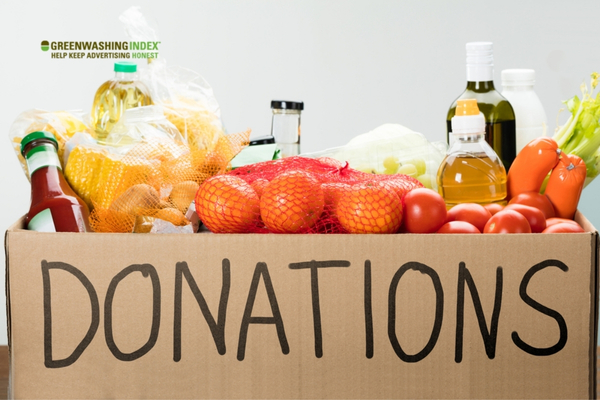
Donating Thanksgiving food is one of the most direct ways to turn abundance into community benefit. Start by identifying local organizations that accept food donations. Many food banks, shelters, and community centers welcome prepared holiday meals during the Thanksgiving week. Call ahead to confirm what types of food they can accept, their delivery hours, and any packaging requirements.
Some organizations only accept unopened, non-perishable items, while others welcome fully prepared meals. If you have prepared dishes to donate, transport them in insulated containers that maintain safe temperatures. Label each container with the food type, preparation date, and any relevant allergen information. Community fridges, an increasingly common feature in urban neighborhoods, offer another option for sharing surplus food.
These public refrigerators operate on a take-what-you-need, give-what-you-can model and are often accessible 24 hours a day. Apps and social media groups dedicated to food sharing can help connect you with neighbors who would welcome extra Thanksgiving food. Always follow the USDA food safety guidelines for hot and cold temperatures when transporting donated food. Keep cold foods below 40 degrees Fahrenheit and hot foods above 140 degrees Fahrenheit throughout the donation process.
Composting is the process of letting organic matter decompose under controlled conditions to produce nutrient-rich soil amendments. For Thanksgiving waste specifically, composting handles the scraps that nobody can eat: vegetable peels, fruit cores, coffee grounds, eggshells, and small amounts of plain cooked vegetables. Here is how to start a compost system at home, whether you have a backyard or just a kitchen counter. Choose a bin that fits your space. A small countertop compost pail works for apartment dwellers. A tumbler or open bin suits a backyard. Know what goes in.
Compostable items include vegetable peels, fruit scraps, coffee grounds, eggshells, tea bags, plain bread and grains, and yard waste like leaves and grass clippings. Do not compost meat, poultry, fish, dairy products, oily or greasy foods, or foods with heavy sauces. These items attract pests, create odors, and decompose too slowly for effective backyard composting. Layer dry materials like shredded paper, cardboard, or dry leaves between layers of wet kitchen waste.
This balance of carbon-rich dry materials and nitrogen-rich wet materials helps the compost break down evenly. Turn the pile every week or two with a shovel or pitchfork to introduce oxygen and speed up decomposition. A well-maintained compost pile breaks down in one to three months and produces dark, crumbly material that improves garden soil. If you don’t have space for a home compost bin, check whether your city offers curbside composting pickup. Many municipalities now accept food scraps alongside yard waste in their regular collection programs.
If you’re new to composting, learn why maggots in compost are actually beneficial for breaking down food scraps faster.
Plan portion sizes carefully based on your guest count, make an ingredient checklist before shopping, use root-to-stem cooking to use every part of your ingredients, store leftovers promptly at safe temperatures, donate surplus food to local shelters, and compost organic scraps instead of sending them to a landfill.
Turn leftover turkey into tetrazzini, soup, or quesadillas. Use leftover stuffing for waffles or breadcrumbs. Transform mashed potatoes into potato cakes. Blend leftover cranberry sauce into cocktails or use it as a sandwich spread. Leftover pumpkin pie makes excellent smoothies. The key is to recombine ingredients in ways that feel fresh rather than repetitive.
Over 320 million pounds of food are wasted during Thanksgiving in the United States each year, valued at over $550 million according to the 2024 ReFED report. The average household discards about 25 percent of the turkey it buys for the holiday. Nationally, food waste totals 88 million tons annually, and Thanksgiving represents one of the largest single-day contributors.
Calculate portion sizes for each dish based on the number of guests using guidelines like one pound of turkey per person and half a cup of sides per person. Ask guests about preferences and dietary needs before finalizing the menu. Shop from a detailed checklist and check your pantry first. Buy in bulk bins to purchase exact quantities. Avoid making too many different dishes that may not all get eaten.
Many food banks accept prepared Thanksgiving meals, but you must call ahead to confirm their guidelines. Keep hot foods above 140 degrees Fahrenheit and cold foods below 40 degrees Fahrenheit during transport. Use insulated containers and label all donations with the food type and preparation date. Some organizations only accept unopened, non-perishable items, so verify their specific requirements before donating prepared dishes.
Refrigerate leftovers within two hours of cooking. Keep your refrigerator at 40 degrees Fahrenheit or below. Use shallow airtight containers to speed cooling. Label everything with the date. Cooked turkey lasts three to four days in the fridge and two to three months in the freezer. Gravy lasts three to four days refrigerated and one to two months frozen. Always reheat leftovers to an internal temperature of 165 degrees Fahrenheit before serving.
Compostable items include vegetable peels, fruit scraps, coffee grounds, eggshells, plain bread and grains, and cooked vegetables without heavy sauces. Do not compost meat, poultry, fish, dairy products, oily or greasy foods, or foods with heavy sauces or cheese. These attract pests and decompose too slowly. Collect kitchen scraps in a bin and transfer them to your compost pile or curbside program regularly to prevent odors.
Plan for one pound of whole turkey per guest, or roughly six ounces of cooked meat per person if buying pre-portioned. Allow half a cup of stuffing or mashed potatoes per person per variety, one-quarter cup of vegetables per person, one-quarter cup of gravy per person, and one small slice of dessert per guest. Scale these numbers up or down based on your guests appetites.
Beyond basic sandwiches, try turkey tetrazzini, stuffing waffles, turkey cranberry quesadillas, loaded mashed potato cakes, turkey shepherd’s pie, wild rice soup, cranberry sauce cocktails, and pumpkin pie smoothies. These transformations use the same ingredients in entirely new formats that feel like different meals rather than repeats of the Thanksgiving plate.
Reducing food waste at Thanksgiving is one of the most practical and impactful things any host can do this holiday season. The statistics are hard to ignore. Over 320 million pounds of food, worth more than $550 million, gets thrown away each year. But those numbers represent a problem with a clear solution. Every host who calculates portions carefully, shops with a checklist, uses every part of their ingredients, stores leftovers properly, and shares surplus food with others is part of the answer. The environmental case for reducing waste is equally compelling.
Food that doesn’t end up in a landfill avoids generating methane, conserves the water and energy embedded in its production, and eases the burden on local waste systems. If even a fraction of American households cut their Thanksgiving waste by half, the collective impact would be enormous. Start with one or two strategies this year. Maybe that means using your turkey bones for stock, or calculating portion sizes before you shop, or donating an extra tray of food to a nearby shelter.
Each small action adds up. And when you sit down to a Thanksgiving table knowing that every dish was prepared with intention and that nothing will go to waste, the meal tastes better for it. That is the real meaning of a sustainable celebration: abundance without excess, generosity without waste, and gratitude for the food we are fortunate enough to share.
