

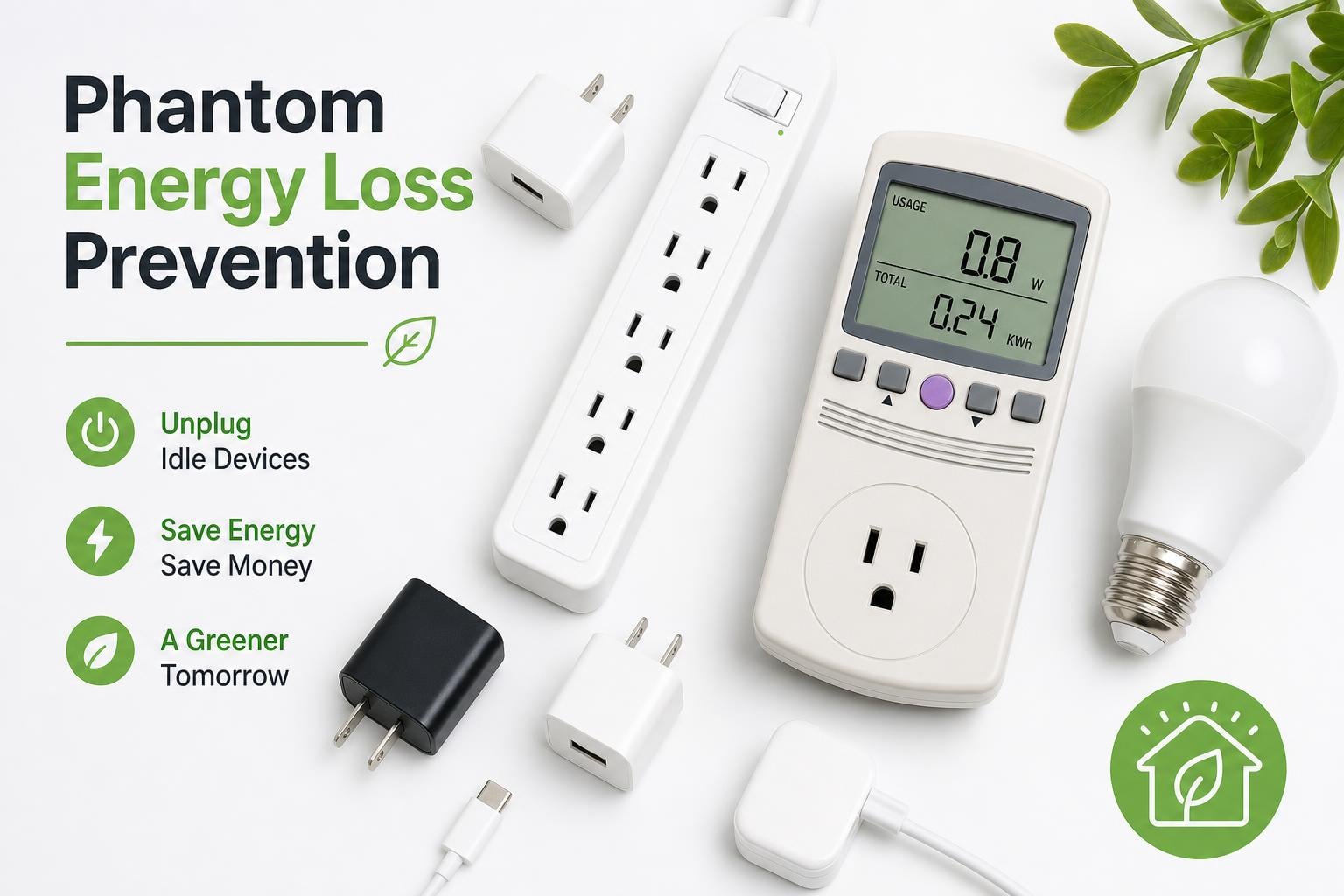
Every time you leave a device plugged in after switching it off, it keeps drawing electricity. That continuous trickle of standby power is called phantom energy, and it is quietly adding charges to your monthly utility bill. According to the U.S. Department of Energy, phantom energy accounts for 5 to 10 percent of the average household’s total electricity consumption, which translates to roughly $92 to $183 per year for a typical American home.
The problem is only getting worse. A 2015 study by the Natural Resources Defense Council (NRDC) found that standby power had grown to consume up to 23 percent of household energy use, driven largely by the explosion of always-on smart home devices, streaming equipment, and voice assistants. With the national average electricity rate now sitting at approximately $0.17 per kilowatt-hour, even a modest reduction in phantom energy loss prevention can produce meaningful savings over the course of a year.
This guide walks through everything you need to know about phantom energy: what causes it, which devices are the biggest offenders, how to measure their actual wattage draw, and what practical steps you can take today to stop vampire power from draining your wallet. Whether you are looking for a simple habit change or a full home energy audit, the strategies below will help you eliminate energy waste and reduce your carbon emissions at the same time.
Key Takeaways: Phantom energy (also called vampire power or standby power) costs the average U.S. household $92 to $183 per year. The worst offenders are cable and satellite boxes, DVRs, gaming consoles, computers in sleep mode, and large-screen TVs. You can stop phantom energy loss by unplugging idle devices, installing smart plugs or smart power strips, choosing ENERGY STAR certified replacements, and auditing your home with a Kill A Watt meter. Even small changes add up to real savings on your electric bill.
Phantom energy refers to the electricity consumed by electronic devices and appliances when they are switched off or in standby mode but remain plugged into an outlet. It is also commonly called standby power, vampire power, phantom load, or idle load. No matter what you call it, the result is the same: your devices draw power around the clock even when you are not actively using them.

Think about the phone charger still in the wall after you take your fully charged phone off the cable. That charger keeps pulling a small but steady current, known as its phantom load. Now multiply that by every device in your home: your TV waiting for a remote signal, your cable box holding its program guide, your computer sitting in sleep mode, your smart speaker listening for a wake word, your gaming console in instant-on standby. Each one adds a few watts of continuous draw, and together those watts add up fast.
Why do devices consume power when off? There are several functional reasons. Devices with remote controls need a small amount of power to keep their infrared or Bluetooth receivers active so they can respond when you press a button. Devices with digital displays, LED indicators, or built-in clocks need power to keep those elements running. Computers and gaming consoles maintain memory states, network connections, and background update schedules. Smart home devices like voice assistants, security cameras, and smart thermostats are essentially always-on devices that need constant connectivity.
The cost of all this idle energy is significant. The U.S. Department of Energy estimates that phantom load represents 5 to 10 percent of residential electricity consumption. The NRDC’s 2015 study found the actual figure had climbed closer to 23 percent, and that percentage has almost certainly continued to rise as smart home device ownership has grown. Berkeley Lab research documented standby power consumption growing from approximately 10 percent of household energy in 2005 to 23 percent by 2015. In dollar terms, the average household wastes between $92 and $183 annually on phantom energy, based on a national average rate of $0.17 per kilowatt-hour applied to the typical U.S. residential usage of 10,791 kWh per year.
Here is the math: 10,791 kWh multiplied by $0.17 per kWh equals approximately $1,834 in annual electricity costs. Five percent of that is $92, and ten percent is $183. That is money paid for electricity that delivered no useful work whatsoever. Phantom energy loss prevention targets exactly this category of waste, and it is one of the easiest ways to cut your electric bill without changing how you use your devices.
Related: 31+ proven ways to conserve energy in your home, including strategies that go beyond phantom power reduction.
Not all devices contribute equally to your phantom energy bill. Some draw less than one watt when idle, while others pull enough to add double-digit dollars to your annual electricity costs. Understanding which categories of devices are the worst energy vampires is the first step toward targeted, effective phantom energy loss prevention.

Devices generally fall into two categories. The first includes electronics with remote controls, network connectivity, or standby functionality: televisions, cable and satellite boxes, game consoles, soundbars and audio systems, streaming devices, and smart home hubs. The second includes devices that draw phantom power through internal power supplies even without smart features: phone and laptop chargers, microwaves, coffee makers with digital clocks, computer printers, and small kitchen appliances with LED displays.
The table below shows typical standby wattage draw for common household devices, based on data from Berkeley Lab, the NRDC study, and measurements reported by Home Efficiency Guide. Keep in mind that actual wattage varies by model, age, and settings. Older devices tend to draw more standby power, while newer ENERGY STAR certified models draw significantly less.
Notice the pattern: entertainment and computing equipment are the biggest energy vampires. A single cable box paired with a DVR can cost you over $100 per year in phantom energy alone. Entertainment centers, where a TV, cable box, streaming device, soundbar, and gaming console all sit plugged in together, are typically the single largest source of standby power waste in a home.
It is also worth noting which devices are growing contributors. Smart home device proliferation has added entirely new categories of always-on electronics. Ring cameras, Nest thermostats, Alexa and Google Home speakers, smart bulbs, and Wi-Fi extenders all draw power continuously. Individually they are small draws, but a home with ten or more smart devices is adding meaningful wattage to its baseline energy use.
Related: TVs are among the worst phantom energy offenders. When shopping for a replacement, look for Energy Star certified TVs that use 25 percent less energy than standard models.
You cannot fix what you cannot measure. Before you start unplugging everything in sight, it helps to identify which devices are actually drawing the most phantom energy. There are several reliable methods for detecting and quantifying standby power in your home, ranging from simple observation to precise measurement tools.

The simplest way to spot phantom energy is visual inspection. Walk through your home at night with the lights off and look for glowing LEDs, standby indicators, and digital displays. Any device showing a light or clock is drawing power. Pay special attention to entertainment centers, home offices, and kitchen counters where multiple devices cluster together.
Another telltale sign is warmth. Devices that are off but still warm to the touch are actively drawing power through their internal power supplies. Transformers and power bricks on chargers are prime suspects: if a charger feels warm when nothing is plugged into it, it is consuming electricity.
Your monthly electric bill measures total consumption in kilowatt-hours (kWh), but it cannot tell you which devices are responsible for that usage. What it can do is help you understand your baseline energy use. Look at your bill during a month when you are away from home for several days or when your heating and cooling systems are not running. The remaining consumption represents your home’s baseline, which is largely phantom energy from always-on devices.
Make a list of every device in your home that stays plugged in around the clock. Walk room by room and inventory everything: chargers, appliances, electronics, and smart devices. This inventory becomes your working list for measurement and targeted reduction.
Several organizations maintain idle load databases that catalog typical standby power consumption for common device categories. The Lawrence Berkeley National Laboratory maintains one of the most comprehensive databases, listing standby wattage for hundreds of consumer electronics. You can look up your specific device types and models to estimate how much phantom energy they are likely consuming.
This approach gives you a useful estimate without any tools, but it has limitations. Actual wattage varies based on model year, settings, and firmware. A TV with quick-start mode enabled will draw significantly more standby power than the same TV with that feature disabled. Use database figures as a planning guide, not a precise measurement.
For precise, device-by-device measurement, a Kill A Watt meter is the gold standard for DIY phantom energy detection. This affordable handheld tool plugs into any standard wall outlet. You plug your device into the meter, and it displays real-time wattage, cumulative kilowatt-hours, and even projected annual cost based on your local electricity rate.
Using a Kill A Watt meter is straightforward. Plug the meter into the wall, plug your device into the meter, leave the device powered off but plugged in, and read the display. Devices drawing more than 5 watts in standby mode are prime candidates for smart plug automation or manual unplugging. Forum users on Reddit’s r/Electricity and r/homeautomation consistently recommend Kill A Watt testing as the most reliable way to identify your worst energy vampires before investing in solutions.
If you want a complete picture of your home’s energy consumption, a whole-home energy monitor like the Sense system installs in your electrical panel and tracks total electricity usage in real time. These monitors use machine learning to identify individual devices by their electrical signatures, giving you a breakdown of how much power each one consumes, including when it is in standby mode.
Whole-home monitors are more expensive than individual Kill A Watt meters, but they provide ongoing visibility into your energy patterns without requiring you to test devices one at a time. They are especially useful for identifying phantom energy from hard-to-reach devices like ceiling fans, hardwired smart switches, and appliances on dedicated circuits.
Many utility companies offer free or low-cost home energy audits. A professional auditor will inspect your home, identify sources of energy waste including phantom energy, and provide a prioritized list of recommendations. Some audits include blower door tests and infrared imaging to detect hidden energy loss, which can reveal issues beyond standby power such as insulation gaps and air leaks.
Also Read: Solar Power Basics: Unlock Clean Energy Mysteries! to understand how renewable energy fits into your overall efficiency strategy.
Once you have identified your worst phantom energy offenders, the next step is choosing the right prevention strategy. The best approach depends on your devices, your budget, and how much convenience you are willing to trade for energy savings. Below are the most effective methods, ranging from free habit changes to affordable hardware upgrades.

The simplest and most cost-effective phantom energy loss prevention method is also completely free: unplug devices when you are not using them. Phone chargers, laptop chargers, kitchen appliances, and small electronics can be unplugged immediately after use. The savings per device may be small, but across an entire home the impact is measurable.
This approach requires building a habit, which is the main barrier for most people. Reddit users in the r/Frugal community report that the most effective strategy is to focus on the highest-wattage devices first rather than trying to unplug everything. Targeting your entertainment center, cable box, and gaming console will deliver far more savings than obsessively unplugging every phone charger.
Smart plugs are Wi-Fi-enabled outlet adapters that let you control power to any device from a smartphone app. They are the most convenient phantom energy loss prevention tool available because they automate the process of cutting power to idle devices. Plug a smart plug into the wall, plug your device into the smart plug, and you can schedule it to turn on and off at set times or toggle it remotely from anywhere.
For phantom energy prevention, the most valuable feature of modern smart plugs is scheduling. You can set entertainment center plugs to power off automatically at bedtime and turn back on before you wake up. You can schedule a coffee maker to power on just before your morning alarm. Many smart plugs also include energy monitoring features that show you how much power each connected device is consuming, giving you ongoing visibility into your phantom energy patterns.
One thing to keep in mind: smart plugs themselves draw a small amount of power, typically 1 to 2 watts. This is far less than the phantom energy they eliminate when controlling high-draw devices like cable boxes or gaming consoles, so the net savings are still strongly positive. Reddit users on r/AskElectricians confirm that cheaper smart plugs in the $5 to $8 range deliver better return on investment than premium models for this specific purpose. For help finding affordable options, check out our guide to the best smart plug deals for cutting phantom energy.
Smart outlets serve a similar purpose but are installed directly into your wall wiring rather than plugged into existing outlets. They are a more permanent solution and work well for dedicated locations like a home theater or office workstation. Americans waste an estimated $19 billion annually on standby power, and smart outlets that eliminate phantom energy waste can help reclaim a meaningful portion of that.
Smart power strips are one of the highest-impact tools for phantom energy loss prevention. Unlike basic power strips, which simply multiply your outlets without controlling power flow, smart power strips actively manage which devices receive electricity. They typically cost between $20 and $50 and can eliminate standby power from entire clusters of devices at once.
There are four main types of smart power strips, each suited to different use cases:
For most households, a master-controlled strip on the entertainment center delivers the best return on investment. When you turn off your TV, the strip automatically kills power to your cable box, soundbar, streaming device, and gaming console, eliminating all of their phantom energy draw simultaneously. For tested recommendations, see our rankings of energy-saving surge protectors that cut phantom power.
Many modern devices have settings that control how much power they draw in standby mode. Adjusting these settings is free and can meaningfully reduce your phantom energy consumption without any hardware changes.
When it is time to replace an appliance or electronic device, choosing an ENERGY STAR certified model is one of the most impactful long-term phantom energy prevention decisions you can make. ENERGY STAR certified devices are required to meet strict federal efficiency standards, including limits on standby power consumption. A certified television, for example, uses approximately 25 percent less energy than a non-certified model, both in active use and in standby mode.
The standby power difference between certified and non-certified models can be dramatic. Older cable boxes and DVRs can draw 30 watts or more continuously, while newer certified models often draw under 10 watts. Over the lifespan of a device, the energy savings from choosing an efficient model can offset the purchase price difference many times over.
Ongoing monitoring is what separates a one-time fix from lasting phantom energy prevention. A whole-home energy monitor gives you continuous visibility into your electricity consumption patterns, making it easy to spot new energy vampires as they appear. When you add a new smart home device, you can watch your baseline energy use change in real time and decide whether the added standby draw is worth it.
For a broader approach to energy efficiency that goes beyond phantom power, explore our guide to building an eco-friendly home with smart energy management. Combining phantom energy prevention with efficiency upgrades and renewable energy can dramatically reduce your total electricity footprint.
Phantom energy is not just a personal finance issue. It has a real environmental cost. Every kilowatt-hour of wasted electricity was generated by a power plant that burned fuel, consumed water, or occupied land for solar or wind infrastructure. When that electricity delivers no useful work, the environmental impact of generating it was entirely wasted.
According to Save on Energy, up to 75 percent of the electricity consumed by some electronics is used when those devices are not even active. The carbon emissions associated with this wasted electricity are substantial. When multiplied across the approximately 130 million households in the United States, phantom energy accounts for the equivalent of millions of tons of carbon dioxide emissions annually, along with significant water consumption from power plant cooling.
The trend is moving in the wrong direction. As smart home device ownership grows, the number of always-on devices in the average household continues to increase. Voice assistants, security cameras, smart thermostats, smart bulbs, and connected appliances each add their own phantom load to the household baseline. Berkeley Lab data shows standby power nearly doubling as a percentage of household energy between 2005 and 2015, and there is no indication that trend has reversed since.
Phantom energy (also called standby power, vampire power, or phantom load) is the electricity consumed by electronic devices and appliances when they are switched off or in standby mode but remain plugged into a power outlet. According to the U.S. Department of Energy, it accounts for 5 to 10 percent of average household electricity use.
Yes, phantom energy is real and measurable. You can confirm it using a Kill A Watt meter, which will show wattage draw even when a device is powered off but still plugged in. The NRDC estimates that standby power costs U.S. households billions of dollars annually.
The most effective ways to stop phantom energy are unplugging devices when not in use, using smart plugs or smart power strips to automate power cutoff, disabling quick-start and always-listening features on electronics, and choosing ENERGY STAR certified replacement devices with lower standby power consumption.
The worst phantom energy offenders are cable and satellite boxes, DVRs, gaming consoles in instant-on mode, desktop computers in sleep mode, smart TVs with quick-start enabled, sound systems, and smart home devices like voice assistants and security cameras. Chargers left plugged in also draw standby power, though typically less than one watt.
Cable and satellite boxes with DVRs are the worst offenders, drawing 18 to 37 watts continuously and costing $27 to $55 per year in phantom energy alone. Desktop computers in sleep mode can draw up to 83 watts, and smart TVs in quick-start mode can draw up to 48.5 watts. Entertainment centers with multiple connected devices are typically the largest single source of phantom energy waste.
Standby phantom power refers to the same concept as phantom energy: electricity consumed by devices that are in standby mode, waiting to be activated by a remote, network signal, or scheduled task. The terms standby power, phantom energy, phantom load, vampire power, and idle load all describe this same form of energy waste.
Vampire power and phantom energy are the same thing. To stop vampire power, prioritize your highest-wattage standby devices (entertainment centers and computers), install master-controlled smart power strips that cut power automatically when the main device turns off, use smart plugs with scheduling for chargers and small appliances, and disable quick-start features on TVs and gaming consoles.
Phantom power and vampire power are two names for the same phenomenon: electricity consumed by plugged-in devices that are turned off or in standby mode. Both terms are accurate and interchangeable. Other names for the same concept include standby power, phantom load, idle load, and ghost energy.
Phantom energy loss prevention is one of the most accessible ways to reduce your electric bill and lower your environmental footprint at the same time. The average U.S. household wastes between $92 and $183 each year on standby power that provides no useful benefit, and in homes with heavy smart device usage, that figure can be even higher. By identifying your worst energy vampires, installing smart plugs or smart power strips on high-draw devices, and adjusting device settings to minimize standby power, you can reclaim a meaningful portion of that wasted money.
The most effective approach is to start with the biggest offenders. Audit your entertainment center and home office first, since those areas typically house your highest-wattage standby devices. A single master-controlled power strip on your TV setup can eliminate dozens of watts of continuous phantom draw. From there, expand to chargers, kitchen appliances, and smart home devices, prioritizing convenience and return on investment as you go.
Phantom energy is a solvable problem. The tools are affordable, the methods are proven, and the savings are real. Start with a Kill A Watt meter, target your worst offenders, and build from there. For a comprehensive list of additional strategies, explore our guide to 31+ proven ways to conserve energy that go beyond phantom power reduction. Every watt you eliminate is money back in your pocket and one less demand on the energy grid.
Also Read: How Much Energy Does A Solar Panel Produce? to see how renewable energy generation compares to what phantom energy waste takes away.
