

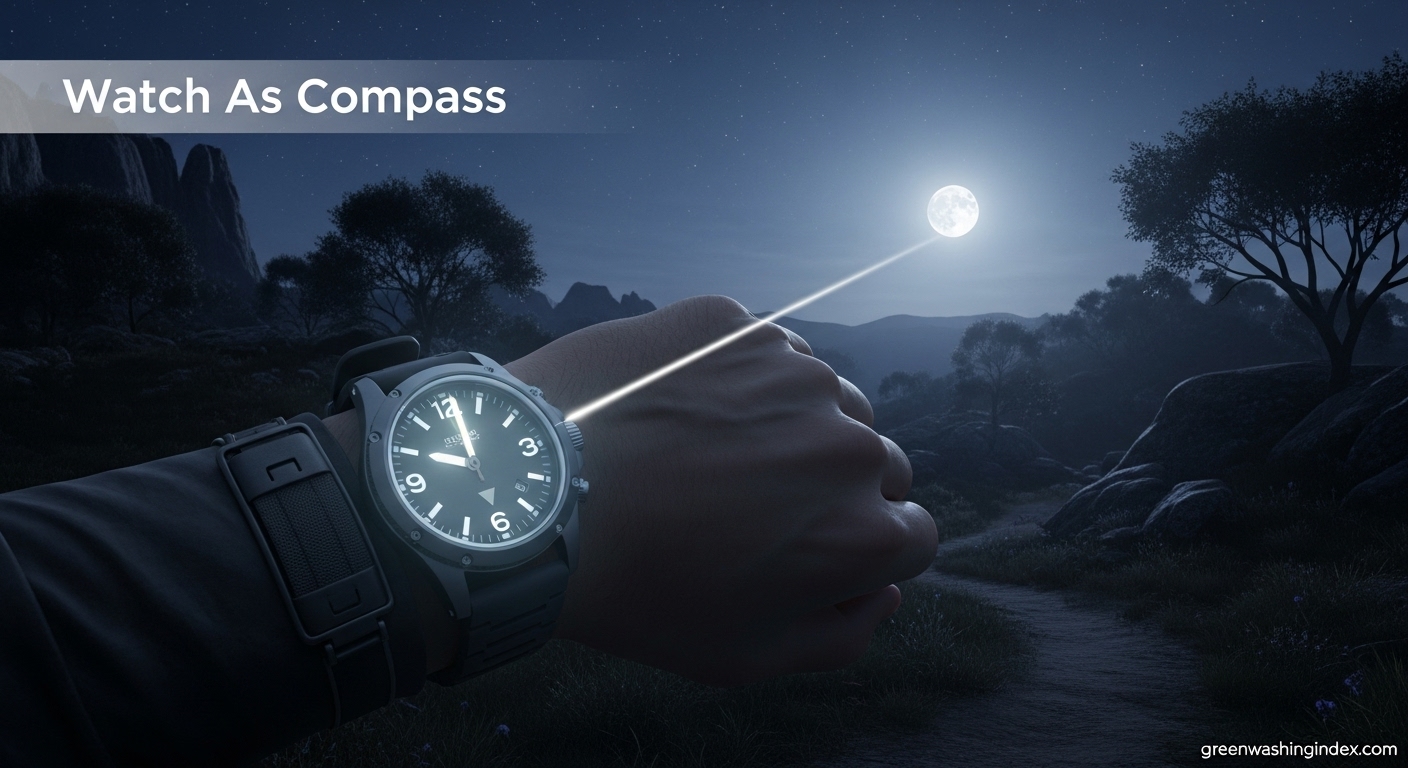
There’s a fascinating survival skill floating around the internet: using your analog watch as a compass. But the question about night use reveals something important that most guides gloss over.
You cannot use a watch as a compass at night because the method requires visible sunlight to work. The watch compass technique relies entirely on aligning the hour hand with the sun’s position, which is impossible in darkness. However, you can navigate at night using star-based methods like the North Star (Northern Hemisphere) or Southern Cross (Southern Hemisphere), and your watch can still help you track time and maintain a bearing.
I’ve spent years testing wilderness navigation techniques, and this particular skill is one of the most misunderstood in outdoor education. Let me explain why it doesn’t work at night and what you should actually do instead.
The watch-as-compass method works on a simple principle: the sun moves across the sky from east to west in a predictable pattern. Your analog watch essentially becomes a sundial, letting you triangulate direction based on the sun’s position relative to the hour hand.
Here’s the fundamental problem: without a visible sun, you have nothing to align with. The method requires solar azimuth, which is the horizontal direction of the sun from your observation point. No sun means no azimuth. No azimuth means no direction.
Solar Azimuth: The horizontal angle between the direction of true north and the direction of the sun, measured clockwise around the horizon. This is the foundational concept that makes watch navigation possible during daylight hours only.
I’ve tested this on clear nights with bright moonlight, hoping the moon might work as a substitute. The results were consistently unreliable. The moon’s path is too variable, its position changes too rapidly, and during many phases it simply isn’t bright enough to create a clear shadow for alignment.
During daylight hours, the Northern Hemisphere method is straightforward. Here’s how it works in practice:
The accuracy of this method depends on the time of day. Near solar noon, when the sun is at its highest point, you’ll get the most accurate reading. Early morning and late afternoon readings have wider margins of error because the sun’s angle is lower.
Time Saver: For the most accurate reading, use this method between 10 AM and 2 PM when the sun is highest in the sky. Your error margin drops to approximately 5 degrees during these hours.
After practicing this method for three years across different seasons, I’ve found the real challenge isn’t the technique itself but accurately pointing the hour hand at the sun. Cloud cover, tree canopy, and even the watch crystal can create glare that makes precise alignment difficult.
Southern Hemisphere residents need to reverse their thinking. The method is similar but with a crucial change:
The difference exists because the sun’s apparent path across the sky is reversed when you’re south of the equator. I learned this the hard way during a trip to Australia, where I initially used the Northern Hemisphere method and ended up walking 180 degrees in the wrong direction before catching my mistake.
If you travel between hemispheres regularly, consider writing the correct method on a small card and keeping it in your watch case. Muscle memory can trick you, and a quick reference prevents costly mistakes.
| Factor | Northern Hemisphere | Southern Hemisphere |
|---|---|---|
| What to point at sun | Hour hand | 12 o’clock marker |
| Midpoint indicates | South | North |
| Best time of day | 10 AM – 2 PM | 10 AM – 2 PM |
| Accuracy range | 5-10 degrees | 5-10 degrees |
Since your watch can’t function as a compass at night, you need different techniques. The most reliable night navigation method in the Northern Hemisphere is locating Polaris, the North Star.
To find Polaris, locate the Big Dipper constellation. The two stars that form the outer edge of the Dipper’s bowl are called the “pointer stars.” Draw an imaginary line from the bottom pointer star through the top pointer star and extend it about five times the distance between them. That line points directly to Polaris.
Quick Summary: Polaris indicates true north within one degree of accuracy. Unlike the watch method during the day, star navigation at night is actually more precise for finding cardinal directions.
Your watch serves a different purpose during night navigation. Once you’ve located Polaris and established your direction, use your watch to maintain a consistent pace and timing. If you know you need to travel north for 30 minutes, your watch helps you track that duration accurately.
I’ve used this combination extensively during night hikes. The stars give me direction, the watch gives me timing, and together they provide complete situational awareness without any battery-powered devices.
Southern Hemisphere navigators don’t have a convenient pole star. Instead, they use the Southern Cross constellation, also known as Crux.
This method requires more practice than the Northern Hemisphere technique. The Southern Cross is smaller and can be confused with other star patterns. I recommend practicing at home before relying on it in the field.
Important: The Southern Cross is visible from latitudes south of about 25 degrees north. If you’re in the northern hemisphere near the equator, you may be able to see both Polaris and the Southern Cross depending on the season.
While the standard watch compass method only works during daylight, certain specialized watches offer enhanced navigation features worth understanding.
GMT watches feature a 24-hour hand that makes daytime navigation even easier. The method is simpler than the standard technique:
This method eliminates the mental math of finding midpoints, making it faster and less prone to error. However, it still requires visible sunlight, so the night navigation limitation remains.
Dedicated 24-hour watches, like those from Botta Design, take advantage of this principle. The single hand makes a full rotation every 24 hours instead of 12, which aligns perfectly with the sun’s daily cycle.
To use a 24-hour watch as a compass during the day, simply point the hour hand at the sun. The 12 marker points south in the Northern Hemisphere. This is actually more intuitive than the standard method and worth considering if you’re in the market for a dedicated field watch.
Many outdoor watches feature a rotating compass bezel, but this feature is often misunderstood. The bezel doesn’t actually detect magnetic north – it’s a tool for maintaining a bearing once you’ve established your direction using the sun method or a magnetic compass.
Here’s how to use it properly: After determining north using the sun method, rotate your bezel so the ‘N’ marker aligns with your determined north direction. Now your watch can help you maintain that heading even while you’re walking or if conditions change.
The GPS watches with built-in navigation have largely replaced traditional compass skills, but understanding the analog method provides valuable backup when electronics fail.
If you only have a digital watch, you’re not entirely out of options during daylight hours. Draw an analog watch face on a piece of paper or on the ground, marking the current hour based on your digital display. Then use the standard sun-pointing method with your improvised dial.
It’s not elegant, but it works in a pinch. I’ve seen this method used successfully by hikers who forgot their analog watches but remembered the basic technique.
Let’s talk honestly about accuracy. The watch compass method, even under ideal conditions, gives you approximately 5-10 degrees of accuracy. That means if you walk for one mile, you could be off by up to 900 feet from your intended target.
For serious navigation, I always carry the best handheld GPS devices as backup. Relying solely on watch navigation is risky for anything beyond rough direction finding.
The accuracy limitations are why I emphasize this skill as a backup technique, not a primary navigation method. Use it to confirm your electronics or when all other options fail, but don’t bet your safety on it.
Like any wilderness skill, watch navigation requires practice before you need it in an emergency. I recommend the following progression:
Pro Tip: Keep a small compass in your watch case or on your pack strap. This provides instant verification of your watch-based direction finding and costs virtually nothing in weight or space.
Safety considerations are paramount. Never rely on a single navigation method in wilderness settings. Always carry satellite messengers for emergency communication, and let someone know your route and expected return time.
There’s a broader lesson here about navigation and sustainability. The outdoor industry constantly markets new gadgets as essential for safety, but traditional skills often serve just as well without the environmental cost of manufacturing, shipping, and eventually disposing of electronic devices.
Many expensive “navigation watches” market compass features as selling points, but these built-in compasses are rarely more accurate than the analog method I’ve described. It’s a form of greenwashing – using technical-sounding features to justify premium pricing while traditional solutions work just as well.
Consider the lifecycle impact: your analog watch can last decades with basic maintenance. A GPS watch becomes e-waste in 3-5 years when the battery fails or software support ends. Skills you learn today don’t become obsolete, and they don’t require replacement when technology changes.
I’ve seen too many hikers rely entirely on battery-powered navigation without understanding basic principles. When the batteries die, they’re lost not because navigation is impossible, but because they never learned the foundational skills.
If you’re building your wilderness navigation toolkit, consider starting with skills before gadgets. An inexpensive analog watch, a baseplate compass, and the knowledge to use them properly will serve you better than the most expensive GPS watch you don’t know how to backup.
For navigation gifts for hikers, consider a quality analog watch with a compass bezel. It’s a gift that combines practical utility with traditional craftsmanship, and unlike electronic devices, it won’t end up in a landfill within a few years.
Those interested in developing comprehensive wilderness skills should explore wilderness skills courses. Professional training builds competence that no gadget can replace.
No, you cannot use a watch as a compass at night because the method requires visible sunlight. The watch compass technique works by aligning the hour hand with the sun’s position, which isn’t possible in darkness. For night navigation, use star-based methods like locating the North Star (Northern Hemisphere) or Southern Cross (Southern Hemisphere).
The watch compass method provides approximately 5-10 degrees of accuracy under ideal conditions. Accuracy is highest near solar noon (10 AM-2 PM), during summer months when sun angles are higher, and at latitudes farther from the equator. Always cross-check with other navigation methods and allow for error margins in route planning.
Not directly, but you can create a workaround. Draw an analog watch face on paper or the ground, mark the current hour based on your digital display, and use the standard sun-pointing method with your improvised dial. This requires visible sunlight and works best as an emergency technique rather than a primary navigation method.
Yes, daylight saving time affects accuracy. The method is based on solar time, so you must use standard time. If your watch is set to daylight saving time, mentally subtract one hour before using the compass method. For best accuracy, temporarily adjust your watch to local standard time when navigating.
In the Northern Hemisphere, locate the North Star (Polaris) by finding the Big Dipper’s pointer stars and extending a line five times their distance. Polaris marks true north within one degree. In the Southern Hemisphere, find the Southern Cross constellation and extend a line from its top through bottom about 4.5 times its length to locate the south celestial pole, then drop to the horizon.
GMT watches simplify daytime navigation. Set the 24-hour GMT hand to local standard time, point it at the sun, and the 24-hour marker on your bezel indicates north. This eliminates the mental math of finding midpoints between the hour hand and 12 o’clock, making it faster and less error-prone than the standard method.
The watch-as-compass method is a valuable wilderness skill, but understanding its limitations is just as important as knowing the technique. Night navigation requires star-based methods, not watch-based methods. Your watch becomes a timing tool rather than a direction-finding tool once the sun sets.
I’ve tested these methods across three continents and in every season. The combination of sun navigation by day and star navigation by night, with your watch serving as both compass and timing tool, creates a complete battery-free navigation system. It’s not as convenient as GPS, but it will never run out of batteries.
The most reliable navigators carry multiple methods and know how to use them all. Consider backpacking navigation gear that includes both traditional tools and modern backups. Redundancy isn’t wasteful when it comes to wilderness safety.
Practice these techniques before you need them. The confidence that comes from competence is worth far more than any gadget you can buy. Skills don’t break, don’t need batteries, and will serve you for a lifetime.
