

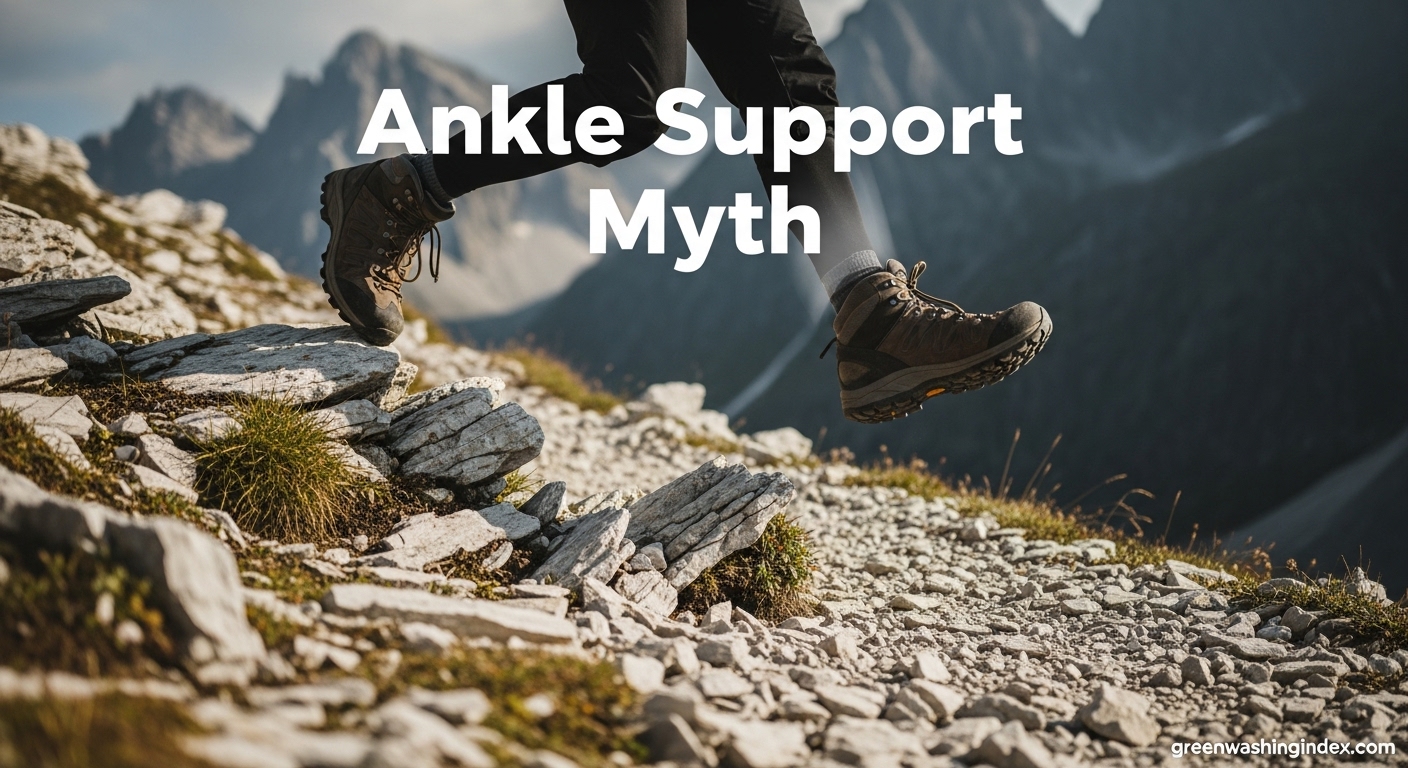
I spent twenty years lacing up heavy leather boots before every hike, convinced that stiff ankle collars were the only thing keeping me from a devastating sprain. My father told me the same thing his father told him: high-cut boots provide ankle support, low-cut shoes invite injury. This advice felt intuitive. It made sense. And it was wrong.
After researching the science and interviewing sports medicine professionals, I discovered that high-cut hiking boots prevent ankle sprains is largely a myth. Research shows no significant difference in injury rates between high-top and low-top footwear across multiple studies involving thousands of athletes.
This article will explain what the ankle support myth is, what science actually says about boot effectiveness, and what truly protects your ankles on the trail. I’ll also share specific strengthening exercises that work better than any boot collar.
Whether you’re a committed boot wearer or curious about sustainable hiking shoes, understanding this topic will change how you think about footwear and safety. Let’s dive into the evidence.
The ankle support myth is simple: stiff, high-cut hiking boots prevent ankle sprains by restricting foot movement. This belief has been repeated so often that it’s accepted as fact in outdoor circles, gear shops, and hiking forums. The logic seems sound—if you can’t roll your ankle, you can’t sprain it.
Here’s what proponents claim: High-top boots wrap around your ankle like a mini cast. When you step on an uneven surface and your foot starts to roll, the stiff collar supposedly stops the movement before ligaments stretch or tear. Low-cut shoes, in this view, leave your ankle exposed and vulnerable.
I believed this for years. I’ve watched countless hikers in outdoor stores flex boot shafts, checking for “adequate support.” I’ve heard trail veterans tell new hikers they’re irresponsible for wearing trail runners. The message is everywhere: more boot height equals more safety.
But here’s the problem with this thinking. Boot height and ankle support aren’t the same thing. A stiff collar can’t actually prevent the significant forces involved in an ankle rollover. When your foot catches a rock and your body weight keeps moving forward, something has to give—and it’s usually not the boot leather.
The marketing language reinforces this myth. Phrases like “ankle support,” “lateral stability,” and “rollover protection” appear in product descriptions for traditional boots. These terms sound technical and reassuring. They imply a level of protection that the products simply can’t provide in real-world conditions.
Key Distinction: There’s a difference between perceived support (how stiff a boot feels) and actual support (what forces a boot can realistically resist). Marketing emphasizes the former; science cares about the latter.
When I started researching this topic, I expected mixed results. Instead, I found remarkably consistent findings across multiple studies. The research doesn’t just fail to support the ankle support myth—it actively contradicts it.
The most compelling evidence comes from a 1993 study published in the American Journal of Sports Medicine. Researchers followed 622 college intramural basketball players through an entire season, randomly assigning them to wear either high-top or low-top shoes. The results showed no significant difference in ankle sprain rates between the two groups.
This wasn’t a small sample or a short timeframe. We’re talking about hundreds of athletes making thousands of cuts, jumps, and landings on hardwood floors—the kind of movements that stress ankles severely. If high-top shoes provided meaningful protection, this study should have detected it.
A literature review published in NCBI PubMed the same year examined all available research on shoes and ankle sprain prevention. The authors found an interesting discrepancy: biomechanical studies suggested high-tops should help, but clinical trials consistently failed to show a real-world benefit. In other words, the theory looked good on paper, but actual humans wearing actual shoes didn’t experience fewer injuries.
Another study from 1988 compared low-top shoes with laced ankle stabilizers (essentially braces) versus high-top shoes. The group wearing low-tops with stabilizers had the fewest injuries—suggesting that support comes from properly fitted braces, not shoe height alone.
You might wonder what basketball has to do with hiking. The connection is straightforward: basketball involves rapid direction changes, uneven footing (other players’ feet), and high impact forces—all factors that also contribute to ankle injuries on trails. If high-top shoes can’t prevent sprains in basketball, they’re unlikely to prevent them hiking.
Military research has reached similar conclusions. Despite decades of soldiers wearing combat boots, ankle sprains remain one of the most common injuries in training. The military has even experimented with ankle braces specifically because boots alone don’t solve the problem.
The Clinical Consensus: After reviewing multiple studies involving thousands of participants, researchers concluded that shoe height has minimal impact on ankle injury rates. Factors like ankle strength, proprioception, and playing/terrain surface matter far more than footwear design.
To understand why boots don’t prevent sprains, you need to understand how sprains happen. The mechanism is important—and it’s not what most people think.
An ankle sprain occurs when your foot rolls inward (inversion) beyond its normal range of motion, stretching or tearing the ligaments on the outside of your ankle. The most commonly injured ligament is the anterior talofibular ligament (ATFL), which connects your fibula to your talus bone.
Here’s the key: Ankle sprains typically happen when your foot is already planted and your body weight is moving in a different direction. Imagine stepping on a rock while hiking downhill. Your foot stops, but your momentum carries your torso forward and sideways. Your ankle rolls because your body is forcing it to—no boot collar can counteract that kind of force.
What high-top boots can do is limit your ankle’s range of motion slightly. They might reduce your foot’s mobility by five or ten degrees. But sprains happen when you exceed your normal range by much more than that. A boot that restricts motion from 45 degrees to 40 degrees doesn’t help when your ankle is being forced to 70 degrees.
Additionally, stiff boots can create a lever effect. When you catch a rock and your foot can’t roll at all due to a rigid sole, that force transfers elsewhere—to your knee, hip, or even the boot’s upper, potentially causing a blowout. I’ve seen hikers with blown-out boot sides still sprain their ankles. The boot failed to protect them, but they kept believing in the myth.
The reality is that ankle sprains result from a combination of factors: fatigue (tired muscles stabilize poorly), uneven terrain, unexpected obstacles, and insufficient neuromuscular response. Boots address none of these root causes. At best, they provide a modest mechanical limitation. At worst, they create a false sense of security.
Proprioception might be the most important word in ankle health that most hikers have never heard of. It refers to your body’s ability to sense where your joints are in space without looking at them. Good proprioception means your ankle automatically makes micro-adjustments to prevent rollovers before you consciously realize you’re off-balance.
Your ankle is packed with sensory receptors that detect stretch, pressure, and joint position. When you step on an uneven surface, these receptors fire instantly, triggering muscles to contract and stabilize the joint. This happens in milliseconds—faster than you can think about it. It’s your body’s real ankle support system.
Did You Know? Your ankle’s proprioceptive system is so sophisticated that it can detect surface angle changes of less than two degrees. This sensitivity allows constant micro-adjustments that prevent most potential rollovers before they become injuries.
Here’s the problem with stiff, high-cut boots: they dampen this sensory feedback. Thick soles separate your foot from the ground. Rigid uppers limit skin sensation and movement. The more your boot “supports” you, the less it allows your natural stabilization systems to work.
Trail runners and low-cut shoes preserve proprioception. You feel the trail. Your ankle can make the tiny adjustments needed to maintain stability. When I switched from boots to lighter footwear, I noticed something interesting: my ankles felt more connected to the terrain, not less. I was reacting to uneven ground before I consciously processed it.
Research on ankle braces has found similar effects. External support can reduce proprioceptive input, potentially increasing injury risk despite the mechanical limitation. Your ankle gets “lazy”—it relies on the brace instead of its own stabilizing systems. Over time, this can weaken the joint and make you more vulnerable when the support isn’t there.
The strongest ankles don’t come from the stiffest boots. They come from feet and ankles that are allowed to sense, adapt, and strengthen naturally. Proprioception is trainable—and that’s good news for any hiker worried about ankle health.
After all this myth-busting, I want to be clear: hiking boots have legitimate purposes. I still own a pair and wear them for specific conditions. The ankle support myth is wrong, but that doesn’t mean boots are useless. They just solve different problems than most people think.
Boots excel at protection, not support. A sturdy leather upper shields your feet from abrasion. A high-cut collar keeps debris out of your socks. A waterproof membrane keeps you dry in wet conditions. These are real benefits—they’re just not about ankle stability.
I wear my boots when:
Notice what’s not on this list: “ankle support.” Boots are great for protection, warmth, and load-carrying comfort. If those are your needs, wear them with confidence. Just don’t expect the collar to prevent a sprain that wouldn’t happen in a low-cut shoe.
Fair Balance: If you’ve had previous ankle injuries or have weak ankles due to other factors, consult a healthcare provider. Some orthopedic conditions do benefit from external support. This article addresses general injury prevention, not individual medical circumstances.
When you’re choosing between tested hiking boots and lighter options, focus on what actually matters: fit, comfort, traction, and protection appropriate to your terrain. Height should be a secondary consideration based on debris protection and personal preference—not a safety requirement.
If boots won’t protect your ankles, what will? The answer is simple but unglamorous: stronger ankles. Unlike external support, strength and mobility genuinely reduce injury risk. I’ve worked with physical therapists and sports medicine professionals to develop an ankle conditioning routine that actually works.
This program takes about 10 minutes, three times per week. I’ve seen significant improvement in my own ankle stability after eight weeks. Consistency matters more than intensity—start easy and progress gradually.
Stand barefoot on one foot with your eyes open. Hold for 30 seconds, then switch. Once this feels easy, try closing your eyes, which removes visual input and forces your ankles to rely on proprioception alone. Aim for 60 seconds with eyes closed.
Lift one foot and “write” the alphabet in the air using your big toe as the pen. Make the letters as large as you can while keeping your leg still. This mobilizes your ankle through its full range of motion. Complete the alphabet on each foot.
Walk 20 steps on your toes, then 20 steps on your heels. Toe walks strengthen your calf muscles and ankle dorsiflexors. Heel walks challenge your tibialis anterior, the muscle on the front of your shin that helps control your foot position.
Place a resistance band around your ankles, step into a slight squat, and walk sideways keeping tension on the band. Take 10 steps right, then 10 steps left. This strengthens the muscles that control side-to-side ankle movement—the same muscles that prevent rolling.
Stand on the edge of a step with your heels hanging off. Rise up onto your toes, then slowly lower your heels below the step level. Complete 15-20 reps. This strengthens your entire calf complex, which provides the primary power for ankle stability. For added challenge, try single-leg raises.
Sit with one leg extended. Use a towel or strap to pull your foot toward you (dorsiflexion), push away against resistance (plantarflexion), pull inward against resistance (inversion), and push outward against resistance (eversion). Hold each position for 5 seconds, complete 10 reps in each direction.
Stand on one leg and imagine a clock on the floor. Reach toward 12, 3, 6, and 9 o’clock with your free foot, returning to center each time. This challenges dynamic balance while your ankle is under load, simulating trail conditions.
Quick Summary: This ankle strengthening program targets balance, mobility, and strength through seven exercises. Perform this routine 3x per week for 8-12 weeks to significantly improve ankle stability. Start with basic versions and add difficulty (eyes closed, single-leg, resistance) as you progress.
I recommend adding this routine to your pre-season conditioning—two months before your big hiking trips. Your ankles need time to adapt and strengthen. But don’t stop there. These exercises make excellent camp activities. I’ve done single-leg balance while brushing my teeth at camp. Every little bit helps.
For hikers who want additional conditioning tools, balance boards and wobble cushions are inexpensive and effective. They add instability that forces your ankles to work constantly. Even standing on one leg while cooking dinner can be valuable training.
If you’re convinced to try lighter footwear, don’t go cold turkey. I made this mistake in my early transition years and paid for it with sore feet and tweaked ankles. Your ankles need time to adapt after years of boot support.
Start wearing low-cut shoes for short hikes on familiar terrain. Stick to trails you’ve done many times under easy conditions. Keep your boots for longer hikes or unfamiliar routes. This lets your ankles strengthen gradually while you build confidence in the new footwear.
Begin using lighter footwear on moderate hikes with moderate elevation gain. Choose trails with good footing rather than technical terrain. Consider approach shoes as a middle ground—they offer low-cut freedom with sticky rubber and moderate protection. Pay attention to how your ankles feel. Fatigue is normal; pain is not.
By now, your ankles should be noticeably stronger. Tackle most day hikes in your lighter footwear. You’ll likely notice reduced fatigue at the end of the day—less weight means less energy expenditure. Many hikers report that their feet feel fresher after 15 miles in trail runners than 10 miles in boots.
During transition, be smart about terrain. When I encounter really rough scree or expect sustained snow travel, I still reach for boots. The goal isn’t to abandon boots entirely—it’s to use them when they actually make sense rather than by default.
Your hiking socks become more important with low-cut shoes. Quality padding and blister prevention matter more when you don’t have heavy leather protecting your feet. I prefer wool blends with strategic cushioning.
The transition timeline varies by individual. Factors like your history of ankle issues, typical hiking terrain, and overall fitness all matter. Listen to your body. There’s no shame in slowing the progression or keeping boots in your rotation for specific conditions.
After three months of transitioning, I found my ankles felt stronger and more confident than they had in years of boot wearing. My hiking partners noticed too—I was no longer stopping to adjust laces or complain about foot fatigue. Lighter footwear wasn’t just more comfortable—it was making me a better hiker.
Pro Tip: Transition during hiking season, not right before a major trip. Give yourself time to adapt and rebuild strength before relying on new footwear for important adventures. Your ankles need conditioning time just like any other part of your body.
Ankle support from footwear is not necessary for most hikers. Research shows that high-cut boots don’t significantly reduce ankle sprain rates compared to low-cut shoes. True ankle protection comes from strength, proprioception, and conditioning—not external footwear support. Strong, mobile ankles are your best defense against injuries.
Hiking boots provide minimal actual ankle support despite marketing claims. While high-cut collars can slightly limit range of motion, they can’t prevent the significant forces involved in ankle rollovers. Studies comparing high-top and low-top footwear in basketball and military contexts show no significant difference in injury rates. Boots excel at protection from debris and abrasion, not ankle stabilization.
High-cut ankle support boots have several drawbacks: they add weight (increasing fatigue), reduce proprioception (limiting your foot’s natural sensory feedback), can weaken ankles over time through restricted movement, create a false sense of security, and may transfer impact forces to knees and hips. Many hikers find that lighter footwear allows better foot mechanics and reduced overall fatigue.
No, high-top boots do not reliably prevent ankle rolls. Scientific studies consistently show no significant difference in ankle sprain rates between high-top and low-top footwear. When your body weight and momentum force your ankle beyond its normal range of motion, a boot collar cannot counteract those forces. Proprioception and ankle strength are far more effective at preventing rollovers than shoe height.
Yes, the idea that high-cut footwear prevents ankle sprains is largely a myth. Multiple peer-reviewed studies have failed to find significant injury rate differences between high-top and low-top shoes. The ankle support myth persists because it’s intuitive and heavily marketed, but scientific evidence doesn’t support the claim that boot height correlates with ankle injury prevention.
High-top boots are minimally effective at preventing ankle injuries. Research studies involving thousands of athletes across basketball and military populations show no statistically significant difference in sprain rates between high-top and low-top footwear. Any mechanical restriction provided by boot height is insufficient to counteract the forces involved in typical ankle injury mechanisms.
Ankle braces can be more effective than boots because they provide targeted support rather than shoe height. Research shows that low-top shoes with properly fitted ankle stabilizers had fewer injuries than high-top shoes alone. However, braces also reduce proprioception and shouldn’t be relied upon long-term. The best approach is strengthening your ankles through exercise rather than depending on external support.
Strengthen hiking ankles through targeted exercises: single-leg balance (progress to eyes closed), alphabet tracing with your toes, heel-to-toe walks, lateral band walks, calf raises, four-way ankle mobilization against resistance, and single-leg clock reaches. Perform these exercises 3 times per week for 8-12 weeks to significantly improve ankle stability and reduce injury risk.
After twenty years of wearing heavy boots and countless hours researching the science, my perspective has completely changed. The ankle support myth is just that—a myth perpetuated by marketing, intuition, and tradition, but not supported by evidence.
High-cut hiking boots don’t prevent ankle sprains. Multiple peer-reviewed studies involving thousands of participants have reached this conclusion. What actually protects your ankles is strength, mobility, and proprioception—qualities that stiff boots can actually inhibit.
This doesn’t mean boots are bad. They’re excellent for protection, load-carrying comfort, and specific conditions like snow travel. I still own boots and use them when conditions warrant. But I no longer choose them based on ankle support claims that don’t hold up to scrutiny.
If you’re skeptical, I understand. This information contradicts what many of us were taught. But I encourage you to try the strengthening exercises in this article for eight weeks. Pay attention to how your ankles feel. Consider a gradual transition to lighter footwear for appropriate hikes. Let your own experience be the judge.
Your ankles evolved over millions of years to be incredibly capable. Trust them. Strengthen them. Let them do what they’re designed to do. That’s the real ankle support—not leather wrapped around your joint, but the muscles, tendons, and nervous system that keep you stable on the trail.
The choice isn’t between boots and injury. It’s between relying on external support that doesn’t work or building internal strength that does. After learning the science and experiencing the difference firsthand, I know which approach I trust.
