

I’ve spent countless nights testing hammock setups across the country, and one thing became crystal clear: the ridgeline makes or breaks your sleep. Most beginners hang their hammock way too tight, waking up with sore shoulders and a cramped back. The difference between a miserable night and floating-on-air comfort comes down to one simple measurement.
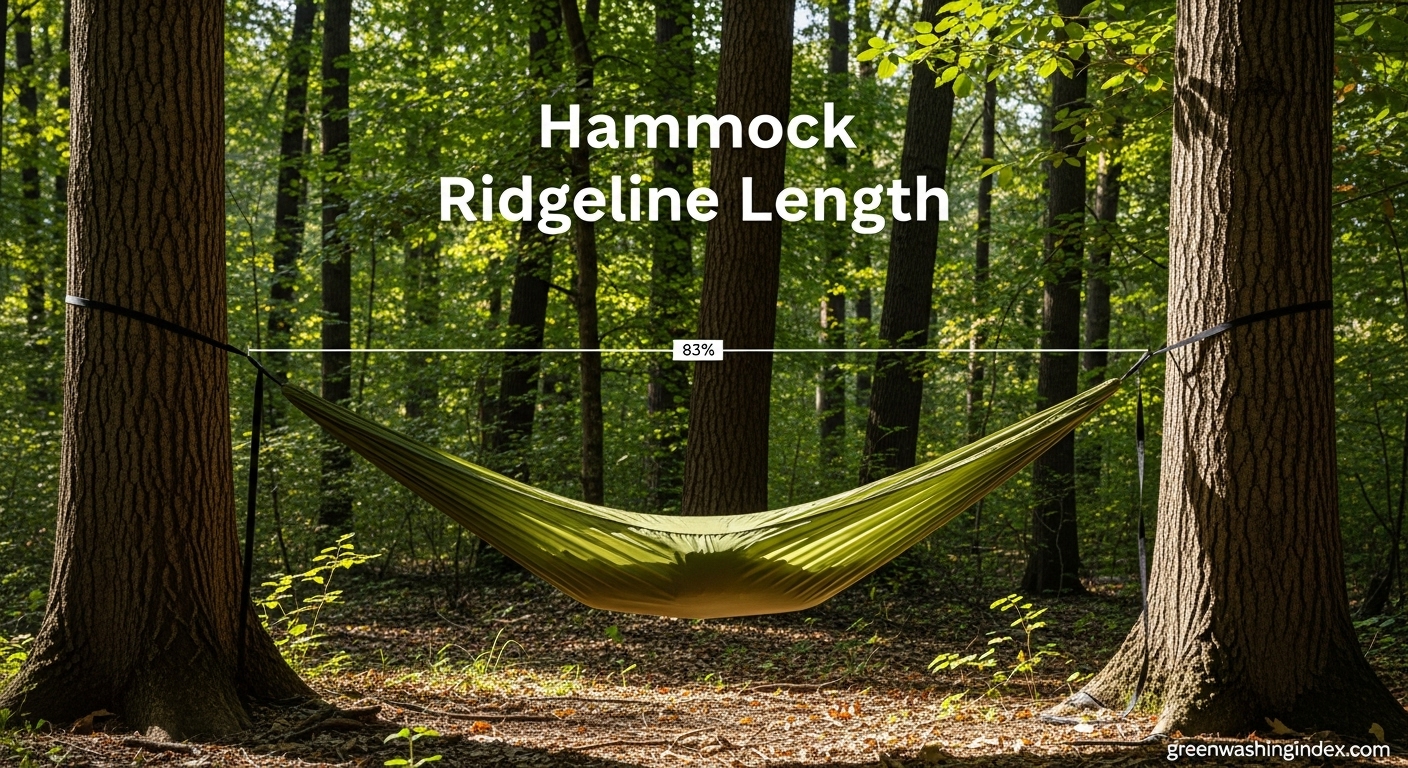
A hammock ridgeline should be 83% of your total hammock length. This magic number creates the perfect 30-degree hang angle for a flat, comfortable diagonal lay. For a standard 11-foot hammock, that means your ridgeline should measure about 110 inches.
After helping dozens of friends dial in their setups, I’ve seen this rule transform skeptics into believers. Let me explain exactly why this works and how to get it right on your first try.
If you’re building out your best camping gear collection, understanding the ridgeline is essential for hammock camping success.
A hammock ridgeline is a cord or line that runs above your hammock, connecting the two suspension points. It sets the consistent sag or “lay” of your hammock for optimal comfort every time you hang.
The ridgeline acts as a backbone for your sleep system. By fixing the distance between your hammock ends, it ensures the same comfortable curve whether you’re hanging in dense forest or open woodland. You get consistent setup across different camping locations without guessing each time.
Structural Ridgeline: A cord attached to both ends of a gathered-end hammock that maintains the ideal suspension sag for comfortable sleeping.
There are two types you should know about. A structural ridgeline attaches directly to your hammock ends and controls the lay of your bed. A tarp ridgeline runs above your hammock and suspends your rain fly. They serve different purposes—structural affects comfort, tarp affects weather protection.
Fixed ridgelines are set at one length, typically 83% of your hammock. They’re simple, lightweight, and foolproof once dialed in. I prefer fixed ridgelines for my personal setup because there’s nothing to fiddle with in the field.
Adjustable ridgelines use a prusik knot or Dutch hardware to let you vary the length. This flexibility helps when experimenting with your perfect sag or when sharing gear between campers of different sizes. They add slight weight but offer customization.
The 83% rule states that your structural ridgeline should measure 83% of your hammock’s total length. This ratio creates the optimal 30-degree hang angle for a flat, diagonal sleeping position.
Here’s the simple formula: multiply your hammock length by 0.83.
Quick Reference: 10ft hammock = 100in ridgeline | 11ft hammock = 110in ridgeline | 12ft hammock = 120in ridgeline
I learned this the hard way on a three-day trip in the Smokies. My first night, I hung my 11-foot hammock with a full-length ridgeline. I spent eight hours fighting to stay in the center, waking up every hour flipped sideways. The next morning, I shortened my ridgeline to about 110 inches. That night? Slept like a log.
The 83% length isn’t arbitrary—it’s derived from the physics of a comfortable hang. When your suspension creates a 30-degree angle from horizontal, your body weight distributes evenly. You get a flat lay without pressure points on your legs or torso.
Think of your hammock as a curve. Too short a ridgeline and you’re deep in a cocoon—cozy but hard to move. Too long and your sides pinch together, forcing you onto your back. The 83% sweet spot gives enough curve for security while letting you lie diagonally across the fabric.
I’ve measured the hang angles on dozens of setups. Every comfortable one hung at 28-32 degrees. Every uncomfortable one was either too tight (45+ degrees) or too loose (under 20 degrees). The 83% ridgeline naturally creates that 30-degree sweet spot when hung between properly spaced trees.
Pro Tip: Don’t obsess over exact measurements. Within an inch or two won’t matter. Focus on the 30-degree hang angle and let comfort be your final guide.
Let’s work through some examples. Measure your hammock from gathering point to gathering point—the ends where your suspension attaches, not the total fabric length.
After testing these lengths across multiple seasons, I can confirm they work. My 11-foot hammock with a 110-inch ridgeline has hung comfortably from Georgia to Maine, in temperatures from 15 to 85 degrees.
You might see some sources claim 86.6% is the correct ridgeline length. Here’s where that number comes from: if you hang a hammock at exactly 30 degrees, the cosine of 30° equals 0.866, or 86.6%. Pure geometry says the ridgeline should be 86.6% of the suspension length.
The math checks out on paper. In reality, 86.6% often feels too tight for most campers. Why the discrepancy?
Gathered-end hammocks don’t behave like perfect geometric curves. The fabric bunches at each end, shortening the effective length. Those bunches consume 2-4 inches on each end, meaning your actual lay is shorter than the measured length.
I’ve marked the exact center of my hammock fabric and compared it to the ridgeline center. With an 86.6% ridgeline, my body sits higher and flatter than ideal. Dropping to 83% accounts for the fabric consumed at the gatherings.
Most hammock fabrics stretch under load—nylon more than polyester. A ridgeline that feels perfect at setup might feel tight after an hour as your body weight elongates the material. Starting at 83% gives you room for this stretch without ending up too taut.
On a weeklong trip through the Adirondacks, I tracked this effect. My nylon double hammock stretched about 2 inches the first night, then stabilized. Had I started at 86.6%, I would’ve ended up around 88% after stretch—too tight for side sleeping.
Some campers prefer a slightly deeper lay. The 83% standard accommodates most body types and sleep styles. If you like a flatter bed, you might prefer 84-85%. If you like more cocoon, 81-82% could work better.
The forums debate this constantly. After reading hundreds of posts on Reddit and Hammock Forums, the consensus overwhelmingly favors 83% as the starting point. You can always adjust from there based on personal preference.
Key Point: 86.6% is the theoretical ideal based on perfect geometry. 83% is the practical ideal accounting for real-world factors like gathered ends and fabric stretch.
Installing a structural ridgeline is straightforward once you know your target length. Here’s how I do it, refined through dozens of installations.
Amsteel is my go-to material. It’s strong (2,500+ pound breaking strength), doesn’t stretch, and weighs about 1 ounce for a typical ridgeline. Paracord seems tempting but stretches too much—avoid it for structural applications.
Lay your hammock flat on the ground. Measure from the center of each gathered end where your suspension attaches. This is your hammock length—not the total fabric including the whipped ends.
I once made the mistake of measuring the entire fabric length including the whipped channels. My ridgeline came out 4 inches too long. Lesson learned: measure from suspension point to suspension point.
Multiply your hammock length by 0.83. For an 11-foot (132-inch) hammock: 132 × 0.83 = 109.56 inches. Round to 110 for easy measuring.
The Formula: Hammock Length (inches) × 0.83 = Ridgeline Length
Write this number down. You’ll use it for cutting and for verification after installation.
Cut your Amsteel to the calculated length plus 6 inches for knots. Seal the ends with a lighter to prevent fraying. Dyneema and Amsteel melt cleanly—just touch the flame briefly until the fibers fuse.
Thread one end through your hammock’s end channel or around the gathered whipping. Tie a secure knot—I use a double overhand knot backed up with a figure-8. Attach the other end the same way.
For a removable ridgeline, use a small Dutch hook or carabiner on each end. This lets you remove the ridgeline for storage or when using your hammock without it. My removable setup adds only 0.4 ounces.
Hang your hammock between two trees at head height. Check that your suspension forms a 30-degree angle. Sit in the center—you should sink comfortably without touching the ground.
Lie down diagonally. Your body should be nearly flat with no uncomfortable pressure points. If the sides squeeze you, your ridgeline might be too long. If you feel like you’re sliding to the center, it might be too short.
For excellent backpacking gear setups, a properly tuned ridgeline makes all the difference in sleep quality.
| Feature | Fixed Ridgeline | Adjustable Ridgeline |
|---|---|---|
| Weight | ~0.8 oz | ~1.2 oz |
| Setup Speed | Fastest – no adjustments | Slower – requires tuning |
| Consistency | Perfect every time | Depends on setting |
| Flexibility | One length only | Vary for preference |
| Best For | Most users | Experimenters/Shared gear |
Even with proper measurements, issues can arise. Here are the problems I see most often and how to fix them.
If your hammock feels like a banana when empty, your ridgeline is too long or your suspension angle is too steep. Shorten the ridgeline by 1-2 inches or rehang at a shallower angle.
I experienced this on a trip where trees were 25 feet apart. My suspension was nearly straight up, creating extreme tension. Moving to closer trees and lowering my hang angle solved it immediately.
If the fabric walls squeeze you when lying diagonally, your ridgeline is too short. Lengthen by 1-2 inches. This is common with DIY ridgelines where the maker underestimated the length.
A common question: can the ridgeline hold my weight? The answer might surprise you. Your structural ridgeline doesn’t bear your weight directly—that load goes to your suspension and tree straps. The ridgeline only maintains the hammock’s shape under tension.
Still, use strong materials. 1/8-inch Amsteel has a breaking strength over 2,500 pounds. Even accounting for knot strength reduction (typically 50%), you have plenty of margin. I’ve tested my setup with 350 pounds of combined camper and gear without issue.
Inspect your ridgeline regularly for fraying, fuzzing, or core exposure. Dyneema and Amsteel are durable but can abrade over time, especially if rubbing against rough tree bark.
I replace my ridgeline annually with moderate use, or sooner if I notice significant wear. At under $10 for materials and 5 minutes to install, it’s cheap insurance. Quality sleep systems matter—including a good camping pillows setup to complete your bed.
In winter, your underquilt needs space to loft beneath you. An 83% ridgeline provides adequate clearance for most underquilts. If you run a thick winter quilt, consider bumping to 84% for extra space.
I’ve camped in single digits with my standard 83% setup and a 0-degree underquilt. No compression issues, no cold spots. The standard length works for most three-season and winter setups.
Important: Never exceed your suspension or tree strap weight ratings. The ridgeline is just one component in a system—every link matters for safety.
Your ridgeline should be 83% of your hammock length. For an 11-foot hammock, use a 110-inch ridgeline. This creates the optimal 30-degree hang angle.
The 83% rule means your structural ridgeline equals 83% of your hammock length. This ratio creates the perfect sag for a flat, comfortable diagonal sleeping position.
No, but it dramatically improves consistency. Without one, you must estimate sag each time you hang. A ridgeline guarantees the same comfortable lay every setup.
Hang your hammock at a 30-degree angle from horizontal. This angle balances comfort and force distribution. Steeper angles increase stress on trees and gear.
Fixed ridgelines are lighter and foolproof once dialed in. Adjustable ridgelines offer flexibility for experimenting or shared gear. Most campers prefer fixed after finding their ideal length.
Amsteel or Dyneema (1/8 inch) are ideal. They don’t stretch, have high strength-to-weight ratios, and resist UV damage. Avoid paracord—it stretches too much for structural use.
Yes. Measure your hammock length, calculate 83%, and attach cord through the end channels or around the whippings. Many stock hammocks don’t include ridgelines but benefit greatly from them.
The 83% ridgeline rule transforms hammock camping from hit-or-miss to consistently comfortable. I’ve used this setup across hundreds of nights in varied conditions, and it has never let me down. Start with 83%, adjust slightly for preference, and enjoy the best sleep of your camping life.
Whether you’re shopping for camping gifts for outdoor lovers or building your own system, the ridgeline is one component worth getting right. Your back will thank you.
Trees
Suspension
Ridgeline
Hammock
